



Gen angst
The cost of growing up online
The Anxious Generation explains how smartphones and social media rewired a generation.


Growing up, I was always going down rabbit holes to explore whatever caught my interest or captured my curiosity. When I felt restless or bored—or got in trouble for misbehaving—I would disappear into my room and lose myself in books or ideas, often for hours without interruption. This ability to turn idle time into deep thinking and learning became a fundamental part of who I am.
It was also crucial to my success later on. At Microsoft in the ’90s, I began taking an annual “Think Week,” when I would isolate myself in a cabin on Washington’s Hood Canal with nothing but a big bag of books and technical papers. For seven days straight, I would read, think, and write about the future, interacting only with the person who dropped off meals for me. I was so committed to uninterrupted concentration during these weeks that I wouldn’t even check my email.
Reading Jonathan Haidt’s The Anxious Generation has made me wonder: Would I have developed this habit if I had grown up with today’s technology? If every time I was alone in my room as a kid, there was a distracting app I could scroll through? If every time I sat down to tackle a programming problem as a teenager, four new messages popped up? I don’t have the answers—but these are questions that everyone who cares about how young minds develop should be asking.
Haidt’s book, about how smartphones and social media have transformed childhood and adolescence, is scary but convincing. Its premise—that starting in the early 2010s, there was a “great rewiring” of an entire generation’s social and intellectual development—was interesting to me in part because I saw it happen in my own house. When my oldest daughter (a pediatrician who recommended the book to me) was in middle school, social media was present but not dominant. By the time my younger daughter reached adolescence six years later, being online all the time was simply part of being a pre-teen.
What makes The Anxious Generation different from other books on similar topics is Haidt’s insight that we’re actually facing two distinct crises: digital under-parenting (giving kids unlimited and unsupervised access to devices and social media) and real-world over-parenting (protecting kids from every possible harm in the real world). The result is young people who are suffering from addiction-like behaviors—and suffering, period—while struggling to handle challenges and setbacks that are part of everyday life.
My childhood was marked by remarkable freedom—something that might surprise people who assume I spent all day glued to a computer indoors. I went hiking on trails that would terrify today’s parents, explored endlessly with neighborhood friends, and ran around Washington D.C. during my time as a Senate page. When I was in high school, Paul Allen and I even lived on our own for a few months in Vancouver, Washington, while working as programmers at a power company. My parents didn’t know where I was half the time, and that was normal back then. While I got hurt on some of these adventures and got in trouble on many others, these experiences were more beneficial than bad. They taught me resilience, independence, and judgment in ways that no amount of supervised, structured activity could replicate.
It wasn’t all fun and games, but I had what Haidt calls a play-based childhood. Now, a phone-based childhood is much more common—a shift that predated the pandemic but solidified when screens became important tools for learning and socializing. The irony is that parents these days are overprotective in the physical world and strangely hands-off in the digital one, letting kids live life online largely without supervision.
The consequences are staggering. Today’s teenagers spend an average of six to eight hours per day on screen-based leisure activities—that is, not for schoolwork or homework. The real number might actually be much higher, given that a third of teenagers also say they’re on a social media site “almost constantly.” For the generation Haidt writes about, this has coincided with sharp spikes in anxiety and depression, higher rates of eating disorders and self-harm, plummeting self-esteem, and increased feelings of isolation despite more around-the-clock, on-demand connection than ever. Then there are the opportunity costs of a phone-based childhood that Haidt documents: less (and worse) sleep, less reading, less in-person socializing, less time outside, and less independence.
All of this is concerning, but I’m especially worried about the impact on critical thinking and concentrating. Our attention spans are like muscles, and the non-stop interruptions and addictive nature of social media make it incredibly difficult for them to develop. Without the ability to focus intensely and follow an idea wherever it leads, the world could miss out on breakthroughs that come from putting your mind to something and keeping it there, even when the dopamine hit of a quick distraction is one click away.
Another alarming finding in the book is the significant gender divide at play here. Severe mental health challenges seem to have hit young women especially hard in recent years. Meanwhile, young men’s academic performance is worsening, their college attendance is dropping, and they’re failing to develop the social skills and resilience that come from real-world interaction and risk-taking. In other words: Girls are falling into despair while boys are falling behind.
The solutions Haidt proposes aren’t simple, but I think they’re needed. He makes a strong case for better age verification on social media platforms and delaying smartphone access until kids are older. Literally and figuratively, he argues, we also need to rebuild the infrastructure of childhood itself—from creating more engaging playgrounds that encourage reasonable risk-taking, to establishing phone-free zones in schools, to helping young people rediscover the joy of in-person interaction. Achieving this won’t come from individual families making better choices; it requires coordination between parents, schools, tech companies, and policymakers. It also demands more research into the effects of these technologies, and the political will to act on what we learn.
The Anxious Generation is a must-read for anyone raising, working with, or teaching young people today. With this book, Haidt has given the world a wake-up call about where we’re headed—and a roadmap for how we can change course.


Soak up the sun
My summer best list for 2026
When the days get long, I want to read, listen to, or watch something that pulls me in.
It’s hard to beat summer here in Seattle. The days are long, sunny, and warm, and you’re never far from Puget Sound or a lake. Something about the season just makes me want to relax with a good book or show. (Although to be fair, I also feel that way every other season of the year.)
As I was putting together this list, I thought about what makes something a “summer best.” For me, that means a book or show that pulls me in and completely commands my attention. I want to sit down in the shade with a book and not look up until the sun starts setting.
This year’s list includes a mix of things I’ve been enjoying lately. There’s a terrific novel, a pair of nonfiction books that will help you understand more about the world, and a show I couldn’t stop watching. I hope you find something here that grabs your attention as much as these did mine.
Best Fiction: Culpability, by Bruce Holsinger.
A family is traveling down the road in their autonomous vehicle when they get into a horrible collision. Someone in the other car is killed. Is the driver responsible? The carmaker? The company that made the self-driving software? A novel that deals with big questions like that could become ponderous, but Holsinger keeps the action moving. You don’t know which way the plot will go next.
Best Nonfiction: 1929: Inside the Greatest Crash in Wall Street History—And How It Shattered a Nation, by Andrew Ross Sorkin.
I thought Too Big to Fail was terrific, and Sorkin’s newest book is just as thoroughly researched as his last one. The factors that led to the stock market crash of 1929 were super complex, and he really helps you understand the various players involved—although I had to write down the names of the key people to keep track of them! While banking systems are a lot more resilient today, I think it’s important to understand what went wrong to ensure we don’t make the same mistakes again. For example, history shows that the boundary between gambling and investing is less black and white than you’d expect. Financial trends like meme stocks, prediction markets, and particularly margin investing make it clear we have more to learn from the past.
Best Listen: The audiobook of Gray Matters: A Biography of Brain Surgery, by Theodore H. Schwartz.
I have become a huge fan of audiobooks in recent years. Although I’ll always enjoy sitting down by myself with a physical book, I love that listening to an audiobook can turn reading into a shared experience. (My girlfriend, Paula, and I often listen while puzzling.) Gray Matters is one of the best I’ve listened to recently. Schwartz does a fantastic job of explaining the maladies of the brain and what it’s like to be a neurosurgeon. There’s so much we still don’t know about how the brain works (although that’s finally changing), but I enjoyed learning about the history of the field. I can be picky about narrators since I usually listen on at least 1.5x speed, but Sean Pratt’s narration here was engaging and easy to follow.
Best Watch: Season 2 of The Pitt.
I’ve become a complete addict of The Pitt. I just finished Season 2, and the show is spectacular (but I get why some people find it too intense or graphic to watch). Set across a single 15-hour shift in a Pittsburgh emergency room, it follows the doctors, residents, and nurses navigating one impossible case after another. From my work with the Gates Foundation, I understand more of the medicine than I expected. But watching with my daughter Jenn, who works in pediatrics, was especially rewarding. She validated not just the medicine but the human dynamics involved in an ER: the satisfaction of a care team clicking into place, and the frustration when the system, the bureaucracy, or a patient’s own choices get in the way. It seems like there’s no other profession where you're exposed to people at their most vulnerable so relentlessly. Clearly, there’s an adrenaline rush to this work that keeps people coming back, even when they wonder why they chose it.
Under the sea
Growing older with Remarkably Bright Creatures
Shelby Van Pelt’s novel was the perfect way to start my next decade of life.
I turned 70 years old last month. I don’t feel like it, though. I still have a ton of energy, and I have no plans to retire. But somehow, I have officially reached an age my younger self would have called “old.” It’s hard to wrap my head around.
Fortunately, I recently read Remarkably Bright Creatures, a terrific novel that helped me make a bit more sense out of aging. Shelby Van Pelt released her debut novel a couple years ago. It was a huge hit, and I think I might be one of the last people to read it—but I’m glad I waited until now.
Tova, the main character, is also 70, and she feels every single one of those years. Her life hasn’t been easy. Tova’s son is presumed dead after he disappeared when he was a teenager, and her husband died from cancer five years earlier. To pass the time, she works night shifts cleaning the local aquarium, which is where she meets Marcellus, an elderly giant Pacific octopus who is nearing the end of his life.
Marcellus is a fascinating character. Octopuses are some of the smartest animals in the world, and although Marcellus can’t speak, he is super observant. Van Pelt cleverly includes chapters from his perspective, so you get to learn about how he sees the world. He considers Tova a friend after she rescues him after a late-night excursion from his tank goes dangerously wrong. I don’t want to spoil the ending, but Marcellus’s power of observation ends up changing the lives of many of the books’ characters.
Tova gets a much-needed sense of fulfillment from caring for Marcellus and the aquarium. She struggles with purpose throughout the book. Her friends are motivated by their grandchildren, but without her husband and son, Tova feels aimless and alone (even though the reader knows that she has plenty of people in her life who love her—including Ethan, the owner of the local grocery store). Early in the book, she feels so lost that she considers moving away from her hometown and into a senior living community.
Tova’s struggle is something I’ve spent a lot of time thinking about, because I worry that we might soon see more people feeling like her. As life expectancies go up, many people are living for years and even decades after they stop working. That sounds like a luxury, and it is in a lot of ways—but it is also a lot of time to fill. The decline of third places like churches and libraries makes it harder than ever to find connections that keep the days interesting. Fewer families are having children, which means that fewer older people are becoming grandparents. And while part-time work can help give life meaning, not everyone is physically capable of working.
“Tova has always felt more than a bit of empathy for the sharks, with their never-ending laps around the tank. She understands what it means to never be able to stop moving, lest you find yourself unable to breathe,” Van Pelt writes. Her message is clear: People need a reason to get out of bed in the morning. For many, it’s hard to transition from a lifetime of working to retirement. So, what can we do to help older people find purpose? And how can we prepare for a potential future where technological advances mean all of us have less work to fill our days?
Remarkably Bright Creatures doesn’t try to answer those questions, but Tova’s story really makes you think about how people find meaning in life. Her story is mirrored by Cameron’s, a young man who struggles to find his own purpose and ends up working with Tova at the aquarium. Although their lives couldn’t be more different, I loved seeing how Tova and Cameron help each other find reasons to get out of bed over the course of the story (with help from Marcellus the octopus).
I think anyone who enjoys fiction would enjoy this book, but it’s a must-read for people who grew up in Western Washington like I did. The novel takes place in Sowell Bay, a fictional coastal town that will feel familiar to anyone who has spent time around Puget Sound. Van Pelt captures the specific feeling of weathered charm you get when you visit places like Hood Canal or Anacortes.
I usually read non-fiction books, but Remarkably Bright Creatures gave me exactly what I want whenever I pick up a novel. It transported me to a different world, and it illuminated something new for me—in this case, about relationships and getting older. Reading Tova and Marcellus’s story was the perfect way to start my next decade of life.
Goes without saying
Lessons from a toilet paper shortage
Steven Pinker’s latest book explores the fascinating science behind common knowledge.
Have you ever thought about how weird the question “Can you pass the salt?” is?
It’s an innocuous question that most of us have asked over the dinner table at some point. It’s also a deeply loaded one. When you ask me if I can pass the salt, you are not actually wondering whether I am physically capable of lifting a salt shaker—you want me to hand it to you. But since it feels rude to command someone to pass the salt, the request is couched as a related but different question. And here’s the weirdest part: It works.
Why? Because of something called common knowledge. I know you really mean “Pass me the salt.” And you know I know that. And because both of us know what each other knows, an indirect question is, in reality, super clear.
If that makes your head spin, I get it. Common knowledge is strangely complicated for something so commonplace. Luckily, Steven Pinker explains the topic brilliantly in his latest book, When Everyone Knows That Everyone Knows.
Steven is a cognitive psychologist, and I’m a big fan of his books, which always illuminate something new and fascinating about how humans interact. In this one, he writes about how common knowledge is key to the fabric of social behavior. As Steven explains, it allows “individual minds [to] coordinate their choices for mutual benefit. Many of our harmonies and discords fall out of our struggles to achieve, sustain, or prevent common knowledge.”
The book starts with the famous story of The Emperor’s New Clothes. As soon as a child points out the obvious—the fact that emperor isn’t wearing any clothes—the entire town realizes everyone knows that the emperor is naked and turns on him.
It sounds like a silly folktale until you realize that it reveals a fundamental truth: The social dynamic changes as soon as I know that you know what I know. In this case, people feel more comfortable speaking out publicly once they realize others see the same thing. Common knowledge makes coordination easier, whether it’s something as small as passing the salt or something as big as a protest against an unfair policy.
Common knowledge is a powerful communications tool, but it can also cause chaos. In the book, Steven explains a phenomenon that has baffled me for years: panic-buying toilet paper during an emergency. As far as I know, toilet paper manufacturers have never struggled to meet demand. And yet, every time there’s an emergency—whether it’s a hurricane, a snowstorm, or a pandemic—people rush to the store and clear toilet paper off the shelves.
Steven traces the blame back to Johnny Carson. In 1973, the U.S. was reeling from shortages of gasoline and staples like sugar. Johnny made a joke in his monologue on The Tonight Show about the country running low on toilet paper. “It wasn’t true at the time,” writes Steven, “but it quickly became true when viewers, knowing how many other Americans were viewers, snapped up the supply.” Ever since, the common knowledge that toilet paper is scarce during emergencies causes people to buy it in bulk, which makes toilet paper scarce during emergencies.
The book is full of recursive examples like this that make your head hurt while revealing deep insights about how we communicate. There aren’t many other mainstream books about this topic, and it provides a kind of groundbreaking way of thinking about human behavior. (Steven sent me an early copy of the book, and I enjoyed it so much that I provided a blurb for the cover.)
The chapter that interested me most is about one of my favorite topics: philanthropy. Steven and his colleagues ran numerous experiments to learn how people feel about different kinds of philanthropy. They found that people see anonymous giving as significantly more virtuous than public giving. As soon as a donation becomes common knowledge, it becomes less impressive. This belief is so strong that some participants in Steven’s research believed a smaller amount given anonymously was better than a larger amount given publicly.
I think there are a lot of practical reasons to be open about your giving, including the fact it creates transparency. But it was helpful to understand more about how people see philanthropy—and how those beliefs might shape their motivations for donating. I spend a lot of time encouraging other wealthy people to give away their money. This book armed me with new information that will (hopefully) make those conversations more effective moving forward.
Most people would benefit from understanding how common knowledge props up every conversation we have. “Human social life can seem baffling,” Steven writes. “It is played out with rituals and symbols and ceremonies, rife with social paradoxes and strategic absurdities… [but] life provides people with opportunities to flourish if they coordinate their actions.” If you are interested in learning more about how humans communicate and work together, I highly recommend reading When Everyone Knows That Everyone Knows.
Diller instinct
The man who built modern media
Barry Diller’s memoir is a candid playbook for creativity and competition in business.
If you don’t know Barry Diller’s name, you definitely know his work.
He invented the made-for-TV movie and the TV miniseries. He greenlit Raiders of the Lost Ark, An Officer and a Gentleman, Grease, Saturday Night Fever, Terms of Endearment, and the Star Trek movies. He created the Fox television network and helped bring the world The Simpsons. He turned QVC into a home shopping behemoth. He assembled a digital empire that built or grew Expedia, Match.com, Ticketmaster, Vimeo, and many more companies now part of everyday online life.
And that’s just scratching the surface.
I’m lucky to call Barry a friend, and I thought I knew his story. But his new memoir Who Knew still managed to surprise and teach me a lot about him, his career, and the many industries he’s transformed.
The book opens with Barry’s complicated childhood in Beverly Hills. From the outside, his family life looked idyllic. But his brother struggled with addiction; his parents, though loving, were often emotionally distant and preoccupied. Meanwhile, Barry was grappling with his sexuality in an age when being gay meant living in constant fear of exposure.
This part of Who Knew is raw and honest in a way most business memoirs usually aren’t. But Barry’s early years are key to understanding not just who he became as a person but also how he succeeded professionally. Reading the book, you can see how the same coping mechanisms he developed as a kid—learning to read people, defuse tension, compartmentalize, adapt—evolved into business instincts later on.
After barely graduating high school, Barry started in the mailroom of William Morris, a talent agency, at 19. Most people trying to break into Hollywood treat the mailroom as a stepping stone. The goal is to get out fast, become someone’s assistant, then get promoted to agent yourself. But Barry spent years there by choice, reading every contract and deal memo in the agency’s history. (His obsessive self-education reminded me of my own approach to learning.)
By the time he joined ABC at 23, he knew more about how the entertainment industry actually worked—the deal structures, the power dynamics, who mattered and why—than executives twice his age. That foundation let him revolutionize an industry in ways you can only do when you truly understand it.
At ABC, Barry came up with the made-for-TV movie: 90-minute films produced specifically for television, with different stories and casts each week. Within a year, ABC was producing 75 original movies annually. By 27, Barry was the youngest vice president in network television history. Then he created the miniseries.
Five years later, he was named chairman of Paramount Pictures, which had fallen to fifth place among the major movie studios. Barry rebuilt it into the number one studio by focusing on ideas first, not pre-packaged deals that came with the stars, directors, and writers already attached. He built a team of young executives and put them through what he called “creative conflict”: exhausting late-night sessions where his team would tear ideas apart to find their essence. Only if an idea survived that process would they develop it and then attach the right talent.
After leaving Paramount, Barry joined 20th Century Fox as chairman. But what he really wanted to do at Fox was create something that didn’t exist yet: a fourth national network to rival ABC, CBS, and NBC. That’s probably what surprised me most in the book—learning that Fox Broadcasting was Barry’s idea, not Rupert Murdoch’s. Barry had been pitching a fourth network for nearly a decade, even though conventional wisdom said that America could only support three networks. But Barry thought they’d become homogenous and identified an opening for something new. Eventually, he got Murdoch to agree.
That pattern shows up throughout the book. Barry is able to see opportunities that are invisible to everyone else and sound crazy until they don’t. When he left Fox at its peak to run QVC, people were baffled, including me. In reality, Barry had recognized that the future of commerce was hiding in plain sight, on a home shopping channel, where phone calls spiked in real-time as products were pitched on TV. This epiphany about interactivity—screens as two-way, not just passive—helped Barry do super well in the digital era.
Barry was early to see the internet’s potential and willing to bet on it when others weren’t. In 2001, he was in the process of buying Expedia from Microsoft when 9/11 happened and air travel grounded to a halt. He had an out clause but decided to go through with the acquisition anyway, betting that travel would come back. It did, and Expedia became one of the first major successes in what would become IAC: the unlikely conglomerate of 150+ internet businesses Barry assembled over the next two decades.
I’ve always wondered why one studio succeeds while another fails, and how revolutionary ideas get greenlit when conventional wisdom says they’re impossible. Barry provides a lot of insight, especially about media and entertainment, that I didn’t know before. He’s also candid about his failures: the disastrous stint running ABC’s prime-time programming, getting outmaneuvered in bidding wars, trusting the wrong people. I like that Barry doesn’t gloss over mistakes or reframe them as “learning experiences.” He just tells you he screwed up.
In his book, Barry attributes much of his success to luck and timing. But there’s a difference between being in the right place at the right time and knowing what to do once you’re there.
Who Knew? Barry did. He just had to wait for everyone else to catch up.
Permit pending
Why good ideas aren’t always enough
In Abundance, Ezra Klein and Derek Thompson explain the bottlenecks that slow progress and what it’ll take to overcome them.
Back in 2007, the Gates Foundation and several partners tried something new. At the time, pneumonia was killing hundreds of thousands of kids in poor countries every year. The science to make a vaccine already existed, but pharmaceutical companies weren’t developing it for African strains of the virus because there was no obvious market to sell to.
So we made the companies a deal: If you build it, we’ll buy it. That promise, known as an Advance Market Commitment, led to the creation of affordable pneumonia vaccines that have saved an estimated 700,000 lives.
I was excited to see this story cited in Abundance, a recent book by Ezra Klein and Derek Thompson about why America struggles to build things and how we can do better. Their argument is that progress and innovation rely not just on good ideas but on systems—economic, political, and regulatory—that help those ideas spread and succeed. Today, those systems too often do the opposite. And good ideas end up slowed down or stonewalled instead.
Abundance is organized into five sections: Grow, Build, Govern, Invent, and Deploy. Each one examines a different bottleneck that gets in the way of getting stuff done.
The Grow section looks at how zoning and land-use rules have made housing scarce and expensive. Build focuses on the reasons it’s so hard to build the infrastructure the U.S. needs, especially for energy and transportation. Govern digs into why government has lost the capacity to make decisions and execute projects. Invent explores what drives scientific breakthroughs. And Deploy, where Klein and Thompson write about the pneumonia vaccines, examines what it will take to get more innovations from the lab into the real world. (An incentive structure like the Advanced Market Commitment is one of many potential solutions.)
I’ve spent a lot of time over the past two decades thinking about these problems. When I was running Microsoft, it was relatively easy to scale a good idea; if we built a better product, customers usually adopted it. But since I began working at the foundation full time, I’ve seen how the bottlenecks discussed in Abundance impede progress in global health—whether we’re trying to improve seeds, design better toilets, or eradicate polio. Sometimes the science itself is hard. But often, the logistics and execution are even harder.
That’s true in climate, too. Breakthrough Energy, which I helped launch in 2015, has backed hundreds of startups working on clean technologies. But getting those technologies to market is incredibly difficult—especially when it requires building new physical infrastructure. One of the biggest barriers to clean energy in the U.S. is the permitting process for long-distance transmission lines. Without them, we can’t upgrade our outdated grid to make it more affordable and reliable. But building them is slow and expensive.
Klein and Thompson dig into why this is. One of their recurring arguments is about government capacity. There was a time, especially in the mid-20th century, when government could make decisions and act on them—building highways, launching space programs, and approving major projects with clear timelines. Today, authority is spread across so many agencies and jurisdictions that even simple projects get stuck in limbo. And when they do move forward, there's a second problem: cost. America now spends exponentially more on infrastructure than other wealthy countries.
It's one thing to talk about these dynamics in the abstract. But Klein and Thompson show how they shape real-life outcomes in less obvious ways.
Take homelessness. A lot of people think mental illness or substance use are the main drivers. But the data tells a different story. While rates of addiction and mental illness are higher in West Virginia, California has much higher rates of homelessness—because housing costs are much higher. When you make it nearly impossible to build inexpensive housing through zoning rules, minimum lot sizes, or limits on shared bathrooms, then only expensive housing is built. The result is a shortage of everything else.
Abundance is tough on both sides of the aisle. The authors note how Republicans often rail against regulation while blocking government investments or gutting the institutions needed to do permitting well.
Klein and Thompson are liberals, though, and that’s who their primary message is for. They argue that Democrats—who tend to believe in government’s power to do good—have added layers of process and regulation that make it way too complex to actually get things done. But progress isn’t made by simply funding projects. It’s made by finishing them. And if you’re going to ask government to take on big challenges, you have to make sure it can deliver.
And we know it can. Our government is incredibly effective at building infrastructure and accelerating innovation when it wants to. Operation Warp Speed's development of COVID vaccines in record time is a perfect example. Democrats and Republicans alike should be competing to make this kind of thing happen more, not less.
Abundance doesn’t have all the answers. But in my view, Klein and Thompson are asking the right questions. I’m glad the book has already sparked some real debate, and I hope the conversation continues.
Climate matters
I loved this clear-eyed guide to global warming
Hannah Ritchie’s concise, reader-friendly Clearing the Air.
Climate change is one of the most important issues of our time and is causing enormous suffering, especially for the world’s poorest people. That makes it especially important for our conversations about climate to be grounded in facts. A few months ago I read a book that does an amazing job of that.
It's called Clearing the Air, and it’s the second book by data scientist Dr. Hannah Ritchie, a senior researcher at Our World in Data, an online platform that uses data to create super-clear visuals about global trends. (The Gates Foundation is one of their funders.) I’ve known and admired Hannah for several years. I learned about her work by reading her excellent first book, Not the End of the World, which argues that the global picture—in terms of health, poverty, the environment, and other measures—is a lot brighter than many people think. I liked it so much that I asked her to record an episode of my podcast with me.
Hannah brings the same spirit to Clearing the Air, which came out this year in the U.K. and will be published in the U.S. next March. She organizes it around fifty questions, like Isn’t nuclear power dangerous?, Is there any hope of low-carbon aviation and shipping?, and Aren’t renewables too expensive?
Her answers are a model of science writing for a general audience. She avoids jargon and keeps things concise—most chapters are only a couple of pages long, and each one starts with a summary that’s only one or two sentences long. For example, here’s her brief answer to a question about whether electric cars are too expensive for the average driver: “Electric cars are much cheaper to run, and will soon be just as cheap to buy upfront.” Over the next few pages, she explains why that’s true, but that single sentence is a memorable way to sum it all up.
She opens the book with a sharp question: Isn’t it too late? Aren’t we heading for a 5 or 6°C warmer world?. Here’s her short answer: “Every tenth of a degree matters. There’s no point at which it’s too late to limit warming and reduce damage from climate change.” After expanding on that answer, she turns to a bulleted list of three tips for talking about climate in a more helpful way.
First, she says, “be honest about where we’re heading…the 1.5°C target is dead.” Second, “don’t throw in the towel… Our 1.5°C and 2°C targets are not cliffs or thresholds.… Stop obsessing over arbitrary targets and focus on how you can help to reduce our carbon emissions as quickly as possible.” Finally, she suggests, “watch out for headlines based on worst-case scenarios. … Knowing the impacts of these extreme cases is useful for scientists, but not for policymakers or the public, who assume that this is the most likely outcome.”
One of the reasons we’re probably not headed for a worst-case scenario is that the energy transition is moving remarkably quickly in many areas. Hannah shows that solar and wind are scaling faster than any other energy source in history. In a single year, China built enough solar and wind capacity to power the entire United Kingdom, and half of the cars sold there are now electric.
Those are reasons to be optimistic, but not excuses to be complacent. We need to get renewables out there even faster, and we need to keep working on new breakthroughs like low-emissions steel, cement, and aviation fuel. These would be necessary even if there weren’t also the possibility that the climate will hit a tipping point and start warming faster than scientists are predicting now. Hannah has excellent chapters on each of those areas, and many others.
If I could add a 51st question to Hannah’s list, it would be: “Aren’t higher temperatures the biggest threat to mankind?” I’d love to hear her answer. Here’s mine: “Higher temperatures cause serious problems, especially in places with a lot of poverty and disease. The solution is to reduce emissions and also make sure people aren’t sick and poor.” I’m fortunate to be able to help on both fronts: lowering emissions by investing billions in clean-energy innovations, and fighting disease and poverty by giving away all my wealth through the Gates Foundation.
What I appreciate the most about Hannah is that she’s realistic about trade-offs and relentlessly focused on solving problems. As she writes toward the end of Clearing the Air, “The solutions we have today are as bad as they’ll ever be, and that’s a good thing.” They will only get better from here. That’s as true for vaccines and climate-smart seeds as it is for clean energy.
If you want a book that explains the climate challenge without doom or denial, Clearing the Air is a must-read. It’s a hopeful reminder that while the problem is enormous, the progress is real.
Starting line
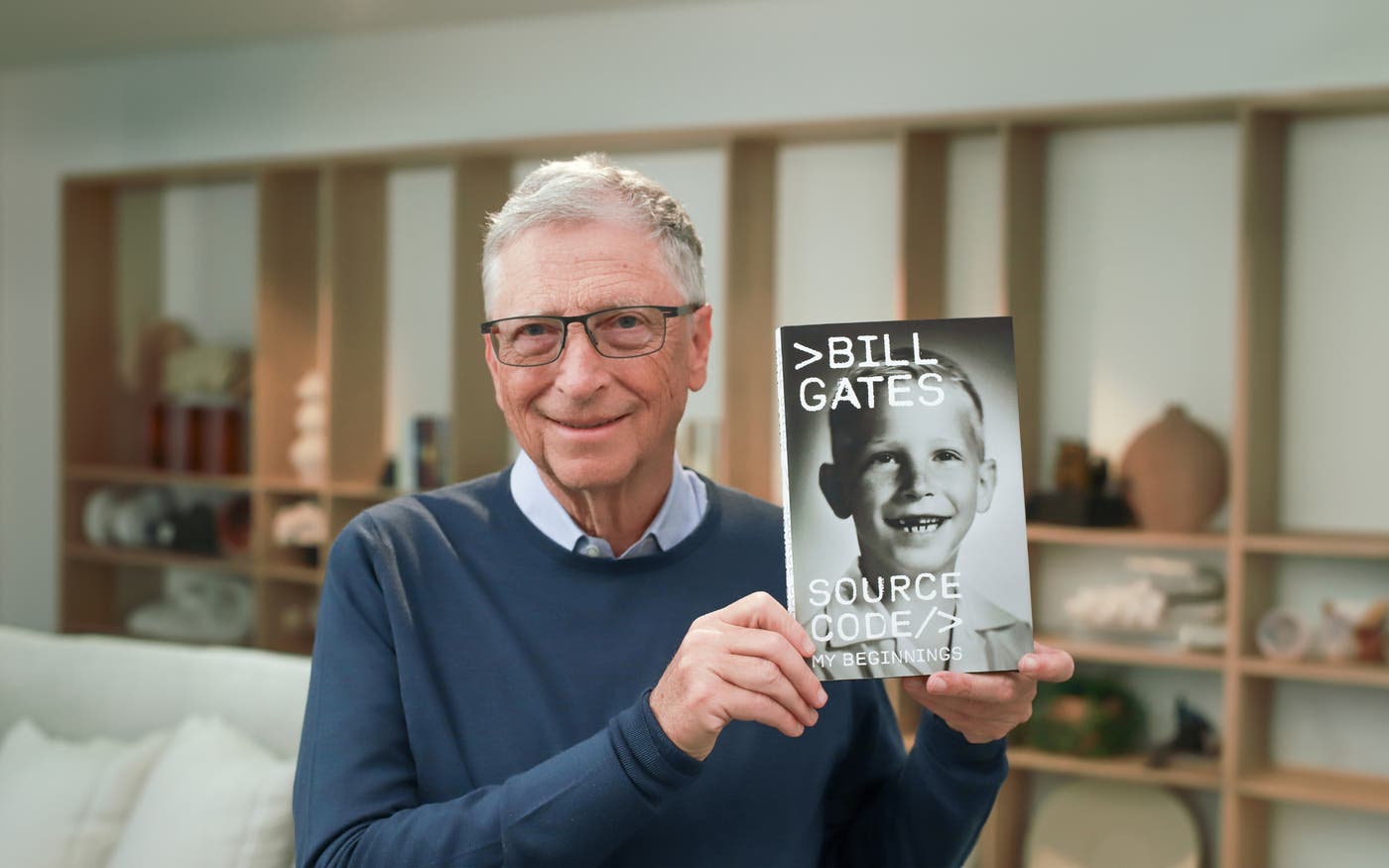
My first memoir is now available
Source Code runs from my childhood through the early days of Microsoft.
I was twenty when I gave my first public speech. It was 1976, Microsoft was almost a year old, and I was explaining software to a room of a few hundred computer hobbyists. My main memory of that time at the podium was how nervous I felt. In the half century since, I’ve spoken to many thousands of people and gotten very comfortable delivering thoughts on any number of topics, from software to work being done in global health, climate change, and the other issues I regularly write about here on Gates Notes.
One thing that isn’t on that list: myself. In the fifty years I’ve been in the public eye, I’ve rarely spoken or written about my own story or revealed details of my personal life. That wasn’t just out of a preference for privacy. By nature, I tend to focus outward. My attention is drawn to new ideas and people that help solve the problems I’m working on. And though I love learning history, I never spent much time looking at my own.
But like many people my age—I’ll turn 70 this year—several years ago I started a period of reflection. My three children were well along their own paths in life. I’d witnessed the slow decline and death of my father from Alzheimer’s. I began digging through old photographs, family papers, and boxes of memorabilia, such as school reports my mother had saved, as well as printouts of computer code I hadn't seen in decades. I also started sitting down to record my memories and got help gathering stories from family members and old friends. It was the first time I made a concerted effort to try to see how all the memories from long ago might give insight into who I am now.
The result of that process is a book that will be published on Feb. 4: my first memoir, Source Code. You can order it here. (I’m donating my proceeds from the book to the United Way.)
Source Code is the story of the early part of my life, from growing up in Seattle through the beginnings of Microsoft. I share what it was like to be a precocious, sometimes difficult kid, the restless middle child of two dedicated and ambitious parents who didn’t always know what to make of me. In writing the book I came to better understand the people that shaped me and the experiences that led to the creation of a world-changing company.
In Source Code you’ll learn about how Paul Allen and I came to realize that software was going to change the world, and the moment in December 1974 when he burst into my college dorm room with the issue of Popular Electronics that would inspire us to drop everything and start our company. You’ll also meet my extended family, like the grandmother who taught me how to play cards and, along the way, how to think. You’ll meet teachers, mentors, and friends who challenged me and helped propel me in ways I didn’t fully appreciate until much later.
Some of the moments that I write about, like that Popular Electronics story, are ones I’ve always known were important in my life. But with many of the most personal moments, I only saw how important they were when I considered them from my perspective now, decades later. Writing helped me see the connection between my early interests and idiosyncrasies and the work I would do at Microsoft and even the Gates Foundation.
Some of the stories in the book were hard for me to tell. I was a kid who was out of step with most of my peers, happier reading on my own than doing almost anything else. I was tough on my parents from a very early age. I wanted autonomy and resisted my mother’s efforts to control me. A therapist back then helped me see that I would be independent soon enough and should end the battle that I was waging at home. Part of growing up was understanding certain aspects of myself and learning to handle them better. It’s an ongoing process.
One of the most difficult parts of writing Source Code was revisiting the death of my first close friend when I was 16. He was brilliant, mature beyond his years, and, unlike most people in my life at the time, he understood me. It was my first experience with death up close, and I’m grateful I got to spend time processing the memories of that tragedy.
The need to look into myself to write Source Code was a new experience for me. The deeper I got, the more I enjoyed parsing my past. I’ll continue this journey and plan to cover my software career in a future book, and eventually I’ll write one about my philanthropic work. As a first step, though, I hope you enjoy Source Code.
The source code for Source Code
5 memoirs that helped shape my own
What I learned from other authors who wrote about their lives.
I feel like I’m always learning, but I really go into serious learning mode when I’m starting a new project. In the early days of Microsoft, I read a ton about technology companies, and as I was starting the Gates Foundation, I researched the history of American philanthropy.
Writing my memoir Source Code, which came out earlier this year, was no different: I thought about what I could draw on from the best memoirs I’ve read.
So for this year’s Summer Books, I want to share a few of them. With the exception of Nicholas Kristof’s Chasing Hope, I read all of these before finishing Source Code—in fact I read Katharine Graham’s Personal History years before I even decided to start writing. (Nick’s book is so good that I wanted to share it anyway.)
You won’t find a direct correlation between any of these books and Source Code. But I think it has shades of Bono’s vulnerability about his own challenges, Tara Westover’s evolving view of her parents, and Trevor Noah’s sense as a kid that he didn’t quite fit in.
In any case, I hope you can find something that interests you on this list. Memoirs are a good reminder that people have countless interesting stories to tell about their lives.
Personal History, by Katharine Graham. I met Kay Graham, the legendary publisher of the Washington Post, on July 5, 1991—the same day I met Warren Buffett—and we became good friends. I loved hearing Kay talk about her remarkable life: taking over the Post at a time when few women were in leadership positions like that, standing up to President Nixon to protect the paper’s reporting on Watergate and the Pentagon Papers, negotiating the end to a pressman’s strike, and much more. This thoughtful memoir is a good reminder that great leaders can come from unexpected places.
Chasing Hope, by Nicholas Kristof. In 1997, Nick Kristof wrote an article that changed the course of my life. It was about the huge number of children in poor countries who were dying from diarrhea—and it helped me decide what I wanted to focus my philanthropic giving on. I’ve been following Nick’s work ever since, and we’ve stayed in touch. He’s reported from more than 150 countries, covering war, poverty, health, and human rights. In this terrific memoir, Nick writes about how he stays optimistic about the world despite everything he’s seen. His book made me think: The world would be better off with more Nick Kristofs.
Educated, by Tara Westover. Tara grew up in a Mormon survivalist home in rural Idaho, raised by parents who believed that doomsday was coming and that the family should interact with the outside world as little as possible. Eventually she broke away from her parents—a process that felt like a much more extreme version of what I went through as a kid, and what I think a lot of people go through: At some point in your childhood, you go from thinking your parents know everything to seeing them as adults with limitations. Tara beautifully captures that process of self-discovery in this unforgettable memoir.
Born a Crime, by Trevor Noah. Back in 2017, I said this memoir shows how the former Daily Show host’s “approach has been honed over a lifetime of never quite fitting in.” I also grew up feeling like I didn’t quite fit in at times, although Trevor has a much stronger claim to the phrase than I do. He was a biracial child in apartheid South Africa, a country where mixed-race relationships were forbidden. He was, as the title says, “born a crime.” In this book, and in his comedy, Trevor uses his outside perspective to his advantage. His outlook transcends borders.
Surrender, by Bono. I’m lucky that my parents were super supportive of my interest in computers—but Bono’s parents had a very different view of his passion for singing. He says his parents basically ignored him, which made him try even harder to get their attention. “The lack of interest of my father … in his son’s voice is not easy to explain, but it might have been crucial.” Bono shows a lot of vulnerability in this surprisingly open memoir, writing about his “need to be needed” and how he learned he’ll never fill his emotional needs by playing for huge crowds. It was a great model for how I could be open about my own challenges in Source Code.
On the record
How Katharine Graham found the courage to challenge Nixon
Personal History contains valuable lessons about leadership and finding strength in vulnerability.
July 5, 1991 was one of the most important days of my life. My mom was hosting a get-together at our family’s favorite vacation spot in Hood Canal, WA. One of her friends had invited Warren Buffett, and I immediately hit it off with him, kickstarting a relationship that would, among other things, lead to the creation of the Gates Foundation.
But Warren wasn’t the only legend in the room. I remember him introducing me to his old friend Katharine Graham, one of the most well-respected newspaper publishers in the world. Even after all these years—and after her death in 2001—I still treasure the friendship I began with Kay that day.
Kay is best known for leading the Washington Post through the Watergate crisis, but her remarkable story goes way beyond her fights with the Nixon White House. That story is told in her riveting memoir Personal History, which came out in 1997—just a few years before she passed away—and won the Pulitzer Prize for Biography.
Kay’s father purchased the Washington Post and saved it from bankruptcy when she was a teenager. In 1946, he made Kay’s husband, Philip Graham, the publisher of the paper. Although this decision sounds strange today—Why would you hand over the family business to your son-in-law instead of your own child?—the thought of putting a woman in charge was unthinkable in that era. “It never crossed my mind that he might have viewed me as someone to take on an important job at the paper,” she writes. Kay was expected to devote her life to being a good wife and mother.
But life with Phil wasn’t easy. He suffered from bipolar disorder at a time when treatments for mental illness were crude and ineffective. The chapters about his mental decline are devastating. Kay describes how Phil had to be sedated after suffering from a manic episode at a publishing conference. A few months later, he dies by suicide during a stay at the family’s country home. Kay is the first person to find his body.
While she was struggling with grief, Kay found herself thrust into a new role: president of the Washington Post Company and the publisher of a major national newspaper. That isn’t an easy job under any circumstances, but several of Kay’s male colleagues made it harder than it needed to be. “I didn’t blame my male colleagues for condescending—I just thought it was due to my being so new,” she writes. “It took the passage of time and the women’s lib years to alert me properly to the real problems of women in the workplace, including my own.”
Still, Kay internalized some of the skepticism, and she is pretty harsh on herself throughout the book. She blames herself for Phil’s suicide and describes her business acumen as “abysmally ignorant” when she takes over the Post. I understand her impulse to be critical of her younger self—I often felt frustrated by how I acted as a kid when I was writing my own memoir, Source Code. But it can be difficult to read at points in Personal History. I wish Kay knew how special she was.
Her story is a powerful reminder that strong leaders don’t always come in the form you expect. What Kay sees as weaknesses end up becoming her strengths. Because she didn’t know much about the newsroom when she took over in 1963, she asked a lot of questions. A more experienced publisher might have come into the job with preconceived notions about how to run things—but Kay listened to her new colleagues, and she took the time to learn how they worked. That trust in her people would pay off years later during the Watergate scandal.
I was a teenager during the Watergate years, and I remember reading about it in the paper. Many people focus on two specific events when they talk about Watergate: the break-in at the Democratic National Committee in June 1972, and President Nixon’s resignation in August 1974 after secret recordings revealed his administration’s involvement in the burglary and subsequent cover-up. But during the more than two years between those two points, the Washington Post reported relentlessly on the scandal.
Nixon himself tried to bully them into giving up, but Kay stood by her newsroom. She protected their editorial independence, never asking her reporters to censor or soften their reporting. At one point, John Mitchell—the chair of Nixon’s re-election campaign and former Attorney General—told a Post reporter that Kay was going to get a certain part of her anatomy “caught in a big fat ringer.” She read about it in the paper the next day.
Kay risked the company’s reputation and financial health to protect journalistic integrity, even in the face of potential lawsuits and calls to discredit the paper. The Post almost folded at one point when the Nixon administration threatened to pull the broadcasting licenses for several TV stations owned by the Washington Post Company. (Despite being the namesake of the company, the Washington Post itself was not profitable at the time. The business relied on local broadcast stations to stay afloat.)
This is where Warren enters the story. He believed the Washington Post was undervalued, and in 1973, Berkshire Hathaway bought a 10 percent ownership share—enough to keep the company going while making sure that Kay remained in control. He eventually became a trusted advisor and a close friend to Kay, which I saw firsthand years later in Hood Canal.
Warren has always hated that Kay was left out of the movie All the President’s Men, which came out just two years after Nixon resigned and received great critical acclaim. Without her leadership and bravery, the Watergate scandal might have faded into obscurity. Fortunately, the film The Post gave Kay her proper due. Meryl Streep was even nominated for an Oscar for playing her.
There is so much to Kay’s story—including her time with President Kennedy, the Pentagon Papers, and the pressmen’s strike—that I cannot mention all of it here. If you want to learn even more about her incredible life, I recommend starting with the new documentary Becoming Katharine Graham before reading Personal History.
Diving deep into Kay's extraordinary life is well worth your time. Her story offers more than just insights into a fascinating chapter of American history—it also reveals valuable lessons about courage, leadership, and finding strength in vulnerability.
Field notes
The world needs more Nick Kristofs
I loved this journalist’s story of chasing hard problems and holding onto hope.
If you’re a big reader, you can probably point to a book or two that changed the course of your life. For me, it was a 1997 New York Times column by Nicholas Kristof about diarrhea, which was killing three million kids a year.
At the time, I had wealth—and knew I planned to give it away—but no clear mission. Nick’s article gave me one. I faxed it to my dad with a note: “Maybe we can do something about this.”
That ended up setting the direction for what became the Gates Foundation. It didn’t just give us a what—it gave us a how. Nick’s reporting showed us that the biggest challenge in global health isn’t always discovering new breakthroughs. Often, it’s making sure the tools we already have—vaccines, medicines, bed nets, or oral rehydration therapies for rotavirus—reach every child, no matter where they’re born.
Reading Nick’s new memoir, Chasing Hope, brought me back to that moment and showed me how it fit into the bigger story of his life. The book is a deeply personal account of a life spent documenting injustice and refusing to look away, whether it’s genocide in Darfur, refugee camps in Sudan, or the streets of his hometown in rural Oregon.
Nick’s impulse to go where the suffering is, and to make people care, has defined his career. He’s reported from more than 150 countries, covering war, poverty, health, and human rights. He and his longtime collaborator and wife, Sheryl WuDunn, won a Pulitzer Prize for their work. Together and individually, they’ve brought injustices around the world into view for millions of readers.
But Chasing Hope isn’t just a greatest-hits collection of his past reporting. It’s the story of how someone becomes Nick Kristof. He writes about growing up on a sheep and cherry farm in Oregon, driving tractors as a teenager, and nearly becoming a lawyer before deciding on journalism. He also reflects on the toll his career has taken on him, his family, and his capacity for hope.
I’ve known Nick for many years now, and I’ve admired his work since that 1997 rotavirus column. On paper, we don’t seem all that similar. He’s a journalist, I’m a technologist; he tells stories, I talk numbers. But reading Chasing Hope, I was struck by what we have in common: growing up in the Pacific Northwest, learning about the value of service from our parents, thinking globally.
We both attended Harvard and left early—me because I dropped out, him because he graduated in three years before heading to Oxford as a Rhodes Scholar. But neither of us ever stopped learning. I think we both believe the world’s pretty interesting if you remain a student.
Nick’s curiosity didn’t come out of nowhere, and neither did his sense of purpose. His mother was an art history professor and a civic leader who helped influence local politics. His father, a political science professor who fled both Nazism and communism, believed deeply in education and the responsibilities that come with freedom. That kind of upbringing left a mark on him and shaped the kind of journalist he became.
Over decades, he’s built a career reporting on crises that are often ignored because they happen in far-off places, far from centers of power. In Chasing Hope, he recounts his experiences chronicling river blindness in Ethiopia, maternal mortality in Cameroon, and malaria in Cambodia. Through the foundation, I mobilize science, data, and funding to address many of the same global challenges Nick reports on. Our approaches are different, but the underlying questions we ask (and try to answer) are the same: Why are some lives valued less than others? And how can we use the tools we have—information, resources, attention—to close that gap?
Nick has an admirable commitment to nuance, especially when it comes to hard subjects like China. Nick lived there for years, speaks Mandarin, and understands the country in a way most Western commentators don’t. I’ve always appreciated his ability to go beyond the headlines—and focus not just on what’s going wrong, but on what’s changing and why it matters.
Nick is also an optimist, which might sound strange given the kinds of suffering he writes about. But his work is grounded in a belief I share: The right data—or the right story—can move people to act. As Nick puts it, “A central job of a journalist is to get people to care about some problem that may seem remote.” People, when given the chance, want to make things better. Progress, while never guaranteed, is possible.
That optimism feels especially important, if increasingly difficult, right now. Isolationism is on the rise around the world, and governments are cutting back on foreign aid at the very moment when we should be doing more, not less. Millions of lives are at stake. Nick’s work reminds us what’s possible when we care about people beyond our own borders—and what happens when we don’t.
Chasing Hope made me think a lot about what kind of person chooses to run toward the hardest problems—and keep going back until they’re solved. It also made me think the world would be a much better place if there were more Nick Kristofs. In the meantime, we’re lucky to have this one.
Quest for knowledge
Educated is even better than you’ve heard
I loved Tara Westover’s journey from the mountains of Idaho to the halls of Cambridge.
I’ve always prided myself on my ability to teach myself things. Whenever I don’t know a lot about something, I’ll read a textbook or watch an online course until I do.
I thought I was pretty good at teaching myself—until I read Tara Westover’s memoir Educated. Her ability to learn on her own blows mine right out of the water. I was thrilled to sit down with her recently to talk about the book.
Tara was raised in a Mormon survivalist home in rural Idaho. Her dad had very non-mainstream views about the government. He believed doomsday was coming, and that the family should interact with the health and education systems as little as possible. As a result, she didn’t step foot in a classroom until she was 17, and major medical crises went untreated (her mother suffered a brain injury in a car accident and never fully recovered).
Because Tara and her six siblings worked at their father’s junkyard from a young age, none of them received any kind of proper homeschooling. She had to teach herself algebra and trigonometry and self-studied for the ACT, which she did well enough on to gain admission to Brigham Young University. Eventually, she earned her doctorate in intellectual history from Cambridge University. (Full disclosure: she was a Gates Scholar, which I didn’t even know until I reached that part of the book.)
Educated is an amazing story, and I get why it’s spent so much time on the top of the New York Times bestseller list. It reminded me in some ways of the Netflix documentary Wild, Wild Country, which I recently watched. Both explore people who remove themselves from society because they have these beliefs and knowledge that they think make them more enlightened. Their belief systems benefit from their separateness, and you’re forced to be either in or out.
But unlike Wild, Wild Country—which revels in the strangeness of its subjects—Educated doesn’t feel voyeuristic. Tara is never cruel, even when she’s writing about some of her father’s most fringe beliefs. It’s clear that her whole family, including her mom and dad, is energetic and talented. Whatever their ideas are, they pursue them.
Of the seven Westover siblings, three of them—including Tara—left home, and all three have earned Ph.D.s. Three doctorates in one family would be remarkable even for a more “conventional” household. I think there must’ve been something about their childhood that gave them a degree of toughness and helped them persevere. Her dad taught the kids that they could teach themselves anything, and Tara’s success is a testament to that.
I found it fascinating how it took studying philosophy and history in school for Tara to trust her own perception of the world. Because she never went to school, her worldview was entirely shaped by her dad. He believed in conspiracy theories, and so she did, too. It wasn’t until she went to BYU that she realized there were other perspectives on things her dad had presented as fact. For example, she had never heard of the Holocaust until her art history professor mentioned it. She had to research the subject to form her own opinion that was separate from her dad’s.
Her experience is an extreme version of something everyone goes through with their parents. At some point in your childhood, you go from thinking they know everything to seeing them as adults with limitations. I’m sad that Tara is estranged from a lot of her family because of this process, but the path she’s taken and the life she’s built for herself are truly inspiring.
When you meet her, you don’t have any impression of all the turmoil she’s gone through. She’s so articulate about the traumas of her childhood, including the physical abuse she suffered at the hands of one brother. I was impressed by how she talks so candidly about how naïve she once was—most of us find it difficult to talk about our own ignorance.
I was especially interested to hear her take on polarization in America. Although it’s not a political book, Educated touches on a number of the divides in our country: red states versus blue states, rural versus urban, college-educated versus not. Since she’s spent her whole life moving between these worlds, I asked Tara what she thought. She told me she was disappointed in what she called the “breaking of charity”—an idea that comes from the Salem witch trials and refers to the moment when two members of the same group break apart and become different tribes.
“I worry that education is becoming a stick that some people use to beat other people into submission or becoming something that people feel arrogant about,” she said. “I think education is really just a process of self-discovery—of developing a sense of self and what you think. I think of [it] as this great mechanism of connecting and equalizing.”
Tara’s process of self-discovery is beautifully captured in Educated. It’s the kind of book that I think everyone will enjoy, no matter what genre you usually pick up. She’s a talented writer, and I suspect this book isn’t the last we’ll hear from her. I can’t wait to see what she does next.
Universal humor
Chameleon comic
Trevor Noah’s funny and moving account of growing up in South Africa.
I’m a longtime fan of Comedy Central’s The Daily Show. When Jon Stewart stepped down as host in 2015, I was sad to see him go. I was also worried for his replacement, Trevor Noah, a South African comedian. Stewart’s style is so unusual that I didn’t see how anyone could fill his shoes—especially someone like Noah, who describes himself as an outsider. As popular as Noah was in South Africa, I didn’t know whether his humor would connect with American audiences.
I’m happy to report that I was wrong. Millions of viewers—myself included—are tuning in to The Daily Show because Noah’s show is every bit as good as Stewart’s. His humor has a lightness and optimism that’s refreshing to watch. What’s most impressive is how he uses his outside perspective to his advantage. He’s good at making fun of himself, America, and the rest of the world. His comedy is so universal that it has the power to transcend borders.
Reading Noah’s memoir, Born a Crime, I quickly learned how Noah’s outsider approach has been honed over a lifetime of never quite fitting in. Born to a black South African mother and a white Swiss father in apartheid South Africa, he entered the world as a biracial child in a country where mixed race relationships were forbidden. Noah was not just a misfit, he was (as the title says) “born a crime.”
In South Africa, where race categories are so arbitrary and yet so prominent, Noah never had a group to call his own. As a little boy living under apartheid laws, he couldn’t be seen in public with his white father or his black mother. In public, his father would walk far ahead of him to ensure he wouldn’t be seen with his biracial son. His mother would pose as a maid to make it look like she was just babysitting another family’s child. On the schoolyard, he didn’t fit in with the white kids or the black kids or the kids who were “colored” (the term used in South Africa to describe people of mixed race).
But during his childhood, he quickly discovered that there’s a freedom that comes with being a misfit. A polyglot who speaks English, Afrikaans, Xhosa, Zulu, Tsonga, Tswana, as well as German and Spanish, Noah used his talent for language to bounce from group to group and win acceptance from all of them. One of my favorite stories in the book involves Noah walking down the street when he overhears a group of men speaking in Zulu about how they were plotting to mug “this white guy.” Noah realizes they were referring to him. Noah spins around and announces in perfect Zulu that they should all mug someone together. The Zulu men are startled that Noah speaks Zulu and a tense situation is defused. Noah is immediately accepted as one of their own.
Again and again throughout his childhood, he discovered that language was more powerful than skin color in building connections with other people. “I became a chameleon,” Noah writes. “My color didn’t change, but I could change your perception of my color. If you spoke to me in Zulu, I replied to you in Zulu. If you spoke to me in Tswana, I replied to you in Tswana. Maybe I didn’t look like you, but if I spoke like you, I was you.”
Much of Noah’s story of growing up in South Africa is tragic. His Swiss father moves away. His family is desperately poor. He’s arrested. And in the most shocking moment, his mother is shot by his stepfather. Yet in Noah’s hands, these moving stories are told in a way that will often leave you laughing. His skill for comedy is clearly inherited from his mother. Even after she’s shot in the face, and miraculously survives, she tells her son from her hospital bed to look at the bright side. “’Now you’re officially the best-looking person in the family,’” she jokes.
In fact, Noah’s mother emerges as the real hero of the book. She’s an extraordinary person who is fiercely independent and raised her son to be the same way. Her greatest gift was to give her son the ability to think for himself and see the world from his own perspective. “If my mother had one goal, it was to free my mind,” he writes. Like many fans of Noah’s, I am thankful she did.
Surrender
The best memoir by a rock star I actually know
I’m lucky to call Bono a friend. But his autobiography still surprised me.
When Paul Hewson was 11, his parents sent him to a Dublin grammar school that happened to have an outstanding boys’ choir. Paul, who later took the nickname Bono, loved singing. His father had a beautiful voice, and Paul thought he might have some of his dad’s talent. But when the principal asked him if he wanted to join the choir, his mom jumped in before he could answer. “Not at all,” she said. “Paul has no interest in singing.”
Bono’s new book, Surrender, is packed with funny, poignant moments like this. Even though I’m a big fan of U2, and Bono and I have become friends over the years—Paul Allen connected us in the early 2000s—a lot of those stories were new to me. I went into this book knowing almost nothing about his anger at his father, the band’s near-breakups, and his discovery that his cousin was actually his half-brother. I didn’t even know that he grew up with a Protestant mom and Catholic dad.
I loved Surrender. You get to observe the band in the process of creating some of their most iconic songs. The book is filled with clever, self-deprecating lines like “Just how effective can a singer with anger issues be in the cause of nonviolence?” And you’ll learn a lot about the challenges he dealt with in his campaigns for debt relief and HIV treatment in Africa. (The Gates Foundation is a major supporter of ONE, the nonprofit that Bono helped start.)
In this passage, he explains how a boy from the suburbs of Dublin became a global phenomenon: “There are only a few routes to making a grandstanding stadium singer out of a small child. You can tell them they’re amazing, that the world needs to hear their voice, that they must not hide their ‘genius under a bushel.’ Or you can just plain ignore them. That might be more effective. The lack of interest of my father, a tenor, in his son’s voice is not easy to explain, but it might have been crucial.” (It also helped that he has, as he later learned from a doctor, freakishly large lung capacity.)
Bono’s loyalty to his bandmates, and their loyalty to him, is pretty incredible. My favorite illustration from the book takes place at a concert in Arizona, when the band was urging the then-governor to uphold the national MLK Day holiday in his state. U2’s security team picked up a credible threat to Bono’s life if the band played their Martin Luther King tribute “Pride (In the Name of Love).” “It wasn’t just melodrama,” he writes, “when I closed my eyes and sort of half kneeled to disguise the fact that I was fearful to sing the rest of the words.” When Bono opened his eyes, he saw that bassist Adam Clayton had moved in front of him to shield him like a Secret Service agent. Fortunately, the threat never materialized.
There’s another factor that explains the band’s tight bonds: They share the same values. All four of them are passionate about fighting poverty and inequity in the world, and they’re also aligned on maintaining their integrity as artists. I learned this the hard way. When Microsoft wanted to license U2’s song “Beautiful Day” for an ad campaign, I joined a call in an attempt to persuade the band to go for the deal. They simply weren’t interested. I admired their commitment.
While Bono never got lost in drugs or alcohol, he acknowledges that stardom gave him a big ego. He also says that he had a “need to be needed.” His key to survival was embracing the concept of spiritual surrender, as the title of the book suggests. He eventually came to see that he’d never fill his emotional needs by playing for huge crowds or being a global advocate. His faith in a higher power helped him a lot. So did his wife, Ali. He writes that when his mom died during his childhood, his home “stopped being a home; it was just a house.” Ali and their four children gave him a home once again.
Bono writes that his surrender is still incomplete. He’s not going to retire anytime soon, which is great news and not just for U2 fans. After the past few years, the field of global health—one of his chief causes—needs an injection of energy and passion. Bono’s unique gifts are perfectly suited to that mission.
Food for thought
What it will really take to feed the world
In his latest book, one of my favorite authors argues that solving hunger requires more than producing more food.
In the introduction to his latest book, How to Feed the World, Vaclav Smil writes that “numbers are the antidote to wishful thinking.” That one line captures why I’ve been such a devoted reader of this curmudgeonly Canada-based Czech academic for so many years. Across his decades of research and writing, Vaclav has tackled some of the biggest questions in energy, agriculture, and public health—not by making grand predictions, but by breaking down complex problems into measurable data.
Now, in How to Feed the World, Vaclav applies that same approach to one of the most pressing issues of our time: ensuring that everyone has enough nutritious food to eat. Many discussions about feeding the world focus on increasing agricultural productivity through improved seeds, healthier soils, better farming practices, and more productive livestock (all priorities for the Gates Foundation). Vaclav, however, insists we already produce more than enough food to feed the world. The real challenge, he says, is what happens after the food is grown.
This kind of argument is classic Vaclav—questioning assumptions, forcing us to rethink the way we frame problems, and turning conventional wisdom on its head. His analysis is never about the best- or worst-case scenarios; it’s about what the numbers actually tell us.
And the numbers tell a striking story: Some of the world’s biggest food producers have the highest rates of undernourishment. Globally, we produce around 3,000 calories per person per day—more than enough to feed everyone—but a staggering one-third of all food is wasted. (In some rich countries, that figure climbs to 45 percent.) Distribution systems fail, economic policies backfire, and food doesn’t always go where it’s needed.
I’ve seen this firsthand through the Gates Foundation’s work in sub-Saharan Africa, where food insecurity is driven by low agricultural productivity and weak infrastructure. Yields in the region remain far lower than in Asia or Latin America, in part because farmers rely on rain-fed agriculture rather than irrigation and have limited access to fertilizers, quality seeds, and digital farming tools. But even when food is grown, getting it to market is another challenge. Poor roads drive up transport costs, inadequate storage leads to food going bad, and weak trade networks make nutritious food unaffordable for many families.
And access is only part of the problem. Even when people get enough calories, they’re often missing the right nutrients. Malnutrition remains one of the most critical challenges the foundation works on—and it’s more complex than eating enough food. While severe hunger has declined globally, micronutrient deficiencies remain stubbornly common, even in wealthy countries. One of the most effective solutions has been around for nearly a century: food fortification. In the U.S., flour has been fortified with iron and vitamin B since the 1940s. This simple step has helped prevent conditions like anemia and neural tube defects and improve public health at scale—close to vaccines in terms of lives improved per dollar spent.
One of the most interesting parts of the book is Vaclav’s exploration of how human diets evolved. Across civilizations, people independently discovered that pairing grains with legumes created complete protein profiles—whether it was rice and soybeans in Asia, wheat and lentils in India, or corn and beans in the Americas. These solutions emerged from practical experience long before modern science could explain why they worked so well.
But just as past generations adapted their diets to available resources, we’re now facing new challenges that require us to adapt in different ways. Technology and innovation can help. They’ve already transformed the way we produce food, and they’ll continue to play a role. Take aquaculture: Once a tiny industry, it’s grown over the past 40 years to supply more seafood for the world than traditional fishing—a scalable way to meet global protein demands. The Green Revolution is another example. Beginning in the 1960s, innovations in higher-yielding crops, more effective fertilizers, and modern irrigation prevented widespread famine in India and Mexico. These changes were once seen as unlikely, too.
New breakthroughs could drive even more progress. CRISPR gene editing, for instance, could help develop crops that are more resilient to drought, disease, and pests—critical for farmers facing the pressures of climate change. Vaclav warns that we can’t count on technological miracles alone, and I agree. But I also believe that breakthroughs like CRISPR could be game-changing, just as the Green Revolution once was. The key is balancing long-term innovation with practical solutions we can implement immediately.
And some of these solutions aren’t about producing more food at all—they’re about wasting less of what we already have. Better storage and packaging, smarter supply chains, and flexible pricing models could significantly reduce spoilage and excess inventory. In a conversation we had about the book, Vaclav pointed out that Costco (which might seem like the pinnacle of U.S. consumption) stocks fewer than 4,000 items, compared to 40,000-plus in a typical North American supermarket.
That kind of efficiency—focusing on fewer, high-turnover products—reduces waste, lowers costs, and ultimately eases pressure on global food supply, helping make food more affordable where it is needed most.
How to Feed the World had a lot to teach me—and I’m sure it will teach you a lot, too. Like all of Vaclav’s best books, it challenges readers to think differently about a problem we thought we understood. Growing more and better food remains crucial—especially in places like sub-Saharan Africa, where there simply isn’t enough. But as the world’s population approaches 10 billion, increasing agricultural productivity alone won’t solve hunger and malnutrition. We also need to ensure that food is more accessible and affordable, less wasted, and just as nutritious as it is abundant.
After all, the goal isn’t to make more food for its own sake—it’s to feed more people.
The Smil test
Three cheers for the dull, factually correct middle
A new masterpiece from one of my favorite authors.
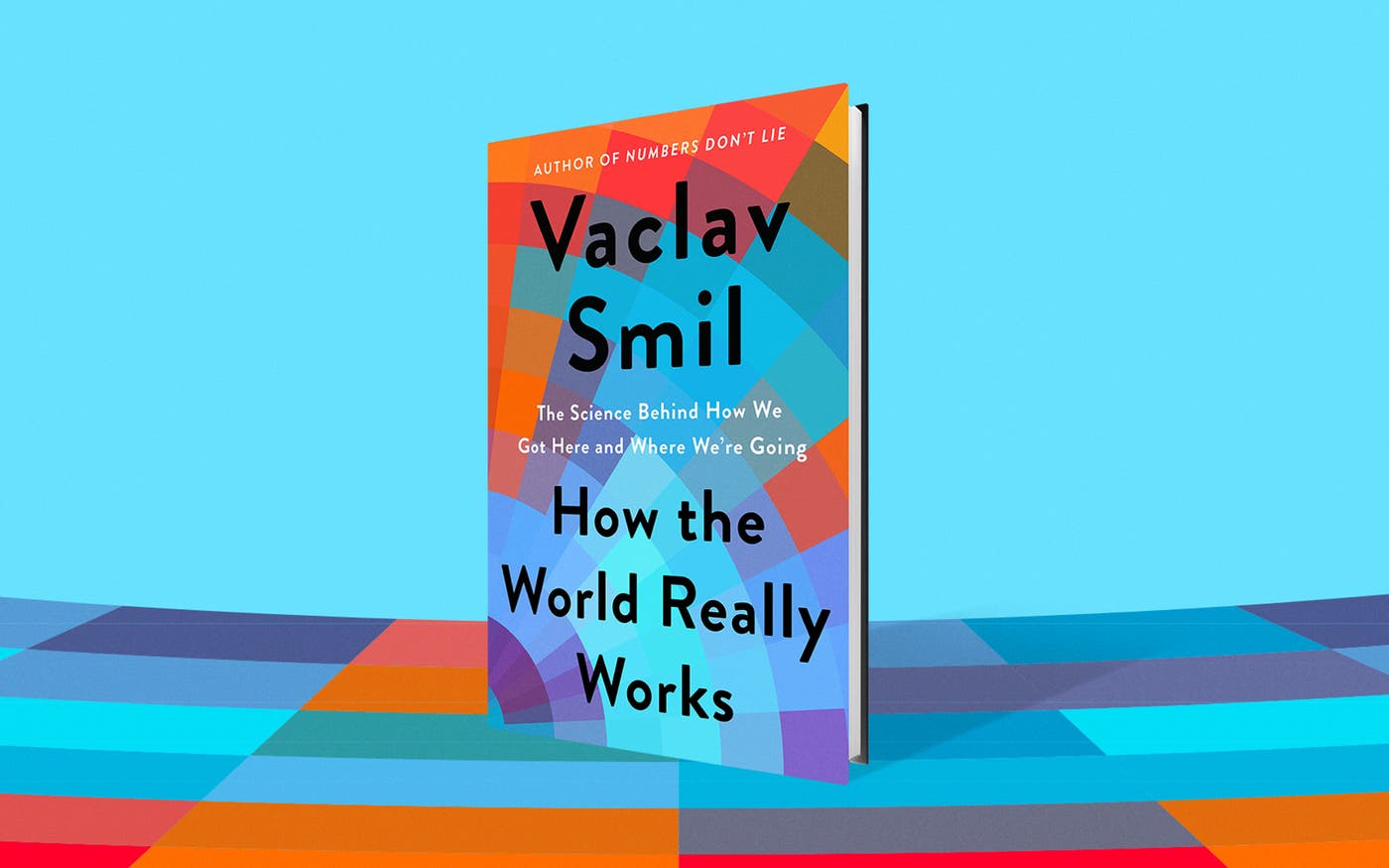
I occasionally check the bestseller lists for ideas about what to read next. A few weeks ago I looked at the New York Times’s nonfiction list and got quite a surprise. The latest book by Vaclav Smil, How the World Really Works, was number 8!
I have been a fan of Vaclav’s work for years—he is one of my favorite authors. But his style is not for everyone. Many of his books are dense and packed with data, and it is an understatement to say they have never sold especially well. So as an admirer of Vaclav’s work, I was excited to see his latest one in the top 10 list. The more people who read his books, the better. (I’m sure his new book got a boost from this largely positive review in the New York Times Book Review.)
What I love about How the World Really Works is that it sums up all of the incredible knowledge Vaclav has gained over the years. Most of his 50 books go into great detail about complex subjects including energy, manufacturing, shipping, and agriculture. He wrote an entire book on how diets in Japan have changed.
Because he has gone so deep into such specific topics, he is qualified to step back and write a broad overview for a general audience, which is what he has done with How the World Really Works. If you want a brief but thorough education in numeric thinking about many of the fundamental forces that shape human life, this is the book to read.
Energy is a great example. I have learned more about energy and its impact on society from Vaclav than from any other single source. In 2017 I reviewed his masterpiece Energy and Civilization: A History and wrote that “he goes deep and broad to explain how innovations in humans’ ability to turn energy into heat, light, and motion have been a driving force behind our cultural and economic progress over the past 10,000 years.”
But if you are not up for a long, dense book on the role of energy in human history—Energy and Civilization is 568 pages long and reads like an academic text—you can get the most important ideas by reading the first three chapters of How the World Really Works. They should be required reading for anyone who wants to have an informed opinion on climate change. All Vaclav wants is for people to look at all the areas of emissions—producing electricity, manufacturing, transportation, and so on—and propose realistic, economically viable plans for reducing emissions in each one.
As I wrote in my book on climate change, parts of which drew on Vaclav’s work, I am more optimistic than he is about the opportunity to innovate our way out of a climate disaster. But I highly recommend reading him on the subject because he is so good at explaining how the world’s energy systems work today. Chapter 1, which you can download for free below, is a great example—it covers fuels and the production of electricity.
Another good example of Vaclav’s approach is from the chapter on food. To help you understand the ways in which new sources of energy have allowed humans to grow crops and raise animals more efficiently, he portrays life on three different farms from three eras. He starts with a hypothetical farmer in western New York state in 1801 and explains all the laborious steps required for that person to harvest wheat. Then he skips ahead a century and takes you to eastern North Dakota, showing you all the advances, including plows and harvesters, that made farming far more efficient. Finally he goes to Kansas in 2021 and shows you how things have changed even more dramatically in the past century.
As usual, Vaclav has crunched all the numbers, so he can explain all of this change in both qualitative and quantitative ways. “In two centuries,” he writes, “the human labor to produce a kilogram of American wheat was reduced from 10 minutes to less than two seconds.”
And then he puts that statistic in an even broader context, showing how higher crop yields freed up people to move off of farms and into urban areas where they could collaborate on other innovations. “Most of the admired and undoubtedly remarkable technical advances that have transformed industries, transportation, communication, and everyday living,” he writes, “would have been impossible if more than 80 percent of all people had to remain in the countryside in order to produce their daily bread… or their daily bowl of rice.”
Although Vaclav has strong opinions on many subjects, they are always grounded in facts. And when he weighs in on a huge problem like climate change, he avoids extremes. As he told one interviewer, “What we need is the dull, factually correct and accurate middle. Because only from that middle will come the solutions.”
I disagree with one word in that quote. How the World Really Works is certainly factually correct and accurate, but it is never dull. It is a compelling and highly readable book that leaves readers with the fundamental grounding needed to help solve the world’s toughest challenges.
Facts of life
What sweat, wine, and electricity can teach us about humanity
Numbers Don’t Lie is Vaclav Smil’s most accessible book yet.
Vaclav Smil is my favorite author, but I sometimes hesitate to recommend his books to other people. His writing, while brilliant, is often too detailed or obscure for a general audience. (Deep dives on Japanese dining habits or natural gas can be a tough sell for even the smartest, most thoughtful readers.) Still, I’m a big enough fan to keep telling my friends and colleagues about his books, even though I know most of them won’t take me up on my recommendations.
That’s why I was thrilled when Vaclav released his most accessible book yet. Numbers Don’t Lie: 71 Things You Need to Know About the World, which came out last fall, takes everything that makes his writing great and boils it down into an easy-to-read format. I unabashedly recommend this book to anyone who loves learning.
This is probably the most information Vaclav has ever put in a book, and yet it’s by far the most digestible. Each chapter is just a couple pages long and covers one of the 71 facts mentioned in the title. Here are three that I found particularly interesting:
1.
You can thank sweat glands for our big brains.
Humans are the grand champions of sweating. We’re able to remove heat from our bodies through perspiration better than any other mammal (partly because we have very little hair). Vaclav writes, “In the race of life, we humans are neither the fastest nor the more efficient. But thanks to our sweating capabilities, we are certainly the most persistent.”
Our ancestors had better endurance than the animals they hunted for food, which allowed them to run down rich sources of protein that provided the fuel for our brains to develop. The next time you feel miserable on a hot day, just think about how all the sweating you’re doing is the reason you’re so smart!
2.
The French are drinking a lot less wine than they used to.
“Viticulture, wine-drinking, and wine exports have been long established as one of the key signifiers of national identity” in France, writes Vaclav. In 1926, the average French person drank an impressive 136 liters of wine (or more than 35 gallons). But by 2020, that figure had shrunk to just 40 liters.
The idea that French wine consumption is now a third of what it was a century ago is amazing to me because of what it might reveal about how society is changing. While young French people are drinking less alcohol overall, the consumption of mineral and spring water has doubled since 1990. Does that mean the French are becoming more health conscious? Was life just so bleak in the 1920s that people had to drink? Have people replaced drinking wine with other diversions like watching TV or browsing the web? I love how this book forces you to think about the story behind a seemingly niche statistic.
3.
The 1880s might be the most consequential decade in human history.
One of my favorite things about Vaclav’s writing is his ability to put history in context. Although it’s tempting to see the era we’re living in now as a time of unprecedented innovation, he argues that the 1880s saw the real technology boom. The decade saw the discovery of electricity and the internal combustion engine—along with somewhat less consequential but still important innovations like the ballpoint pen, the modern bicycle, and Coca-Cola. If you want to read more about the inventions the 1880s gave us, you can download a free chapter here:
Vaclav believes that progress comes in fits and starts rather than in a constant stream. Humanity will go through long periods where everything stays the same, and then a new invention will come along that sets off a rapid period of change. For example, Thomas Edison’s discovery enabled the creation of the electric elevator in 1889. This, in turn, let us build taller buildings like skyscrapers since people would no longer have to rely on stairs to reach the top floor. City skylines would look a lot different today if it weren’t for the 1880s.
If you read Numbers Don’t Lie and like it, you might also enjoy Vaclav’s latest book Grand Transitions. Numbers Don’t Lie(He is nothing if not prolific, having released two books during the pandemic.) It looks at how societies are shaped by shifts in demographics, agriculture, economics, and energy use. It’s not quite as accessible as , but the subject matter is so interesting that I think people will find it worthwhile.
Vaclav finds as much joy and fascination in looking to the past as anyone else I know. As someone who tends to be optimistic about technology—maybe even too optimistic at times—I appreciate how his natural skepticism about future innovation keeps my outlook realistic. If you’re looking for someone to help you understand how history ties together, you can’t do better than Vaclav—and Numbers Don’t Lie is a great place to start.
Smil test
Is this really an unrivaled era of innovation?
Vaclav Smil has written “a brief history of hype and failure.”
There is one writer whose books I’ve reviewed on Gates Notes more than anyone else: Vaclav Smil. I’ve read all of his 44 books, which cover everything from the role of energy in human life to changes in the Japanese diet. I find his perspective to be super valuable. Although sometimes he’s too pessimistic about the upside of new technologies, he’s almost always right—and informative—when it comes to the complexities of deploying those technologies in the real world.
In his newest book, Invention and Innovation: A Brief History of Hype and Failure, Smil looks skeptically at the notion that we’re living in an unrivaled era of innovation. Based on his analysis of fields including agriculture, transportation, and pharmaceuticals, he concludes that our current era is not nearly as innovative as we think. In fact, he says, it shows “unmistakable signs of technical stagnation and slowing advances.”
This conclusion feels especially counterintuitive at a time when artificial intelligence and deep learning are advancing so fast. But to Smil, AI researchers only have managed “to deploy some fairly rudimentary analytical techniques to uncover patterns and pathways that are not so readily discernible by our senses” and produced “impressive achievements on some relatively easy tasks.”
Smil believes there was only one real period of explosive innovation in the past 150 years: 1867-1914. During those years, inventors created internal combustion engines, electric lights, the telephone, inexpensive methods of producing steel, aluminum smelting, plastics, and the first electronic devices. Humanity also gained revolutionary insights in the fields of infectious disease, medicine, agriculture, and nutrition.
Smil argues that the ensuing years have been lackluster, with far more “breakthroughs that are not” than important inventions that achieve scale and stick in the marketplace. One of his iconic examples of a false breakthrough is leaded gasoline, which helped internal combustion engines operate much more smoothly but produced devastating cognitive declines and millions of premature deaths.
One thing that I agree with him about is how the exponential growth in computing power over the past several decades has given people a false idea about growth and innovation in other areas. Smil acknowledges “the much-admired post-1970 ascent of electronic architecture and performance,” but he concludes that this growth “has no counterpart in … other aspects of our lives.” It’s misguided to assume that anything else will grow as fast as computing power has.
On the other hand, I think Smil underestimates accomplishments in AI. The past two years of AI improvement, particularly large language models, have surprised all of us. In fact, we’re starting to see early signs that machines can produce human-like reasoning—moving beyond just producing answers to questions they were programmed to solve. AI is going to become smart, not just fast. When it achieves what researchers call “artificial general intelligence,” that will give humanity incredible new tools for problem solving in almost every domain, from curing disease to personalizing education to developing new sources of clean energy. And as I wrote earlier this year, we will have to develop strict guidelines and protocols to curtail negative outcomes.
Smil also neglects to account for the convergence of new technologies. In the work I do with the Gates Foundation and Breakthrough Energy, I have a great vantage point for observing innovation driven not just by advances in one area (AI, for example) but by the compounding effects of many different technologies advancing at the same time, like digital simulations, storage capacity, mobile communications, and domain-specific tools such as gene sequencing.
Smil is also pessimistic about many green technologies, including some approaches that I’m investing in. For example, he describes sodium-cooled nuclear fission reactors as pie in the sky. And yet in May I walked on the ground that will soon be broken for just such a reactor. Thanks to advances in digital simulation as well as ample risk capital, TerraPower has designed a sodium-cooled reactor that could be delivering power to the grid by 2030. Even if it takes longer to get running, I’m optimistic that sodium-cooled reactors are not just technically possible but will also prove to be economically viable, safe, and helpful for achieving net-zero carbon emissions.
Every Smil book that I own is marked up with lots of notes that I take while reading. Invention and Innovation is no exception. Even when I disagree with him, I learn a lot from him. Smil is not the sunniest person I know, but he always strengthens my thinking.
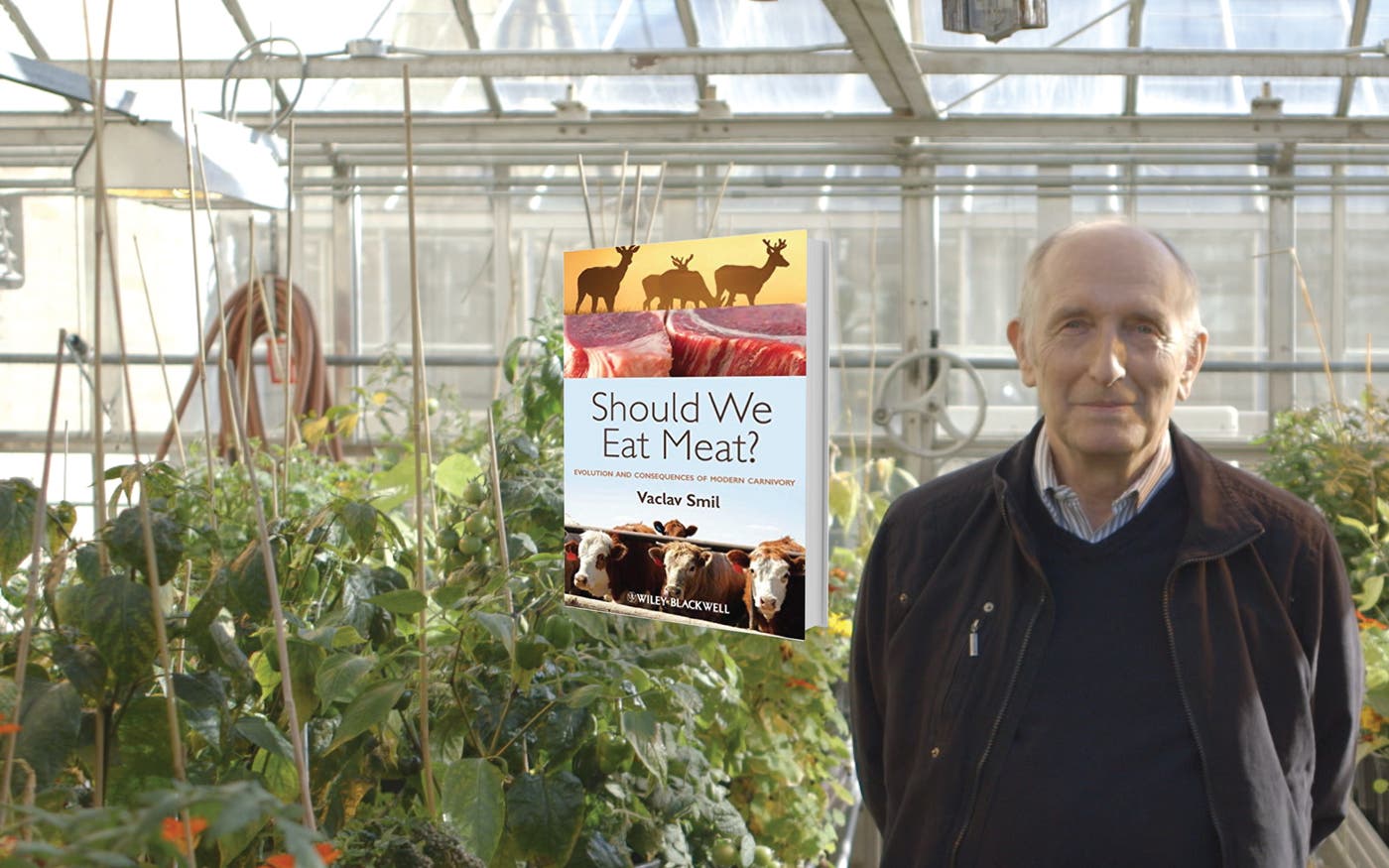
High-Stakes Steaks
Is there enough meat for everyone?
Can we produce enough meat for everyone without wrecking the planet?
In my late twenties I went vegetarian for a year. Some of my friends were strict non-meat-eaters, and I wanted to try it out. Plus I was flying a lot for work and found that the airplane meals made with tomatoes and beans just tasted better than the shoe-leather beef. In the end, though, I couldn’t keep it going, and I eventually returned to my carnivorous ways.
Years later, I came to realize that it was a luxury for me to spurn meat. In most places, as people earn more money, they want to eat more meat. Brazil’s per-capita consumption has gone up fourfold since 1950. China’s nearly doubled in the 1990s. Mexico, Indonesia, South Korea, and Japan have also seen big increases.
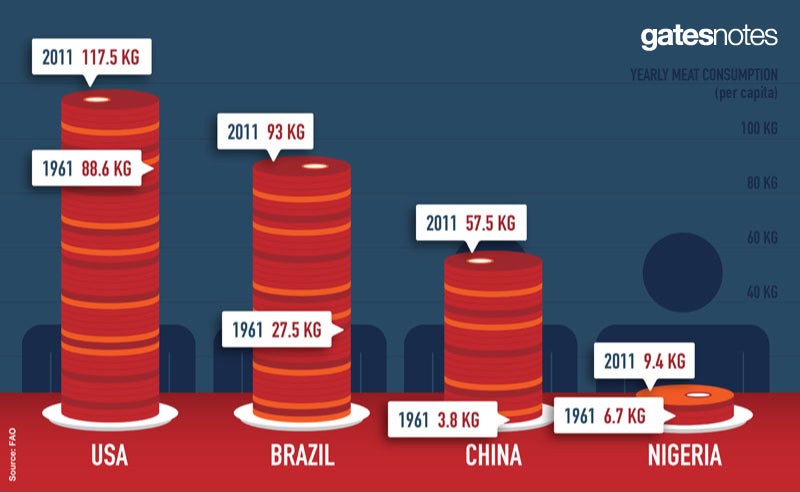
More countries are sure to follow, and that’s a good thing. Meat is a great source of high-quality proteins that help children fully develop mentally and physically. In fact part of our foundation’s health strategy involves getting more meat, dairy, and eggs into the diets of children in Africa.
But there’s also a problem. Raising animals can take a big toll on the environment. You have to feed the animal far more calories than you extract when you eat it. It’s especially problematic as we convert large swaths of land from crops that feed people to crops that feed cows and pigs. Plus clearing forests to make more farmland contributes to climate change, as do the greenhouse gases produced by all those animals.
The richer the world gets, the more meat it eats; the more meat it eats, the bigger the threat to the planet. How do we square this circle?
I can’t think of anyone better equipped to present a clear-eyed analysis of this subject than Vaclav Smil. I have written several times before about how much I admire Smil’s work. When he tackles a subject, he doesn’t look at just one piece of it. He examines every angle. Even if I don’t agree with all of his conclusions, I always learn a lot from reading him.
That is certainly true of his book Should We Eat Meat?. He starts by trying to define meat (it’s surprisingly slippery—do you count kangaroos? crickets?), then explores its role in human evolution, various countries’ annual consumption (the United States leads the way with roughly 117 kilograms of carcass weight per person), and the health and environmental risks. He also touches on ethical questions about raising animals for slaughter and covers some simple ways to eliminate the needless cruelty involved.
As usual, Smil offers up some intriguing statistics along the way. A quarter of all ice-free land in the world is used for grazing livestock. Every year, the average meat-eating American ingests more than enough blood to fill a soda can. And Americans eat a lot of pepperoni:
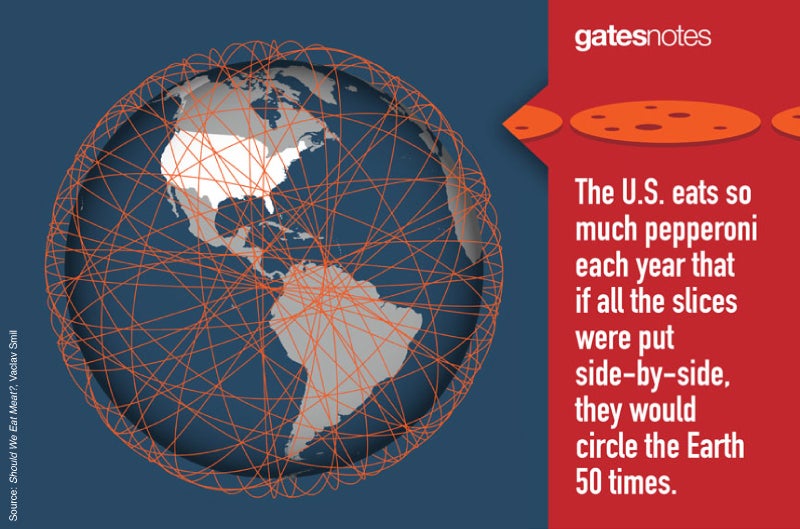
Another thing Smil loves to do is question the conventional wisdom. For example, you may have read that raising meat for food requires a lot of water. This has been in the news lately because of the drought in California. Estimates vary, but the consensus is that between watering the animals, cleaning up after them, and growing crops to feed them (far and away the biggest use), it takes several thousand liters of water to produce one kilogram of boneless beef.
But Smil shows you how the picture is more complicated. It turns out that not all water is created equal. Nearly 90 percent of the water needed for livestock production is what’s called green water, used to grow grass and such. In most places, all but a tiny fraction of green water comes from rain, and because most green water eventually evaporates back into the atmosphere, it’s not really consumed.
As Smil writes, “the same water molecules that were a part of producing Midwestern corn to feed pigs in Iowa may help to grow, just a few hours later, soybeans in Illinois… or, a week later, grass grazed by beef cattle in Wales.” One study that excluded green water found that it takes just 44 liters—not thousands—to produce a kilo of beef. This is the kind of thing Smil excels at: using facts and analysis to examine widely held beliefs.
Returning to the question at hand—how can we make enough meat without destroying the planet?—one solution would be to ask the biggest carnivores (Americans and others) to cut back, by as much as half. Although it might be possible to get people in richer countries to eat less or shift toward less-intensive meats like chicken, I don’t think it’s realistic to expect large numbers of people to make drastic reductions. Evolution turned us into omnivores.
But there are reasons to be optimistic. For one thing, the world’s appetite for meat may eventually level off. Consumption has plateaued and even declined a bit in many rich countries, including France, Germany, and the United States. I also believe that innovation will improve our ability to produce meat. Cheaper energy and better crop varieties will drive up agricultural productivity, especially in Africa, so we won’t have to choose as often between feeding animals and feeding people.
I’m also hopeful about the future of meat substitutes. I have invested in some companies working on this and am impressed with the results so far. Smil is skeptical that it will have a big impact—and it is true that today the best products are sold mostly in fancy grocery stores—but I think it has potential.
With a little moderation and more innovation, I do believe the world can meet its need for meat.
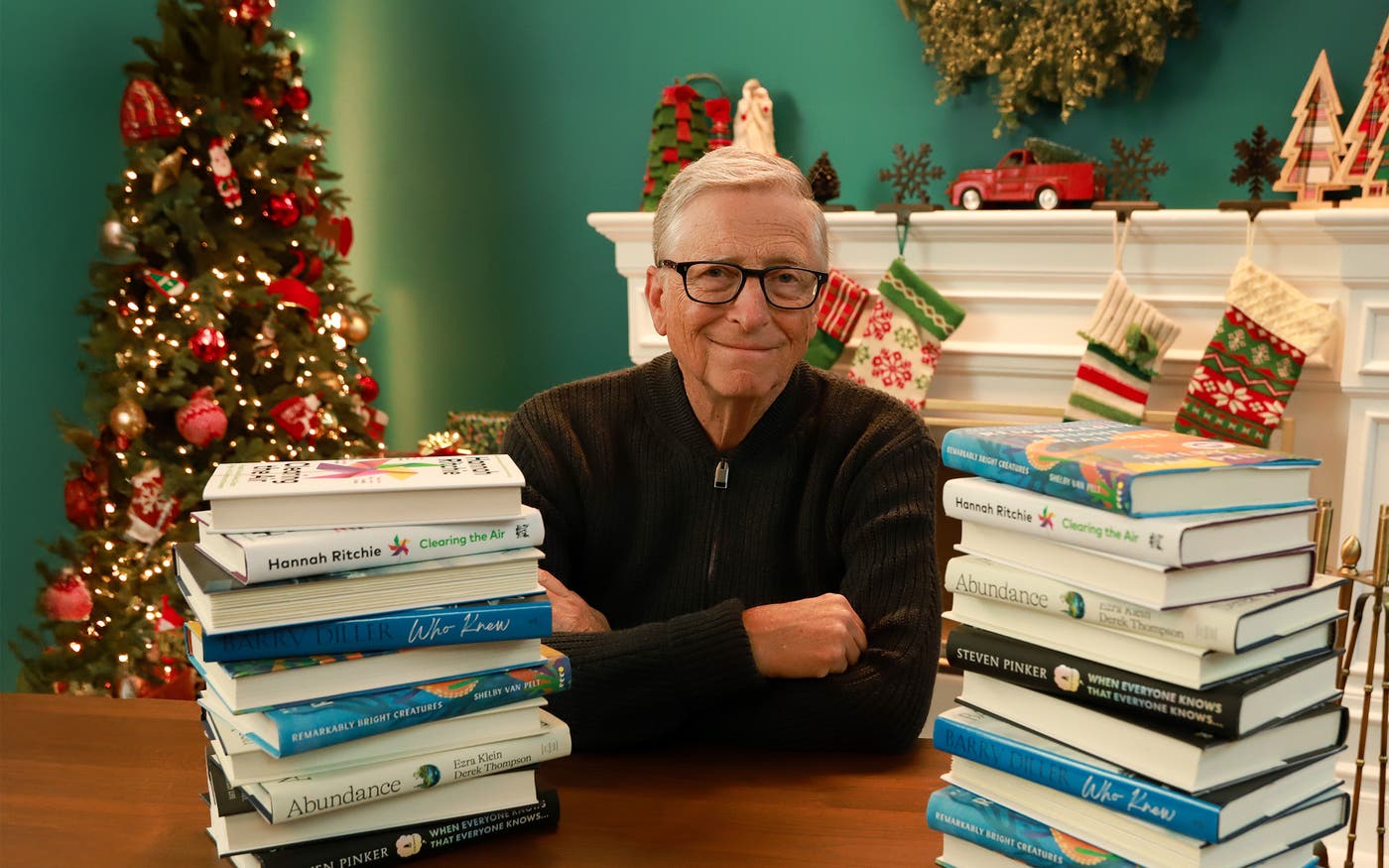
Seasons readings
Five books to read this winter
These were some of my favorite books from 2025.
The holidays are almost here. I always love taking advantage of this time of year to catch up on reading, and I know a lot of people feel the same way. There’s something about the quieter days around the holidays that makes it easier to sit down with a good book. So I’m sharing a few recent favorites.
Each of these books pulls back the curtain on how something important really works: how people find purpose later in life, how we should think about climate change, how creative industries evolve, how humans communicate, and how America lost its capacity to build big things—and how to get it back.
I hope you find something here that sparks your curiosity. And I hope your holiday season is filled with happy loved ones, good food, and great conversation.
Remarkably Bright Creatures by Shelby Van Pelt. I don't read fiction often, but when I do, I want to read about interesting characters who help me see the world in a new way. Remarkably Bright Creatures delivered on that front. I loved this terrific novel about Tova, a 70-year-old woman who works night shifts cleaning an aquarium and finds fulfillment caring for a clever octopus. Tova struggles to find meaning in her life, which is something a lot of people deal with as they get older. Van Pelt's story made me think about the challenge of filling the days after you stop working—and what communities can do to help older people find purpose.
Clearing the Air by Hannah Ritchie. I’ve followed Hannah’s work at Our World in Data for years, and her new book is one of the clearest explanations of the climate challenge I’ve read. She structures it around 50 big questions—like whether it’s too late to act, whether nuclear power is dangerous, and whether renewables really are affordable—and answers each one in concise, accessible language. She’s realistic about the risks but grounded in data that shows real progress: Solar and wind are growing at record speed, electric cars are getting cheaper, and innovation is accelerating across areas like steel, cement, and clean fuels. If you want a hopeful, fact-driven overview of where climate solutions stand, this is a great pick.
Who Knew by Barry Diller. I’ve known Barry for decades, but his memoir still surprised and taught me a lot. He’s one of the most influential figures in modern media. He invented the made-for-TV movie, helped create the TV miniseries, built Paramount into the #1 film studio, launched the Fox broadcast network, and later assembled an internet empire. He’s spent his life betting on ideas before they were obvious, and the industries he’s transformed show how much those bets can pay off.
When Everyone Knows That Everyone Knows by Steven Pinker. Few people explain the mysteries of human behavior better than Steven Pinker, and his latest book is a must-read for anyone who wants to learn more about how people communicate. When Everyone Knows That Everyone Knows shows how “common knowledge” lets people coordinate: When we know what others know, indirect signals become clear. Although the topic itself is pretty complicated, the book is readable and practical, and it made me see everyday social interactions in a new light.
Abundance by Ezra Klein and Derek Thompson. This book is a sharp look at why America seems to struggle to build things and what it will take to fix that. Klein and Thompson argue that progress depends not just on good ideas but on the systems that help ideas spread. Today, these systems often slow things down instead—from housing and infrastructure to clean energy and scientific breakthroughs. I recognized many of the bottlenecks they describe from my own work in global health and climate. Abundance doesn’t pretend to have all the answers, but it asks the right questions about how the U.S. can rebuild our capacity to get big things done.

Deck the shelves
Books to keep you warm this holiday season
Each book on my list is about making sense of the world around you.
Happy holidays! I hope you and your loved ones are enjoying the coziest time of year—and that you are able to find time to enjoy some good books in between spending time with family.
If you’re in the market for something new to read, I have put together a list of four books I enjoyed this year. All four are, in one way or another, about making sense of the world around you. This wasn’t an intentional theme, but I wasn’t surprised to see it emerge: It’s natural to try and wrap your head around things during times of rapid change, like we’re living through now.
Two of the books on my list focus on the future and how the rise of artificial intelligence and huge technological advances are changing the ways we live, learn, and love. One looks to the past for answers—the lessons it offers about how leaders have tackled tough times before are both comforting and fascinating. And the fourth book on my list is all about the present. It will help you appreciate the amazing, invisible backbone of society that surrounds us every day.
I’ve also thrown in one bonus pick, just in case you are looking for a gift for a tennis lover in your life. You can never have enough books, especially this time of year!
An Unfinished Love Story, by Doris Kearns Goodwin. I’m a huge fan of Doris’s books, but I didn’t know a lot about her personal life until I read her new autobiography. The book focuses on her life with her late husband, who served as a policy expert and speechwriter to Presidents Kennedy and Johnson during one of the most turbulent times in recent U.S. history. Doris is such a talented writer that the chapters about her love story are just as engaging and enlightening as the chapters about the Kennedy assassination and the Vietnam War.
The Anxious Generation, by Jonathan Haidt. This book is a must-read for anyone raising, working with, or teaching young people today. It made me reflect on how much of my younger years—which were often spent running around outside without parental supervision, sometimes getting into trouble—helped shape who I am today. Haidt explains how the shift from play-based childhoods to phone-based childhoods is transforming how kids develop and process emotions. I appreciate that he doesn’t just lay out the problem—he offers real solutions that are worth considering.
Engineering in Plain Sight, by Grady Hillhouse. Have you ever looked at an unusual pipe sticking out of the ground and thought, “What the hell is that?” If so, this is the perfect book for you. Hillhouse takes all of the mysterious structures we see every day, from cable boxes to transformers to cell phone towers, and explains what they are and how they work. It’s the kind of read that will reward your curiosity and answer questions you didn’t even know you had.
The Coming Wave, by Mustafa Suleyman. Mustafa has a deep understanding of scientific history, and he offers the best explanation I’ve seen yet of how artificial intelligence—along with other scientific advances, like gene editing—is poised to reshape every aspect of society. He lays out the risks we need to prepare for and the challenges we need to overcome so we can reap the benefits of these technologies without the dangers. If you want to understand the rise of AI, this is the best book to read.
A bonus read: Federer, by Doris Henkel. This book isn’t for everyone. It’s pretty expensive, and it weighs as much as a small dog. But if you—or someone you love—is a fan of Roger’s, Federer is a wonderful retrospective of his life and career. I thought I knew pretty much everything about Roger’s history with tennis, but I learned a ton, especially about his early years. It includes a lot of photographs I’d never seen before. This is a special treat for the tennis fan in your life.
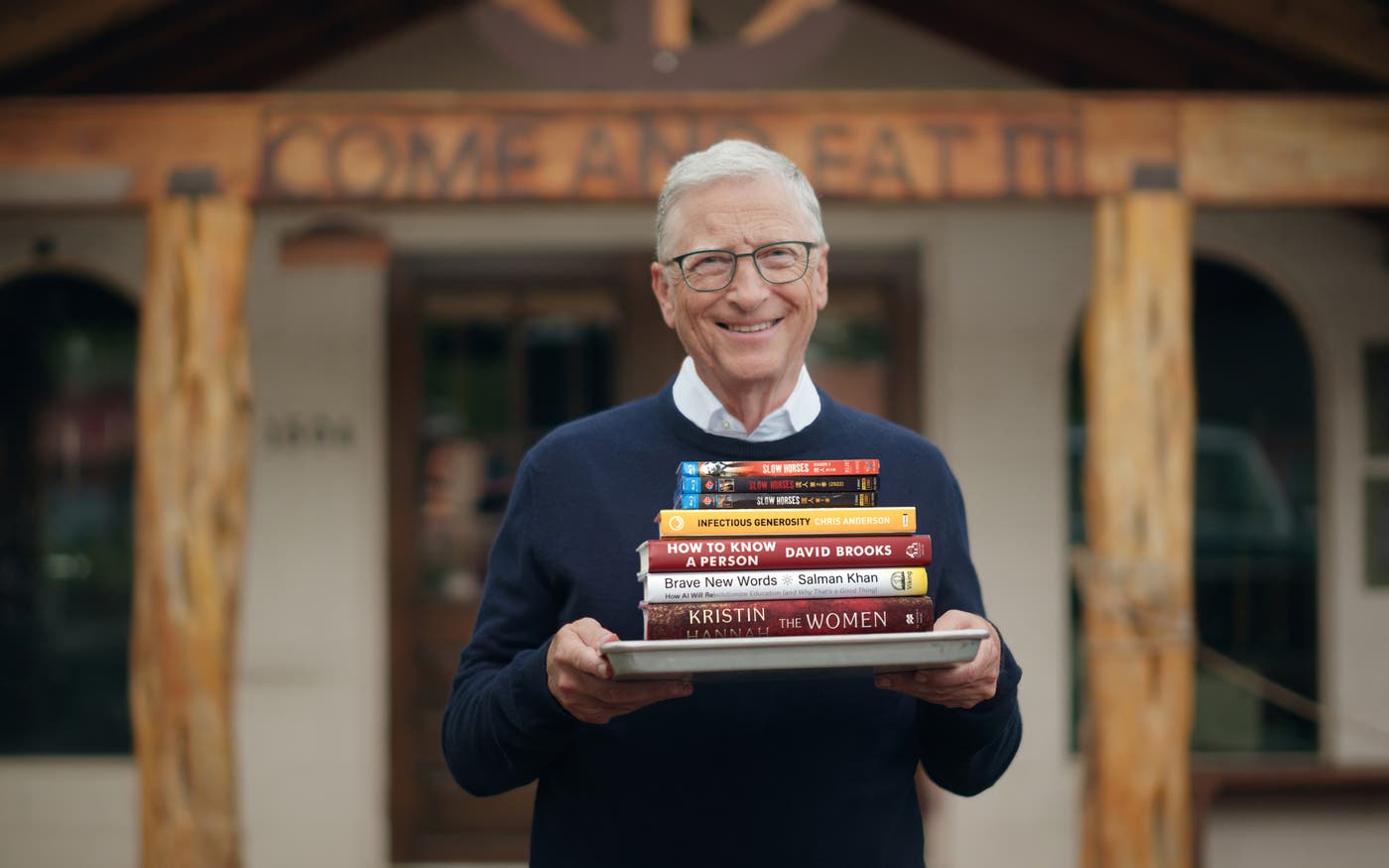
In service
5 great things to read or watch this summer
I found an unintentional theme connecting them all.
When I finish one book and decide what to read next, there’s rarely a logical connection between the two. I might get to the end of a history book on the Civil War and then pick up a sci-fi novel set in the distant future. The same goes for shows and movies: I gravitate toward whatever sounds most interesting at the moment.
But when I put together a list of recommendations, it’s fun to look back and see if there’s a thread that runs through them. This time, there definitely is.
The books and TV series on my summer list all touch on the idea of service to others—why we do it, the things that can make it difficult, and why we should do it anyway. One is a novel about the sacrifices made by American nurses on the front lines of the Vietnam War. Another is a call for (and a guide to) being more generous in the digital age. Others include a rumination on connecting with other people and a look at the evolution of how schoolteachers support their students. Even the TV series is a fictional show about government agents protecting their country.
I didn’t intend to go deep on the idea of service, but it’s certainly as relevant today as ever. At a time when wars dominate the headlines and our politics is becoming more and more polarized, it’s inspiring to appreciate those who help others and think about how we can be more generous in our own lives.
Here’s my list, with links to longer reviews of each entry. Do you ever look back and discover unexpected themes in the things you’ve read, watched, and listened to?
The Women, by Kristin Hannah. This terrific novel tells the story of a U.S. Army nurse who serves two tours on the frontlines in Vietnam before returning home to a country rocked by protest and anti-war sentiment. The author, Kristin Hannah, has written a number of books that did quite well—including this one—and I can see why. It’s a beautifully written tribute to a group of veterans who deserve more appreciation for the incredible sacrifices they made.
Infectious Generosity, by Chris Anderson. Chris, who has been the curator of TED Talks for more than two decades, explores how the internet can amplify the impact of generosity. He offers a plan for how everyone—including individuals, governments, and businesses—can foster more generosity. It’s not just about giving money; he argues that we need to expand our definition of generosity. If you want to help create a more equitable world but don’t know where to start, Infectious Generosity is for you.
Slow Horses. I’m a sucker for stories about spies. I’ve read several of John le Carré’s novels, and two of my favorite movies are Spy Game and Three Days of the Condor. I’d put Slow Horses up there with the best of them. It’s a British series about undercover agents assigned to Slough House, a fictional group inside MI5 where people are sent when they mess up badly, but not quite badly enough to get fired. Gary Oldman plays the head of Slough House, who’s basically the polar opposite of James Bond. He’s a slob and an alcoholic, but then he surprises you with some amazing bit of spycraft. Like le Carré novels, Slow Horses has enough complex characters and plots that you have to really pay attention, but it pays off in the end. (Available in the U.S. on Apple TV+.)
Brave New Words, by Sal Khan. Sal—the founder of Khan Academy—has been a pioneer in the field of education technology since long before the rise of artificial intelligence. So the vision he lays out in Brave New Words for how AI will improve education is well grounded. Sal argues that AI will radically improve both outcomes for students and the experiences of teachers, and help make sure everyone has access to a world-class education. He’s well aware that innovation has had only a marginal impact in the classroom so far but makes a compelling case that AI will be different. No one has sharper insights into the future of education than Sal does, and I can't recommend Brave New Words enough.
How to Know a Person, by David Brooks. I liked David’s previous book, The Road to Character, but this one is even better. His key premise is one I haven't found elsewhere: that conversational and social skills aren't just innate traits—they can be learned and improved upon. And he provides practical tips for what he calls “loud listening,” a practice that can help the people around you feel heard and valued. It’s more than a guide to better conversations; it’s a blueprint for a more connected and humane way of living.
Read, watch, listen
Great books, courses, and music for the holidays
Some favorites from 2023, including a new playlist.
At the end of the year, it’s always fun to look back on some of the best books I read. For 2023, three came to mind right away, each of them deeply informative and well written. I’ve also included economics courses by a phenomenal lecturer that I watched more than a decade ago but am still recommending to friends and family today. Just for fun, I threw in a playlist of great holiday songs from past and present, and from the U.S. and around the world.
I didn’t have time to write up a full review, but I should mention that I just watched the series All the Light We Cannot See on Netflix. I had read the book, which is amazing, sometimes an adaptation of a book you love can be disappointing. That’s not the case here—the series is just as good. The actor who plays von Rumpel, a Nazi gem hunter and the villain in the story, is especially memorable.
I hope you find something fun here to read, watch, or listen to. And happy holidays!
The Song of the Cell, by Siddhartha Mukherjee. All of us will get sick at some point. All of us will have loved ones who get sick. To understand what’s happening in those moments—and to feel optimistic that things will get better—it helps to know something about cells, the building blocks of life. Mukherjee’s latest book will give you that knowledge. He starts by explaining how life evolved from single-celled organisms, and then he shows how every human illness or consequence of aging comes down to something going wrong with the body’s cells. Mukherjee, who’s both an oncologist and a Pulitzer Prize–winning author, brings all of his skills to bear in this fantastic book.
Not the End of the World, by Hannah Ritchie. Hannah Ritchie used to believe—as many environmental activists do—that she was “living through humanity’s most tragic period.” But when she started looking at the data, she realized that’s not the case. Things are bad, and they’re worse than they were in the distant past, but on virtually every measure, they’re getting better. Ritchie is now lead researcher at Our World in Data, and in Not the End of the World, she uses data to tell a counterintuitive story that contradicts the doomsday scenarios on climate and other environmental topics without glossing over the challenges. Everyone who wants to have an informed conversation about climate change should read this book.
Invention and Innovation, by Vaclav Smil. Are we living in the most innovative era of human history? A lot of people would say so, but Smil argues otherwise. In fact, he writes, the current era shows “unmistakable signs of technical stagnation and slowing advances.” I don’t agree, but that’s not surprising—having read all 44 of his books and spoken with him several times, I know he’s not as optimistic as I am about the prospects of innovation. But even though we don’t see the future the same way, nobody is better than Smil at explaining the past. If you want to know how human ingenuity brought us to this moment in time, I highly recommend Invention and Innovation.
Online economics lectures by Timothy Taylor. I’ve watched a lot of lecture series online, and Taylor is one of my favorite professors. All three of his series on Wondrium are fantastic. The New Global Economy teaches you about the basic economic history of different regions and how markets work. Economics is best suited for people who want to understand the principles of economics in a deep way. Unexpected Economics probably has the broadest audience, because Taylor applies those principles to things in everyday life, including gift-giving, traffic, natural disasters, sports, and more. You can’t go wrong with any of Taylor’s lectures.
A holiday playlist. This one doesn’t need much explanation. I love holiday music and have put together a list of some favorites—classics and modern tunes, from the U.S. and around the world.
Read, watch, and listen
Great books, songs, and shows for the summer
Because there’s more to life than reading. (Though reading is still the best.)
For the past decade, I’ve recommended great books to read each summer. This year, I decided to mix it up and try something different. I’m recommending just two books—one novel and one nonfiction—plus a mix of other things I’ve enjoyed lately, including a TV series set in Denmark and a few dozen songs that are on regular rotation for me. Whatever your summer plans are, I hope you find something here to help you make the most of them.
Books
Tomorrow, and Tomorrow, and Tomorrow, by Gabrielle Zevin. This terrific novel tells the story of two friends who grow up bonding over Super Mario Bros. and then, in college, start making their own games together. I really related to the story—in fact, it reminded me a lot of my relationship with Paul Allen and our work together at Microsoft. Tomorrow was one of the biggest books of last year, and it’s easy to see why. Zevin is a great writer who makes you care deeply about her characters.
Born in Blackness, by Howard French. I’m a student of Africa, but I still learned a lot from this thoughtful, well-researched book. French, a journalist of African descent, challenges the standard Western accounts of the continent’s history. It was far from stateless and primitive when Europeans arrived. In reality, he explains, various African kingdoms had established city-states that rivaled Europe’s in terms of political organization, military power, commerce, art, and exploration. I mean it as a compliment when I say that Born in Blackness left me wanting to know more.
TV
Borgen (available on Netflix in the U.S.). I’ve binged all four seasons of this Danish political drama. Named for the palace in Copenhagen where the Danish government is based, it follows the country’s (fictional) first female prime minister as she navigates a complex political landscape. I’m fascinated by how political coalitions come together and stay together, and I loved watching the PM, Birgitte Nyborg, figure it all out. She’s a principled and talented leader who’s also fallible and sometimes misguided. Borgen is entertaining above all else, but I’ve learned a ton from watching it too.
My summer playlist
Here’s a Spotify playlist with many of my favorite tracks—songs newer and older that have stuck with me over the years. You’ll find everything from Billie Holiday, Nat King Cole, and the Beatles to Vampire Weekend, Adele, and U2.
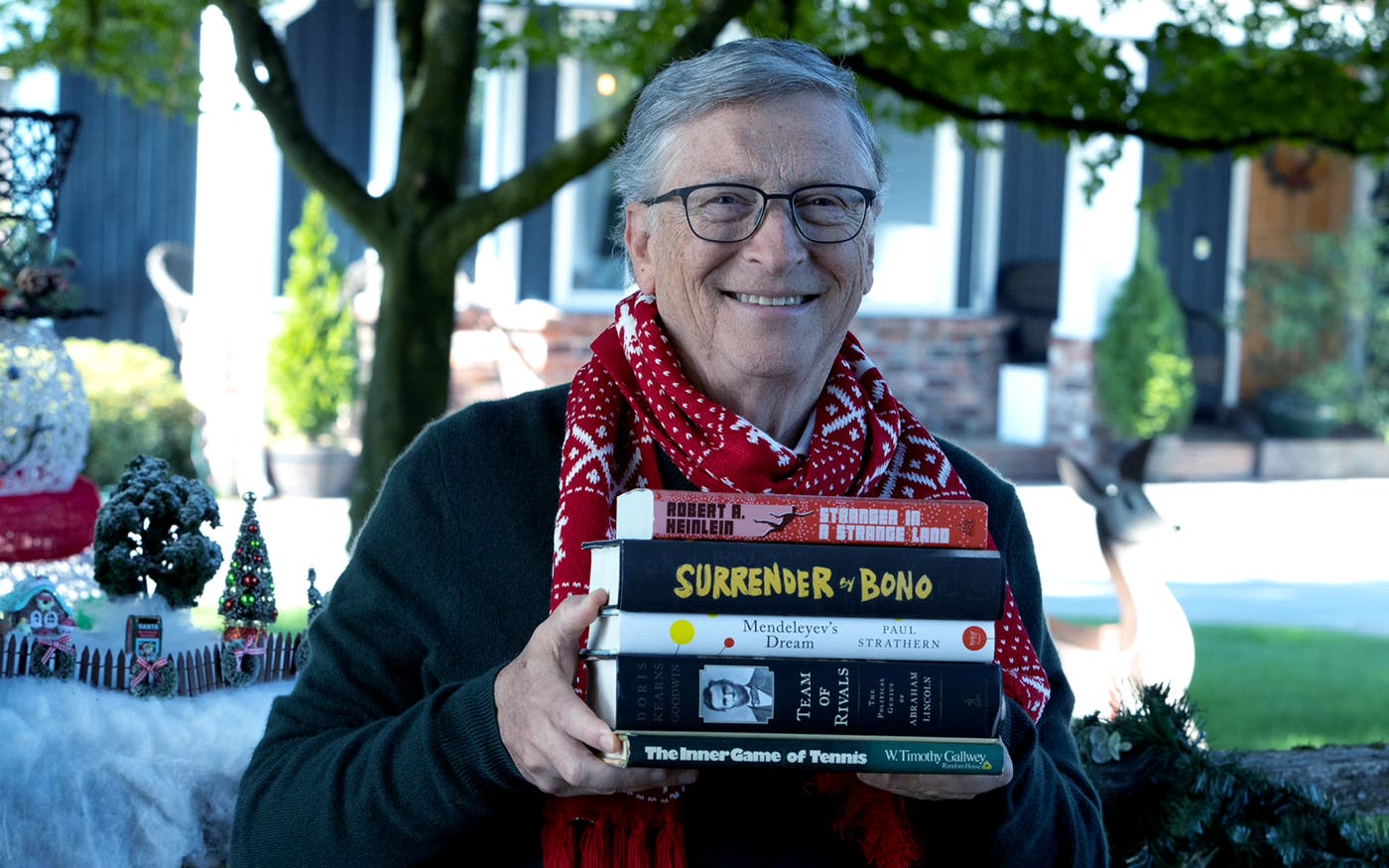
Page turners
5 of my all-time favorite books
I decided to try something different for my list of holiday books this year.
The holidays are a great time for annual traditions. Like many people, I love to spend the end of the year celebrating the holidays with my family. (We usually wear matching pajamas on Christmas.) I also enjoy sitting down to write my annual list of holiday books, which I’ve done around this time of year for the last decade. It’s always a fun opportunity for me to reflect on everything I’ve read recently.
This time, though, I decided to try something different. Rather than limit myself to things I’ve read over the previous twelve months, I instead picked books regardless of when I finished them.
One of the selections has been a favorite of mine since middle school. Another is a brand-new memoir that I just finished. This isn’t a complete list of my favorite books of all time—that list would include a lot more Vaclav Smil and Elizabeth Kolbert. But all five are books that I have recommended to my family and friends over the years.
I hope you find something new to read this winter—and that you and your loved ones enjoy celebrating your favorite traditions together over the holiday season.
Best introduction to grownup sci-fi: Stranger in a Strange Land, by Robert Heinlein. Paul Allen and I fell in love with Heinlein when we were just kids, and this book is still one of my favorite sci-fi novels of all time. It tells the story of a young man who returns to Earth after growing up on Mars and starts a new religion. I think the best science fiction pushes your thinking about what’s possible in the future, and Heinlein managed to predict the rise of hippie culture years before it emerged.
Best memoir by a rock star: Surrender, by Bono. This book came out this month, so it’s the most recent one I’ve read on my list. If you’re a U2 fan, there is a good chance you already plan to check it out. Even if you’re not, it’s a super fun read about how a boy from the suburbs of Dublin grew up to become a world-famous rock star and philanthropist. I’m lucky enough to call Bono a friend, but a lot of the stories he tells in Surrender were new to me.
Best guide to leading a country: Team of Rivals, by Doris Kearns Goodwin. I can’t read enough about Abraham Lincoln, and this is one of the best books on the subject. It feels especially relevant now when our country is once again facing violent insurrection, difficult questions about race, and deep ideological divides. Goodwin is one of America’s best biographers, and Team of Rivals is arguably her masterpiece.
Best guide to getting out of your own way: The Inner Game of Tennis, by Timothy Gallwey. This book from 1974 is a must-read for anyone who plays tennis, but I think even people who have never played will get something out of it. Gallwey argues that your state of mind is just as important—if not more important—than your physical fitness. He gives excellent advice about how to move on constructively from mistakes, which I’ve tried to follow both on and off the court over the years.
Best book about the periodic table: Mendeleyev’s Dream, by Paul Strathern. The history of chemistry is filled with quirky characters like Dimitri Mendeleyev, the Russian scientist who first proposed the periodic table after it allegedly came to him in a dream. Strathern’s book traces that history all the way back to its origins in ancient Greece. It’s a fascinating look at how science develops and how human curiosity has evolved over the millennia.
Now read this
5 great books for the summer
I loved all of them and hope you’ll find something you enjoy too.
As I was putting together my list of suggested reading for the summer, I realized that the topics they cover sound pretty heavy for vacation reading. There are books here about gender equality, political polarization, climate change, and the hard truth that life never goes the way young people think it will. It does not exactly sound like the stuff of beach reads.
But none of the five books below feel heavy (even though, at nearly 600 pages, The Lincoln Highway is literally weighty). Each of the writers—three novelists, a journalist, and a scientist—was able to take a meaty subject and make it compelling without sacrificing any complexity.
I loved all five of these books and hope you find something here you’ll enjoy too. And feel free to share some of your favorite recent reads in the comments section below.
The Power, by Naomi Alderman. I’m glad that I followed my older daughter’s recommendation and read this novel. It cleverly uses a single idea—what if all the women in the world suddenly gained the power to produce deadly electric shocks from their bodies?—to explore gender roles and gender equality. Reading The Power, I gained a stronger and more visceral sense of the abuse and injustice many women experience today. And I expanded my appreciation for the people who work on these issues in the U.S. and around the world.
Why We’re Polarized, by Ezra Klein. I’m generally optimistic about the future, but one thing that dampens my outlook a bit is the increasing polarization in America, especially when it comes to politics. In this insightful book, Klein argues persuasively that the cause of this split is identity—the human instinct to let our group identities guide our decision making. The book is fundamentally about American politics, but it’s also a fascinating look at human psychology.
The Lincoln Highway, by Amor Towles. I put Towles’s A Gentleman in Moscow on my summer books list back in 2019, but I liked this follow-up novel even more. Set in 1954, it’s about two brothers who are trying to drive from Nebraska to California to find their mother; their trip is thrown way off-course by a volatile teenager from the older brother’s past. Towles takes inspiration from famous hero’s journeys and seems to be saying that our personal journeys are never as linear or predictable as we might hope.
The Ministry for the Future, by Kim Stanley Robinson. When I was promoting my book on climate change last year, a number of people told me I should read this novel, because it dramatized many of the issues I had written about. I’m glad I picked it up, because it’s terrific. It’s so complex that it’s hard to summarize, but Robinson presents a stimulating and engaging story, spanning decades and continents, packed with fascinating ideas and people.
How the World Really Works, by Vaclav Smil. Another masterpiece from one of my favorite authors. Unlike most of Vaclav’s books, which read like textbooks and go super-deep on one topic, this one is written for a general audience and gives an overview of the main areas of his expertise. If you want a brief but thorough education in numeric thinking about many of the fundamental forces that shape human life, this is the book to read. It’s a tour de force. Bonus: You can download a free chapter from How the World Really Works on the full review page.
Cover to cover
5 books I loved reading this year
Lately, I’ve found myself drawn to the kinds of books I would’ve liked as a kid.
When I was a kid, I was obsessed with science fiction. Paul Allen and I would spend countless hours discussing Isaac Asimov’s original Foundation trilogy. I read every book by Edgar Rice Burroughs and Robert Heinlein. (The Moon Is a Harsh Mistress was a particular favorite.) There was something so thrilling to me about these stories that pushed the limits of what was possible.
As I got older, I started reading a lot more non-fiction. I was still interested in books that explored the implications of innovation, but it felt more important to learn something about our real world along the way. Lately, though, I’ve found myself drawn back to the kinds of books I would’ve loved as a kid.
My holiday reading list this year includes two terrific science fiction stories. One takes place nearly 12 light-years away from our sun, and the other is set right here in the United States—but both made me think about how people can use technology to respond to challenges. I’ve also included a pair of non-fiction books about cutting-edge science and a novel that made me look at one of history’s most famous figures in a new light.
I read a lot of great books this year—including John Doerr’s latest about climate change—but these were some of my favorites.
A Thousand Brains: A New Theory of Intelligence, by Jeff Hawkins. Few subjects have captured the imaginations of science fiction writers like artificial intelligence. If you’re interested in learning more about what it might take to create a true AI, this book offers a fascinating theory. Hawkins may be best known as the co-inventor of the PalmPilot, but he’s spent decades thinking about the connections between neuroscience and machine learning, and there’s no better introduction to his thinking than this book.
The Code Breaker: Jennifer Doudna, Gene Editing, and the Future of the Human Race, by Walter Isaacson. The CRISPR gene editing system is one of the coolest and perhaps most consequential scientific breakthroughs of the last decade. I’m familiar with it because of my work at the foundation—we’re funding a number of projects that use the technology—but I still learned a lot from this comprehensive and accessible book about its discovery by Nobel Prize-winning biochemist Jennifer Doudna and her colleagues. Isaacson does a good job highlighting the most important ethical questions around gene editing.
Klara and the Sun, by Kazuo Ishiguro. I love a good robot story, and Ishiguro’s novel about an “artificial friend” to a sick young girl is no exception. Although it takes place in a dystopian future, the robots aren’t a force for evil. Instead, they serve as companions to keep people company. This book made me think about what life with super intelligent robots might look like—and whether we’ll treat these kinds of machines as pieces of technology or as something more.
Hamnet, by Maggie O’Farrell. If you’re a Shakespeare fan, you’ll love this moving novel about how his personal life might’ve influenced the writing of one of his most famous plays. O’Farrell has built her story on two facts we know to be true about “The Bard”: his son Hamnet died at the age of 11, and a couple years later, Shakespeare wrote a tragedy called Hamlet. I especially enjoyed reading about his wife, Anne, who is imagined here as an almost supernatural figure.
Project Hail Mary, by Andy Weir. Like most people, I was first introduced to Weir’s writing through The Martian. His latest novel is a wild tale about a high school science teacher who wakes up in a different star system with no memory of how he got there. The rest of the story is all about how he uses science and engineering to save the day. It’s a fun read, and I finished the whole thing in one weekend.
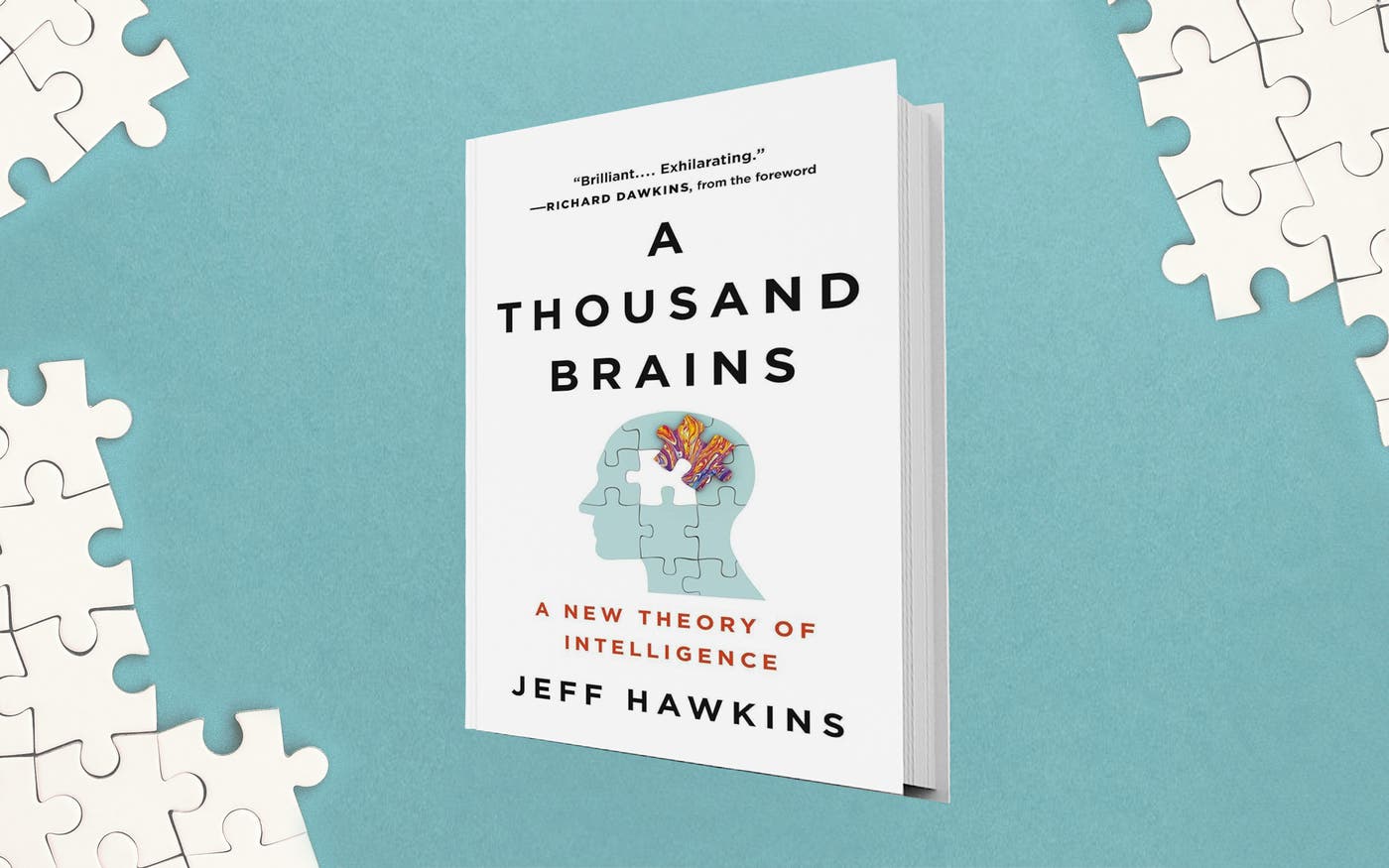
Gray matter matters
Is this how your brain works?
Jeff Hawkins’s book explores a new theory about human intelligence.
Of all the subjects I’ve been learning about lately, one stands out for its mind-boggling complexity: understanding how the cells and connections in our brains give rise to consciousness and our ability to learn.
Thanks to better instruments for observing brain activity, faster genetic sequencing, and other technological improvements, we’ve learned a lot in recent years. For example, we now understand more about the different types of neurons that make up the brain, how neurons communicate with one another, and which neurons are active when we’re performing all kinds of tasks. As a result, many people call this the golden era of neuroscience.
But let’s put this progress in context. We’re only beginning to understand how a worm’s brain works—and it has only 300 neurons, compared with our 86 billion. So you can imagine how far we are from getting answers to the really big, important questions about brain function, including what causes neurodegeneration and how we can block it. Watching helplessly as my dad declined from Alzheimer’s made me feel as if this era is not yet a golden era. I think it’s more like an early dawn.
Over the years, I’ve read quite a few books about the brain, most of them written by academic neuroscientists who view it through the lens of sophisticated lab experiments. Recently, I picked up a brain book that’s much more theoretical. It’s called A Thousand Brains: A New Theory of Intelligence, by a tech entrepreneur named Jeff Hawkins.
I got to know Hawkins in the 1990s, when he was one of the pioneers of mobile computing and co-inventor of the PalmPilot. After his tech career, he decided to work with a singular focus on just one problem: making big improvements in machine learning. His platform for doing that is a Silicon Valley–based company called Numenta, which he founded in 2005.
Machine learning has incredible promise. I believe that in the coming decades we will produce machines that have the kind of broad, flexible “general intelligence” that would enable them to help us address truly complex, multifaceted challenges like improving medicine through a more advanced understanding of how proteins fold. Nothing we call AI today has anything like that kind of intelligence.
As Hawkins puts it, “There is no ‘I’ in AI.” Computers can beat a grandmaster in chess, but they don’t know that chess is a game. Hawkins argues that we can’t achieve artificial general intelligence “by doing more of what we are currently doing.” In his view, understanding much more about the part of the brain called the neocortex is key to developing true general AI, and that’s what this book is about.
A Thousand Brains is appropriate for non-experts who have little background in brain science or computer science. It’s filled with fascinating insights into the architecture of the brain and tantalizing clues about the future of intelligent machines. In the foreword, the legendary evolutionary biologist Richard Dawkins says the book “will turn your mind into a maelstrom of … provocative ideas.” I agree.
Hawkins begins by walking us through the basics of the neocortex, which makes up 70 percent of the human brain. It’s responsible for almost everything we associate with intelligence, such as our ability to speak, create music, and solve complex problems.
Borrowing from the work of neuroscientist Vernon Mountcastle, Hawkins reports that the basic circuit of the neocortex is called a “cortical column,” which is divided into several hundred “minicolumns” with about a hundred individual neurons. He argues that “our quest to understand intelligence boils down to figuring out what a cortical column does and how it does it.”
He believes that the basic function of the cortical column is to make constant predictions about the world as we move through it. “With each movement, the neocortex predicts what the next sensation will be,” Hawkins writes. “If any input doesn’t match with the brain’s prediction … this alerts the neocortex that its model of that part of the world needs to be updated.”
The name of the book comes from Hawkins’s conclusion that cortical columns operate in parallel, each making separate predictions about what the next sensory input will be. In other words, each column functions as its own separate learning machine.
If Hawkins is right that the only viable path to artificial general intelligence is by replicating the workings of the neocortex, that means it’s unlikely that intelligent machines will supplant or subjugate the human race—the kind of thing you see in classic sci-fi movies like The Matrix and The Terminator. That’s because the neocortex operates differently from parts of the brain that evolved much earlier and that drive our primal emotions and instincts.
“Intelligent machines need to have a model of the world and the flexibility of behavior that comes from that model, but they don’t need to have human-like instincts for survival and procreation,” Hawkins writes. In other words, we will eventually be able to create machines that replicate the logical, rational neocortex without having to wrap it around an old brain that’s an “ignorant brute” wired for fear, greed, jealousy, and other human sins. That’s why Hawkins dismisses the notion that humans will lose control of the machines they create.
Unfortunately, we may still need to worry about the dark side of artificial intelligence. Even if intelligent machines replicate only the “new brain” and are not saddled with an “old brain,” some people will still try to use them for bad purposes. Sadly, that is human nature.
In the end, I come back to my starting premise that we’re still early in our understanding of the human brain compared with just about every other part of our world. We don’t know yet whether Hawkins’s Thousand Brains Theory will hold up to experimental scrutiny. And even if it does, we still don’t know how to replicate cortical columns with digital technologies.
All I know for sure is that I’ll be reading a lot more about this topic. My hope is that it will help lead to great breakthroughs in the way we go about solving the world’s hardest problems.
Patterns and Influences
It’s not always a eureka moment
According to this book, some environments foster more innovation than others.
I picked up Steven Johnson’s book, Where Good Ideas Come From: The Natural History of Innovation, with a little bit of skepticism. Lots of books have been written about innovation—what it is, the most innovative companies, how you measure it. The subject can seem a little faddish, but Johnson’s book is quite good at giving examples of how you create environments that can encourage good ideas.
Especially for people in business or education, it’s a worthwhile book. It talks about the institutional structures that facilitate good ideas—how you get lots of people thinking about cutting edge problems, how you put people together in a space where different skill sets and influences can come together, how you make the right kinds of materials available but don’t force a conclusion.
Some books about innovation revolve around the idea that a small number of amazingly smart individuals have had Eureka moments, leading to extraordinary breakthroughs that changed the course of civilization.
But Johnson challenges this view, which I liked: “We have a natural tendency to romanticize breakthrough innovations, imagining momentous ideas transcending their surroundings…But ideas are works of bricolage…We take the ideas we’ve inherited or that we’ve stumbled across, and we jigger them together into some new shape.”
The decision to start Microsoft, for example, wasn’t based on a momentous flash of insight. It was based on incremental developments in a nascent personal computing industry, the fact that Paul Allen and I had access to mainframe computers at the high school we attended, and our hunch about what people could do with computers in the future.
At the foundation, our work in global health, development, and education builds on the great ideas that others have developed over the years in a wide range of fields—global health, international development, agriculture, engineering, scientific research, and public policy.
Johnson focuses on the elements of our cultural environment that foster an atmosphere of innovation, and the recurring patterns that often are at play in bringing great ideas to fruition. He believes that urban environments and technology are potent fertilizers of discovery and invention, and that the connections between people and their ideas are the underlying seed beds of innovation.
The author identifies a number of conditions, or patterns, that enable innovation. One is the “adjacent possible,” a theory first articulated by American scientist Stuart Kauffman. It’s the idea that what is achievable today is defined by the various combinations of events and activities that have occurred prior.
For example, in the 1870s, a French doctor, Stephane Tarnier, saw incubators for chicken hatchlings at the Paris Zoo and hired the zoo’s poultry-raiser to build incubator boxes for premature newborns at his hospital. Other hospitals at the time were using devices to keep babies warm, but Tarnier was the first to conduct research showing how incubators significantly reduced the infant mortality rate, leading to their widespread use in Paris and beyond.
Earlier in the 19th century, a British inventor, Charles Babbage, tinkered with two ideas—a Difference Engine to calculate polynomial functions, and an Analytical Engine, which would have been the world’s first programmable computer. Neither machine was built at the time, but many of the ideas underlying the Difference Engine took hold fairly quickly, leading to the mass production of mechanical calculators. Although the Analytical Engine was a brilliant idea that included many of the key concepts in today’s computers, it was, Johnson suggests, beyond the adjacent possible of the day. Babbage’s design would have required a huge number of mechanical gears and switches, which probably would have made the machine too slow to operate effectively. It took another 100 years for researchers to independently rediscover Babbage’s ideas and apply them using newer technology—vacuum tubes and eventually integrated circuits.
A more recent example of the adjacent possible, Johnson says, is YouTube. If it had been launched 10 years earlier, it would have failed because most people connecting to the Internet were still on slow dial-up connections that could not have handled video sharing. But by the time YouTube launched, many more people had high-speed Internet connections.
Johnson also talks about the importance of “liquid networks” that are flexible enough to facilitate dynamic connections between good ideas, but structured enough to support and hold them. I’m familiar with one of the examples he cites, Building 99 on the Microsoft campus which houses Microsoft Research. To optimize collaboration and creativity, Building 99 was designed so rooms could be easily reconfigured to provide flexible work and meeting spaces. Lots of the walls are covered with whiteboards that allow scientists to gather informally to sketch out ideas whenever inspiration hits. This may not seem revolutionary, but it’s amazing what happens when you open up work spaces in this way versus traditional office cubicles.
A third pattern that Johnson explores is “the slow hunch.” It took Joseph Priestley, an 18th century scientist, 20 years to conclude that plants create oxygen. (Priestly first had an inkling when, as a child, the spiders he trapped in glass jars died.) The core pieces of Charles Darwin’s theory of natural selection were articulated in his notebooks more than a year before he seemed to fully grasp their significance and published them. I’ve seen this many times at Microsoft and at the foundation. People start with an idea and over time it evolves and becomes clearer.
Serendipity (or what Johnson calls “happy accidents”) accounts for other breakthroughs. He includes dreams, contemplative walks, long showers, and carving out time to read a variety of books and papers that might lead to “serendipitous collisions” of ideas. He mentions the Think Week breaks I’ve taken for many years, where I immerse myself in books and papers that people send me. We expanded who participates in Think Week a few years ago at Microsoft to include the top 50 engineering thinkers. It has definitely led to an exciting exchange of ideas and inspirations that would not otherwise have occurred.
I don’t have space here to cover the other patterns that Johnson talks about, but you can read about them in his book. You can also watch a video of Johnson discussing them at a 2010 TED speech.
All of us have great ideas from time to time. The challenge is how to put more of them into action to help solve the world’s biggest problems. Writers like Johnson remind us that good ideas are most often the result of people building on other’s ideas—either individually or together—and having a fertile environment in which they can prosper.

Sea change
My favorite book on AI
The Coming Wave is a clear-eyed view of the extraordinary opportunities and genuine risks ahead.
When people ask me about artificial intelligence, their questions often boil down to this: What should I be worried about, and how worried should I be? For the past year, I've responded by telling them to read The Coming Wave by Mustafa Suleyman. It’s the book I recommend more than any other on AI—to heads of state, business leaders, and anyone else who asks—because it offers something rare: a clear-eyed view of both the extraordinary opportunities and genuine risks ahead.
The author, Mustafa Suleyman, brings a unique perspective to the topic. After helping build DeepMind from a small startup into one of the most important AI companies of the past decade, he went on to found Inflection AI and now leads Microsoft’s AI division. But what makes this book special isn’t just Mustafa’s firsthand experience—it’s his deep understanding of scientific history and how technological revolutions unfold. He's a serious intellectual who can draw meaningful parallels across centuries of scientific advancement.
Most of the coverage of The Coming Wave has focused on what it has to say about artificial intelligence—which makes sense, given that it's one of the most important books on AI ever written. And there is probably no one as qualified as Mustafa to write it. He was there in 2016 when DeepMind’s AlphaGo beat the world’s top players of Go, a game far more complex than chess with 2,500 years of strategic thinking behind it, by making moves no one had ever thought of. In doing so, the AI-based computer program showed that machines could beat humans at our own game—literally—and gave Mustafa an early glimpse of what was coming.
But what sets his book apart from others is Mustafa’s insight that AI is only one part of an unprecedented convergence of scientific breakthroughs. Gene editing, DNA synthesis, and other advances in biotechnology are racing forward in parallel. As the title suggests, these changes are building like a wave far out at sea—invisible to many but gathering force. Each would be game-changing on its own; together, they’re poised to reshape every aspect of society.
The historian Yuval Noah Harari has argued that humans should figure out how to work together and establish trust before developing advanced AI. In theory, I agree. If I had a magic button that could slow this whole thing down for 30 or 40 years while humanity figures out trust and common goals, I might press it. But that button doesn’t exist. These technologies will be created regardless of what any individual or company does.
As is, progress is already accelerating as costs plummet and computing power grows. Then there are the incentives for profit and power that are driving development. Countries compete with countries, companies compete with companies, and individuals compete for glory and leadership. These forces make technological advancement essentially unstoppable—and they also make it harder to control.
In my conversations about AI, I often highlight three main risks we need to consider. First is the rapid pace of economic disruption. AI could fundamentally transform the nature of work itself and affect jobs across most industries, including white-collar roles that have traditionally been safe from automation. Second is the control problem, or the difficulty of ensuring that AI systems remain aligned with human values and interests as they become more advanced. The third risk is that when a bad actor has access to AI, they become more powerful—and more capable of conducting cyber-attacks, creating biological weapons, even compromising national security.
This last risk—of empowering bad actors—is what leads to the biggest challenge of our time: containment. How do we limit the dangers of these technologies while harnessing their benefits? This is the question at the heart of The Coming Wave, because containment is foundational to everything else. Without it, the risks of AI and biotechnology become even more acute. By solving for it first, we create the stability and trust needed to tackle everything else.
Of course, that’s easier said than done.
While previous transformative technologies like nuclear weapons could be contained through physical security and strict access controls, AI and biotech present a fundamentally different challenge. They're increasingly accessible and affordable, their development is nearly impossible to detect or monitor, and they can be used behind closed doors with minimal infrastructure. Outlawing them would mean the good guys unilaterally disarm while bad actors forge ahead anyway. And it would hurt everyone because these technologies are inherently dual-use. The same tools that could be used to create biological weapons could also cure diseases; the same AI that could be used for cyber-attacks could also strengthen cyber defense.
So how do we achieve containment in this new reality? It’s hardly fair to complain that Mustafa hasn’t single-handedly solved one of the most complex problems humanity has ever faced. Still, he lays out an agenda that’s appropriately ambitious for the scale of the challenge—ranging from technical solutions (like building an emergency off switch for AI systems) to sweeping institutional changes, including new global treaties, modernized regulatory frameworks, and historic cooperation among governments, companies, and scientists. When you finish his list of recommendations, you might wonder if we can really accomplish all this in time. But that’s precisely why this book is so important: It helps us understand the urgency while there’s still time to act.
I’ve always been an optimist, and reading The Coming Wave hasn’t changed that. I firmly believe that advances in AI and biotech could help make breakthrough treatments for deadly diseases, innovative solutions for climate change, and high-quality education for everyone a reality. But true optimism isn’t about blind faith. It’s about seeing both the upsides and the risks, then working to shape the outcomes for the better.
Whether you’re a tech enthusiast, a policymaker, or someone simply trying to understand where the world is heading, you should read this book. It won’t give you easy answers, but it will help you ask the right questions—and leave you better prepared to ride the coming wave, instead of getting swept away by it.
Bad but better
Why I want to stop talking about the “developing” world
Factfulness is one of the most educational books I’ve ever read.
I talk about the developed and developing world all the time, but I shouldn’t.
My late friend Hans Rosling called the labels “outdated” and “meaningless.” Any categorization that lumps together China and the Democratic Republic of Congo is too broad to be useful. But I’ve continued to use “developed” and “developing” in public (and on this blog) because there wasn’t a more accurate, easily understandable alternative—until now.
I recently read Hans’ new book Factfulness: Ten Reasons We're Wrong About the World—and Why Things Are Better Than You Think. In it, he offers a new framework for how to think about the world. Hans proposes four income groups:
- Level 1: One billion people live on level 1. This is what we think of as extreme poverty. If you’re on level 1, you survive on less than $2 a day and get around by walking barefoot. Your food is cooked over an open fire, and you spend most of your day traveling to fetch water. At night, you and your children sleep on a dirt floor.
- Level 2: Three billion people live on level 2, between $2 and $8 a day. Level 2 means that you can buy shoes and maybe a bike, so it doesn’t take so long to get water. Your kids go to school instead of working all day. Dinner is made over a gas stove, and your family sleeps on mattresses instead of the floor.
- Level 3: Two billion people live on level 3, between $8 and $32 a day. You have running water and a fridge in your home. You can also afford a motorbike to make getting around easier. Some of your kids start (and even finish) high school.
- Level 4: One billion people live on level 4. If you spend more than $32 a day, you’re on level 4. You have at least a high school education and can probably afford to buy a car and take a vacation once in a while.
This was a breakthrough to me. The framework Hans enunciates is one that took me decades of working in global development to create for myself, and I could have never expressed it in such a clear way. I’m going to try to use this model moving forward.
Why does it matter? It’s hard to pick up on progress if you divide the world into rich countries and poor countries. When those are the only two options, you’re more likely to think anyone who doesn’t have a certain quality of life is “poor.”
Hans compares this instinct to standing on top of a skyscraper and looking down at a city. All of the other buildings will look short to you whether they’re ten stories or 50 stories high. It’s the same with income. Life is significantly better for those on level 2 than level 1, but it’s hard to see that from level 4 unless you know to look for it.
The four levels are just one of many insights in Factfulness that will help you better understand the world. I’m excited that Hans’ publisher Flatiron Books plans to donate 5,000 copies to Books for Africa and Reader to Reader—two organizations that encourage reading in underserved communities. Hans worked on the book until his last days (even bringing several chapters with him in the ambulance to the hospital), and his son Ola and daughter-in-law Anna helped finish it after he passed.
The bulk of the book is devoted to ten instincts that keep us from seeing the world factfully. These range from the fear instinct (we pay more attention to scary things) to the size instinct (standalone numbers often look more impressive than they really are) to the gap instinct (most people fall between two extremes). With each one, he offers practical advice about how to overcome our innate biases. Gates Notes Insiders can get a free preview of the gap instinct chapter here:
Hans argues that these instincts make it difficult to put events in perspective. Imagine news coverage about a natural disaster—say, a tornado that kills 10 people in a small town. If you look at only the headlines, you’ll view the event as an unbearable tragedy (which it is). But if you put it in the context of history, you’ll also know that tornadoes today are a lot less deadly than they used to be, thanks to advanced warning systems. That’s no consolation to the loved ones of those who died, but it matters a great deal to everyone who survived the tornado.
In other words, the world can be both bad and better. That idea drives the work Melinda and I do every day, and Hans articulates it beautifully in Factfulness. It’s a great companion to Steven Pinker’s Enlightenment Now (although Hans is a little less academic than Pinker is). With rare exceptions, most of the miracles of humankind are long-term, constructed things. Progress comes bit by bit. We’ve cut the number of people living in extreme poverty by half over the last twenty years, but there was never a morning when “POVERTY RATES DROP INCREMENTALLY” dominated newspaper headlines.
Another remarkable thing about Factfulness—and about Hans himself—is that he refuses to judge anyone for their misconceptions. Most writers would beat people up for their ignorance, but he doesn’t. Hans even resists going after the media. Instead, he tells you about the history of his own ignorance. He explains that these instincts make us human, and that overcoming them isn’t easy.
That’s classic Hans. He was always kind, often patient, and never judgmental. He spent his life not only understanding how global health was improving but sharing what he learned in a fun, clear way with a broad set of people. If you never met Hans or watched one of his many TED talks, Factfulness will help you get a sense of why he was so special. I wish I could tell Hans how much I liked it. Factfulness is a fantastic book, and I hope a lot of people read it.
Positive Outcomes
Learning from a less violent present
Cognitive scientist Steven Pinker shows just how violence is declining.
People often ask me what is the best book I’ve read in the last year. Steven Pinker’s The Better Angels of Our Nature: Why Violence Has Declined stands out as one of the most important books I’ve read—not just this year, but ever.
The book is about violence, but paints a remarkable picture that shows the world has evolved over time to be a far less violent place than before. It offers a really fresh perspective on how to achieve positive outcomes in the world.
Pinker presents a tremendous amount of evidence that humans have gradually become much less violent and much more humane. The trend started thousands of years ago and has continued to this day. As I’m someone who’s fairly optimistic in general, the book struck a chord with me and got me to thinking about some of our foundation’s strategies.
I’m a dogged advocate for innovations that have brought us longer life spans, better nutrition and more freedom. But I’m also concerned about the things innovation can’t always change, like how we look at justice and violence. Is there a positive trend there, and if so, what are the lessons? How can we make sure the trend continues? How can we broaden it—and maybe even speed it up?
Many people are surprised to hear that we live in a far less violent time, because you see and read about tons of violence in the news. But Pinker argues convincingly that it’s our awareness and sensitivity to violence that have increased, not violence itself, which is way down.
For example, when archaeologists dig in ancient gravesites, they find that a lot of the people there were clearly murdered, their skulls cracked open before they died. Pinker thoroughly debunks the romantic idea that ancient humans lived in harmony with nature and each other. It’s an overly rosy view of the past and a view that ignores much of the progress we have made.
We began moving away from violence when we first settled down into stable agricultural communities, Pinker writes. After the Enlightenment, governments themselves became less violent, eliminating cruel punishments and other things that infringed on citizen’s rights. And in the two thirds of a century since World War II, nations have become less war-like, especially as the idea of universal human rights has taken hold.
It seems to me that higher rates of violence in some poor countries may have to do with the fact that governance has lagged behind. These are young countries, most of them, and some of their national governments haven’t yet fully established the rule of law and protection for human rights.
Before I picked up The Better Angels of Our Nature, I assumed that most murders were motivated by economic gain. In fact, only about 15 percent of U.S. homicides involve robbery or other economic factors. The perpetrator is usually driven by a sense of injustice or desire for revenge, and he doesn’t trust institutions to mete out punishment.
Also before I read this book, I always thought of honor as a good thing. I can remember my mom impressing on us kids that maintaining your honor by not lying and living right was important. But Pinker makes a case that honor is often a dangerous concept. It used to lead noblemen to kill each other in duels. It can lead to violent feuds, like between the Hatfields and McCoys in the Appalachians in the late 19th century. And some societies still have this notion of honor killing.
Pinker isn’t saying that peace, justice and nonviolence are inevitable. He acknowledges that modern technologies have really expanded how lethal wars can be. Things can go very wrong, but Pinker is saying the arc of history is toward less violence, and we should understand that and tap into it.
His ideas could be very helpful in different countries as a guide to how to build more peaceful societies, which is not just about economics. Some African countries, which still have high murder rates, might find ways to move faster toward the levels of developed countries. The Better Angels of Our Nature explains some ideas that I think should be widely understood, like the idea that the basis for morality—and the continued decline of violence—lies in empathy, strengthened by rules, codes and laws.
It’s a big book, more than 700 pages, and I wish that the summary chapter was available separately as an article, because many people could benefit from it who might be scared off by a book this long. As a guy who is pretty rigorous about how he spends his time, I think this book is completely worth the time to read it.
I would put “Better Angels” on the same scale as Big History, David Christian’s ambitious project to create a framework for how human history was influenced and shaped by everything around it.
For me, what’s most important about The Better Angels of Our Nature are its insights into how to help achieve positive outcomes. How can we encourage a less violent, more just society, particularly for the poor? Steven Pinker shows us ways we can make those positive trajectories a little more likely. That’s a contribution, not just to historical scholarship, but to the world.
Infinite Genius
A literary master serves up a winner
I loved this book on tennis as much for the writing as its insights into my favorite sport.
When it comes to books, it’s pretty rare that I get intimidated. I read all kinds of books, including ones that only the harshest college professors would assign. And yet I must admit that for many years I steered clear of anything by David Foster Wallace. I often heard super literate friends talking in glowing terms about his books and essays. I even put a copy of his tour de force Infinite Jest on my nightstand at one point, but I just never got around to reading it.
I’m happy to report that has now changed. It started last year when I watched “The End of the Tour,” a great movie with Jason Segel and Jesse Eisenberg that takes place when Wallace was on the road somewhat reluctantly promoting Infinite Jest. The movie made Wallace seem so damn interesting, and it really humanized him for me. In addition to shedding light on the nature of his literary genius, it also foreshadows the depression that led him to commit suicide in 2008. Recently, I also watched an amazing video of Wallace’s famous 2005 commencement speech at Kenyon College. It is one of the most moving speeches I’ve heard in a long time.
Then this past May, Library of America came out with String Theory, a short volume of Wallace’s essays on tennis. The book gave me the perfect opportunity to give Wallace a try, because I really enjoy tennis. I gave up tennis when I got fanatical about Microsoft. (During those intense years, my only exercise was running around the office and jumping up and down.) I’m now back on the court at least once a week and have built a pretty solid game for a 61-year old who can’t hit a lot of winners from the baseline.
I would say to anyone who likes tennis as much as I do, you have to read String Theory. You’ll take away insights that go way beyond what you get by reading the typical article in a tennis magazine or listening to a color commentator on TV. In this respect, the book reminded me of John McPhee’s classic Levels of the Game, about Arthur Ashe’s 1968 U.S. Open victory, and The Blind Side, Michael Lewis’s brilliant book about the evolution of the game of football.
Wallace is insightful about the sport partly because he was a very good junior player when he was growing up in the late ’70s, using his brilliant math mind to understand and play all the angles on the court. His personal experience gave him a lasting appreciation for the physical and mental gifts you need to be truly great.
As much as I loved the book for its insights on the game, I loved it just as much for the writing itself. I now understand why people talk about David Foster Wallace with the same kind of awe that tennis fans use to talk about a Roger Federer or Serena Williams. Wallace’s ability to use language is mind-blowing. He’s an artist who approaches a canvas with the exact same oil paints everyone before him has used and then applies them in breathtaking new and creative ways.
The first thing you have to get used to with Wallace is his non-linear expository style. You just have no idea where Wallace’s mind or story will go next, like a great tennis player who never telegraphs a shot. An essay that starts out describing his childhood tennis competitions in Illinois will flow into fascinating eddies on calculus, geometry, meteorology, and engineering. Fortunately, almost all of his narrative digressions are both fascinating and surprisingly easy to follow, even when Wallace uses lots of footnotes. (Even some of the footnotes have footnotes!)
When I was putting off reading Wallace, I assumed his writing would be pretentious. I was wrong. Yes, there are lots of words you’ll have to look up online. But even with all the SAT words, Wallace just doesn’t sound like he’s trying to prove he went to a fancy college. For every reference to Aquinas or Wagner, there’s a reference to Beavis or Danny DeVito.
I came away with the sense that Wallace felt compelled to bend language like a metal spoon not to show off his supernatural ability but simply to allow him to capture all the keen observations his mind was constantly making. It’s almost impossible to illustrate this idea with a single passage of his writing—so I encourage you to pick up String Theory or one of his other books and see for yourself. But I can give you at least a hint of what I’m talking about. Here’s a passage from a review of Tracy Austin’s memoir, which was less about the book than about our unrealistic expectations of our sports heroes:
Real indisputable genius is so impossible to define, and true technē so rarely visible (much less televisable), that maybe we automatically expect people who are geniuses as athletes to be geniuses also as speakers and writers, to be articulate, perceptive, truthful, profound. If it’s just that we naively expect geniuses-in-motion to be also geniuses-in-reflection, then their failure to be that shouldn’t really seem any crueler or more disillusioning than Kant’s glass jaw or Eliot’s inability to hit the curve.
With the fancy words, English-major allusions, and winding sentences, it’s the opposite of the elegantly simple language of Hemingway. But it’s no less articulate, perceptive, truthful, or profound. That’s why I’m now on a big Wallace kick. I still haven’t read Infinite Jest, at a whopping 1,079 pages, but I know I’ll get to it. Because this troubled genius, who died way too young, was the real deal.
Road trip
A novel about going west in a Studebaker
I loved the latest from the author of A Gentleman in Moscow.
Whenever I choose a novel and put it in my canvas book bag, I optimize for great storytelling—almost regardless of the topic. One of my new favorite storytellers is the writer Amor Towles. In 2019, I reviewed his book A Gentleman in Moscow, which was fantastic. So it was a no-brainer to pick up his next novel, The Lincoln Highway, when it came out last October.
Once again, I was wowed by Towles’s writing—especially because The Lincoln Highway is so different from A Gentleman in Moscow in terms of setting, plot, and themes. Towles is not a one-trick pony. Like all the best storytellers, he has range.
The title of this latest book refers to America’s first cross-country roadway for automobiles, which stretched from New York City to San Francisco. The story takes place over ten days in 1954, when two young brothers, Emmett and Billy, intend to drive their Studebaker from Nebraska to California. (I could picture the car clearly—my dad had one too.) But fate, in the form of a sympathetic but volatile character named Duchess, forces them to travel in the opposite direction before they can have a chance to start fresh in the West.
Towles takes inspiration from famous hero’s journeys, including The Iliad, The Odyssey, Hamlet, Huckleberry Finn, and Of Mice and Men. He seems to be saying that our personal journeys are never as linear or predictable as an interstate highway. But, he suggests, when something (or someone) tries to steer us off course, it is possible to take the wheel.
My favorite character is Billy, an eight-year-old who has endured abandonment by his mother and the death of his father. At the beginning of the story, when Billy’s brother, Emmett, returns home after 15 months of juvenile detention, Billy comes across as a sweet but hapless dreamer who has survived by escaping into adventure stories. By the end of Billy and Emmett’s journey east, it’s clear that Billy is anything but a tragic figure. He is amazingly clever and resilient. In that way, he reminds me of Nina, the precocious nine-year-old from A Gentleman in Moscow.
Emmett also seems like a tragic character early on. He has the tragic flaw of anger: His juvenile detention was the result of punching (and inadvertently killing) a bully who was taunting him. But Emmett finds ways to overcome his temper.
Another hero is Sally, a young neighbor who cares deeply for both Billy and Emmett. I think she represents a type of kindness that’s been almost non-existent for Billy or Emmett. Sally turns out to be a bold and wise character—she bristles at the strictures placed on women in 1950s America and has what it takes to overcome them. We don’t know if she and Emmett fall in love; Towles doesn’t give his story such a tidy narrative. But I suspect most readers will hope they end up that way.
I definitely finished Lincoln Highway hoping that Towles is busy writing his next novel. It almost doesn’t matter what time or place he decides to write about. I just know I’ll want to read it.
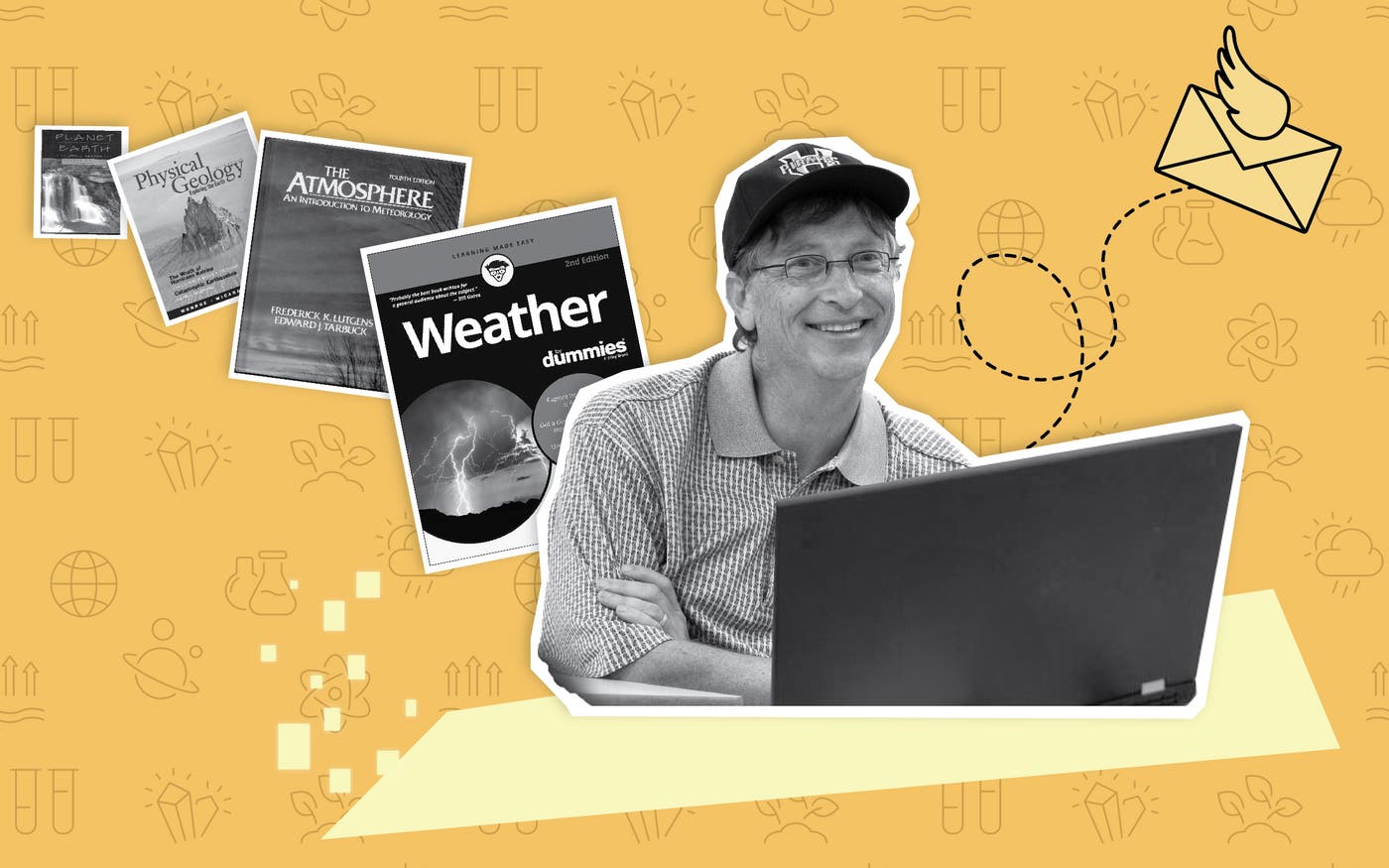
In the archive
An email from my younger self
In 2008, I wanted a bunch of science textbooks. Not much has changed since then.
Recently I was telling a friend about Weather for Dummies. This was not unusual—it’s actually one of the first books I recommend to anyone who wants to understand the weather and how it’s affected by climate change.
After that conversation, I started wondering when I got my own copy of Weather for Dummies. I searched through old emails and was amazed to learn that it was more than 14 years ago!
In the fall of 2008, I had transitioned from being full-time at Microsoft to full-time at the Gates Foundation. After decades of focusing maniacally on software, I finally had the time to get a better grounding in physics, chemistry, biology, and other sciences, which would help me in my work on health, education, and climate change. I was also just curious about all these subjects for their own sake. So I looked around for the best books and read as many of them as I could find. Weather for Dummies was one of 25 titles that I chose.
It took a while, but I eventually made it through all the books. Although there were many good ones, here are three in addition to Weather for Dummies that I especially recommend:
The Atmosphere, by Frederick K. Lutgens and Edward Tarbuck. This one was first published in 1979 and is now in its 14th edition. (Redina Herman joined as a third author sometime after I got my copy.) Although it’s intended as a textbook for a college-level course, it’s quite accessible for anyone who’s motivated to learn about how the Earth’s climate works. It covers precipitation, air pressure, storms, air pollution, and much more and uses colorful illustrations to explain complex subjects. (Available for rent or purchase from the publisher, Pearson.)
Physical Geology, by James S. Monroe, Reed Wicander, and Richard Hazlett. Like The Atmosphere, Physical Geology is a college textbook that can also stand on its own. Part of the joy of reading it is that you get into subjects you probably learned about in elementary school—like plate tectonics and volcanoes—but in way more depth, which makes them even more interesting. There are some helpful ties to climate change, such as a chapter on glaciers (which are retreating dramatically as the Earth warms), and some amusing asides, like a page on the geology of the British Crown Jewels. (Available used on Amazon.)
Planet Earth, by John Renton. I appreciate this book for two reasons: because it’s fascinating on its own, and because it introduced me to John Renton as a teacher. After reading Planet Earth, I watched his series of video lectures, Nature of Earth: An Introduction to Geology, on The Great Courses. Renton was a professor at the University of West Virginia and was just so good at making geology interesting. Through his writing, he helps you see the physical world around you in a different way. (You can find Planet Earth on Amazon and watch Nature of Earth on The Great Courses or Wondrium.)
I’m glad I did these deep dives. Although I’m not a scientist, I draw on a basic grasp of sciences all the time. Knowing something about the weather and geology helps me with Breakthrough Energy’s work on climate change. Knowing some chemistry and biology helps me with the foundation’s work on new medicines and vaccines.
There’s always more to learn. More recently, I’ve gained a lot from reading a diverse set of books and authors including Under a White Sky by Elizabeth Kolbert, On Immunity by Eula Biss, The Gene by Siddhartha Mukherjee, and Eradication by Nancy Stepan. Vaclav Smil’s books are always phenomenal. And I recently read Mukherjee’s newest book, The Song of the Cell, which is about how understanding cells is key to improving human health.
But these days I’m not just reading about science. I make sure to look at lots of other kinds of books too, including novels, histories, and biographies. A couple months ago I even let myself goof off by reading a murder mystery! I doubt my younger self would approve, but it’s fun and educational to branch out.


