





Too big to succeed
What happened to GE?
The fall of one of America’s great companies.


GE is a mythic corporation. It was at one time the largest, most powerful company in the world. Its founding story includes the innovator Thomas Edison and financier J.P. Morgan. Its legendary CEO Jack Welch, who wrote five bestselling books on leadership, became a model for an entire generation of executives. When GE started using Microsoft software in our early days, that gave us a huge boost in the market, because GE was such a bellwether company.
It turns out that the word “mythic” is the perfect word for GE. The corporation has come crashing to Earth in one of the greatest downfalls in business history. Its workforce has been hollowed out, from 333,000 employees in 2017 to fewer than 174,000 at the end of last year. Its share price has fallen precipitously. In 2018, GE was dropped from the Dow Jones Industrial Average after more than a century in the index.
GE’s fall is not the result of innovators developing a better jet engine or wind turbine. It’s also not a case of outright fraud, like Enron. It’s a textbook case of mismanagement of an overly complex business.
Only a few people saw it coming (including one, ironically, from J.P. Morgan’s namesake bank). I wish I could tell you that I was one of them, but I was just as surprised as most people.
That’s why I was eager to read Lights Out: Pride, Delusion, and the Fall of General Electric, by the Wall Street Journal reporters Thomas Gryta and Ted Mann. I wanted to understand what really went wrong and what lessons this story holds for investors, regulators, business leaders, and business students.
At times, it was a bit hard for me, as a former CEO, to read such harsh criticism of fellow leaders, including people I know and like. But I got a lot out of reading this book. Gryta and Mann gave me the detailed insight I was looking for into the culture, decisions, and accounting that eventually caught up to GE in a gigantic way.
My first big takeaway is that one of GE’s greatest apparent strengths was actually one of its greatest weaknesses. For many years, investors loved GE’s stock because the GE management team always “made their numbers”—that is, the company produced earnings per share at least as large as what Wall Street analysts predicted. It turns out that culture of making the numbers at all costs gave rise to “success theater” and “chasing earnings.” In Gryta and Mann’s words, “Problems [were] hidden for the sake of preserving performance, thus allowing small problems to become big problems before they were detected.”
Chapter 14 of Lights Out details many of the gimmicks GE employed to make the numbers look better than they really were. For example, Gryta and Mann report that GE would sometimes artificially boost quarterly profits by selling an asset (e.g., a diesel train) to a friendly bank, knowing that it could then buy back the asset at a time of GE’s choosing.
There are a lot of ways a company can end up with a culture that rewards gaming the numbers. Although Steve Ballmer and I made our share of strategic mistakes, we were maniacal about making sure our numbers were rock solid and avoiding incentive systems where people could cram a lot of sales into a quarter in order to look good or meet some quota. Satya Nadella works the same way today.
In many companies, bad news travels very slowly, while good news travels fast. We tried hard to combat that. A team member might send me mail saying “we just won a software design competition,” and “isn’t this amazing?” I’d typically respond, “Why am I hearing about this one? That’s not statistically representative. How many competitions did we lose?” I used the term “making bad news travel fast” all the time. I wanted to catch negative trends early, when we could still do something about them.
My second big takeaway from Lights Out is that GE didn’t have the right talent and systems to bundle together a dizzying array of unrelated businesses—including moviemaking, insurance, plastics, and nuclear power plants—and manage them well. Investors bought into the notion that the company’s world-renowned training made it better at managing things than anyone else, and that GE could produce consistent profits even in highly cyclical markets. And GE successfully persuaded people that its generalists could avoid the pitfalls that had tripped up big conglomerates in the past.
In reality, those generalists often didn’t understand the specifics of the industries they had to manage and couldn’t navigate trends in their industries. For example, the authors make the case that CEO Jeff Immelt didn’t have a good handle on its huge banking unit, GE Capital. “Making money from [GE Capital] seemed shockingly simple to him at first, as it had to Welch, but the balance sheets were treacherously complex, and deep risks lurked there and were not always easily spotted in the quarterly profits and losses,” write Gryta and Mann. One former GE executive told the authors that “Immelt struggled with basic concepts—the difference between secured and unsecured debt, for instance, which was fundamental to a lending operation like GE Capital.”
This dynamic was not confined to Immelt. It was rampant throughout the company’s top ranks. As a result, the ability of top executives to understand what was really going on was quite limited. The only people who could actually dig down into the numbers and see what was going on were in finance. And as I mentioned above, the finance people didn’t have much incentive to bring negative news to Welch or Immelt.
In my role at our foundation, I sometimes hear fellow philanthropists say things like, “I just wish my grantees could operate more like a business.” The story of GE, led by very smart men who cared deeply about their work, should tamp down that kind of talk. The truth is that businesses, even the giants of industry, are just as susceptible to mistakes as any nonprofit. Anyone who wants to avoid the mistakes made by GE should read this book.


Permit pending
Why good ideas aren’t always enough
In Abundance, Ezra Klein and Derek Thompson explain the bottlenecks that slow progress and what it’ll take to overcome them.
Back in 2007, the Gates Foundation and several partners tried something new. At the time, pneumonia was killing hundreds of thousands of kids in poor countries every year. The science to make a vaccine already existed, but pharmaceutical companies weren’t developing it for African strains of the virus because there was no obvious market to sell to.
So we made the companies a deal: If you build it, we’ll buy it. That promise, known as an Advance Market Commitment, led to the creation of affordable pneumonia vaccines that have saved an estimated 700,000 lives.
I was excited to see this story cited in Abundance, a recent book by Ezra Klein and Derek Thompson about why America struggles to build things and how we can do better. Their argument is that progress and innovation rely not just on good ideas but on systems—economic, political, and regulatory—that help those ideas spread and succeed. Today, those systems too often do the opposite. And good ideas end up slowed down or stonewalled instead.
Abundance is organized into five sections: Grow, Build, Govern, Invent, and Deploy. Each one examines a different bottleneck that gets in the way of getting stuff done.
The Grow section looks at how zoning and land-use rules have made housing scarce and expensive. Build focuses on the reasons it’s so hard to build the infrastructure the U.S. needs, especially for energy and transportation. Govern digs into why government has lost the capacity to make decisions and execute projects. Invent explores what drives scientific breakthroughs. And Deploy, where Klein and Thompson write about the pneumonia vaccines, examines what it will take to get more innovations from the lab into the real world. (An incentive structure like the Advanced Market Commitment is one of many potential solutions.)
I’ve spent a lot of time over the past two decades thinking about these problems. When I was running Microsoft, it was relatively easy to scale a good idea; if we built a better product, customers usually adopted it. But since I began working at the foundation full time, I’ve seen how the bottlenecks discussed in Abundance impede progress in global health—whether we’re trying to improve seeds, design better toilets, or eradicate polio. Sometimes the science itself is hard. But often, the logistics and execution are even harder.
That’s true in climate, too. Breakthrough Energy, which I helped launch in 2015, has backed hundreds of startups working on clean technologies. But getting those technologies to market is incredibly difficult—especially when it requires building new physical infrastructure. One of the biggest barriers to clean energy in the U.S. is the permitting process for long-distance transmission lines. Without them, we can’t upgrade our outdated grid to make it more affordable and reliable. But building them is slow and expensive.
Klein and Thompson dig into why this is. One of their recurring arguments is about government capacity. There was a time, especially in the mid-20th century, when government could make decisions and act on them—building highways, launching space programs, and approving major projects with clear timelines. Today, authority is spread across so many agencies and jurisdictions that even simple projects get stuck in limbo. And when they do move forward, there's a second problem: cost. America now spends exponentially more on infrastructure than other wealthy countries.
It's one thing to talk about these dynamics in the abstract. But Klein and Thompson show how they shape real-life outcomes in less obvious ways.
Take homelessness. A lot of people think mental illness or substance use are the main drivers. But the data tells a different story. While rates of addiction and mental illness are higher in West Virginia, California has much higher rates of homelessness—because housing costs are much higher. When you make it nearly impossible to build inexpensive housing through zoning rules, minimum lot sizes, or limits on shared bathrooms, then only expensive housing is built. The result is a shortage of everything else.
Abundance is tough on both sides of the aisle. The authors note how Republicans often rail against regulation while blocking government investments or gutting the institutions needed to do permitting well.
Klein and Thompson are liberals, though, and that’s who their primary message is for. They argue that Democrats—who tend to believe in government’s power to do good—have added layers of process and regulation that make it way too complex to actually get things done. But progress isn’t made by simply funding projects. It’s made by finishing them. And if you’re going to ask government to take on big challenges, you have to make sure it can deliver.
And we know it can. Our government is incredibly effective at building infrastructure and accelerating innovation when it wants to. Operation Warp Speed's development of COVID vaccines in record time is a perfect example. Democrats and Republicans alike should be competing to make this kind of thing happen more, not less.
Abundance doesn’t have all the answers. But in my view, Klein and Thompson are asking the right questions. I’m glad the book has already sparked some real debate, and I hope the conversation continues.
Goes without saying
Lessons from a toilet paper shortage
Steven Pinker’s latest book explores the fascinating science behind common knowledge.
Have you ever thought about how weird the question “Can you pass the salt?” is?
It’s an innocuous question that most of us have asked over the dinner table at some point. It’s also a deeply loaded one. When you ask me if I can pass the salt, you are not actually wondering whether I am physically capable of lifting a salt shaker—you want me to hand it to you. But since it feels rude to command someone to pass the salt, the request is couched as a related but different question. And here’s the weirdest part: It works.
Why? Because of something called common knowledge. I know you really mean “Pass me the salt.” And you know I know that. And because both of us know what each other knows, an indirect question is, in reality, super clear.
If that makes your head spin, I get it. Common knowledge is strangely complicated for something so commonplace. Luckily, Steven Pinker explains the topic brilliantly in his latest book, When Everyone Knows That Everyone Knows.
Steven is a cognitive psychologist, and I’m a big fan of his books, which always illuminate something new and fascinating about how humans interact. In this one, he writes about how common knowledge is key to the fabric of social behavior. As Steven explains, it allows “individual minds [to] coordinate their choices for mutual benefit. Many of our harmonies and discords fall out of our struggles to achieve, sustain, or prevent common knowledge.”
The book starts with the famous story of The Emperor’s New Clothes. As soon as a child points out the obvious—the fact that emperor isn’t wearing any clothes—the entire town realizes everyone knows that the emperor is naked and turns on him.
It sounds like a silly folktale until you realize that it reveals a fundamental truth: The social dynamic changes as soon as I know that you know what I know. In this case, people feel more comfortable speaking out publicly once they realize others see the same thing. Common knowledge makes coordination easier, whether it’s something as small as passing the salt or something as big as a protest against an unfair policy.
Common knowledge is a powerful communications tool, but it can also cause chaos. In the book, Steven explains a phenomenon that has baffled me for years: panic-buying toilet paper during an emergency. As far as I know, toilet paper manufacturers have never struggled to meet demand. And yet, every time there’s an emergency—whether it’s a hurricane, a snowstorm, or a pandemic—people rush to the store and clear toilet paper off the shelves.
Steven traces the blame back to Johnny Carson. In 1973, the U.S. was reeling from shortages of gasoline and staples like sugar. Johnny made a joke in his monologue on The Tonight Show about the country running low on toilet paper. “It wasn’t true at the time,” writes Steven, “but it quickly became true when viewers, knowing how many other Americans were viewers, snapped up the supply.” Ever since, the common knowledge that toilet paper is scarce during emergencies causes people to buy it in bulk, which makes toilet paper scarce during emergencies.
The book is full of recursive examples like this that make your head hurt while revealing deep insights about how we communicate. There aren’t many other mainstream books about this topic, and it provides a kind of groundbreaking way of thinking about human behavior. (Steven sent me an early copy of the book, and I enjoyed it so much that I provided a blurb for the cover.)
The chapter that interested me most is about one of my favorite topics: philanthropy. Steven and his colleagues ran numerous experiments to learn how people feel about different kinds of philanthropy. They found that people see anonymous giving as significantly more virtuous than public giving. As soon as a donation becomes common knowledge, it becomes less impressive. This belief is so strong that some participants in Steven’s research believed a smaller amount given anonymously was better than a larger amount given publicly.
I think there are a lot of practical reasons to be open about your giving, including the fact it creates transparency. But it was helpful to understand more about how people see philanthropy—and how those beliefs might shape their motivations for donating. I spend a lot of time encouraging other wealthy people to give away their money. This book armed me with new information that will (hopefully) make those conversations more effective moving forward.
Most people would benefit from understanding how common knowledge props up every conversation we have. “Human social life can seem baffling,” Steven writes. “It is played out with rituals and symbols and ceremonies, rife with social paradoxes and strategic absurdities… [but] life provides people with opportunities to flourish if they coordinate their actions.” If you are interested in learning more about how humans communicate and work together, I highly recommend reading When Everyone Knows That Everyone Knows.
Starting line
My first memoir is now available
Source Code runs from my childhood through the early days of Microsoft.
I was twenty when I gave my first public speech. It was 1976, Microsoft was almost a year old, and I was explaining software to a room of a few hundred computer hobbyists. My main memory of that time at the podium was how nervous I felt. In the half century since, I’ve spoken to many thousands of people and gotten very comfortable delivering thoughts on any number of topics, from software to work being done in global health, climate change, and the other issues I regularly write about here on Gates Notes.
One thing that isn’t on that list: myself. In the fifty years I’ve been in the public eye, I’ve rarely spoken or written about my own story or revealed details of my personal life. That wasn’t just out of a preference for privacy. By nature, I tend to focus outward. My attention is drawn to new ideas and people that help solve the problems I’m working on. And though I love learning history, I never spent much time looking at my own.
But like many people my age—I’ll turn 70 this year—several years ago I started a period of reflection. My three children were well along their own paths in life. I’d witnessed the slow decline and death of my father from Alzheimer’s. I began digging through old photographs, family papers, and boxes of memorabilia, such as school reports my mother had saved, as well as printouts of computer code I hadn't seen in decades. I also started sitting down to record my memories and got help gathering stories from family members and old friends. It was the first time I made a concerted effort to try to see how all the memories from long ago might give insight into who I am now.
The result of that process is a book that will be published on Feb. 4: my first memoir, Source Code. You can order it here. (I’m donating my proceeds from the book to the United Way.)
Source Code is the story of the early part of my life, from growing up in Seattle through the beginnings of Microsoft. I share what it was like to be a precocious, sometimes difficult kid, the restless middle child of two dedicated and ambitious parents who didn’t always know what to make of me. In writing the book I came to better understand the people that shaped me and the experiences that led to the creation of a world-changing company.
In Source Code you’ll learn about how Paul Allen and I came to realize that software was going to change the world, and the moment in December 1974 when he burst into my college dorm room with the issue of Popular Electronics that would inspire us to drop everything and start our company. You’ll also meet my extended family, like the grandmother who taught me how to play cards and, along the way, how to think. You’ll meet teachers, mentors, and friends who challenged me and helped propel me in ways I didn’t fully appreciate until much later.
Some of the moments that I write about, like that Popular Electronics story, are ones I’ve always known were important in my life. But with many of the most personal moments, I only saw how important they were when I considered them from my perspective now, decades later. Writing helped me see the connection between my early interests and idiosyncrasies and the work I would do at Microsoft and even the Gates Foundation.
Some of the stories in the book were hard for me to tell. I was a kid who was out of step with most of my peers, happier reading on my own than doing almost anything else. I was tough on my parents from a very early age. I wanted autonomy and resisted my mother’s efforts to control me. A therapist back then helped me see that I would be independent soon enough and should end the battle that I was waging at home. Part of growing up was understanding certain aspects of myself and learning to handle them better. It’s an ongoing process.
One of the most difficult parts of writing Source Code was revisiting the death of my first close friend when I was 16. He was brilliant, mature beyond his years, and, unlike most people in my life at the time, he understood me. It was my first experience with death up close, and I’m grateful I got to spend time processing the memories of that tragedy.
The need to look into myself to write Source Code was a new experience for me. The deeper I got, the more I enjoyed parsing my past. I’ll continue this journey and plan to cover my software career in a future book, and eventually I’ll write one about my philanthropic work. As a first step, though, I hope you enjoy Source Code.
Inner Game of Tennis
The best guide to getting out of your own way
A profound book about tennis and much more.
When Roger Federer announced his retirement, I thought of a fascinating insight he once gave me into his playing style. One of the keys to his success, he told me, is his incredible ability to keep his cool and remain calm.
Anyone who saw Roger play knows what he meant. When he got down, he knew he might need to push himself a little more, but he never worried too much or got too down on himself. And when he won a point, he didn’t waste a lot of energy congratulating himself. His style was the opposite of someone like John McEnroe, who showed all of his emotions and then some.
I was glad to hear Roger talk about that element of his game, because it’s something I’ve been trying to incorporate in my own way since the mid-70s, when I first came across Timothy Gallwey’s groundbreaking book The Inner Game of Tennis. It’s the best book on tennis that I have ever read, and its profound advice applies to many other parts of life. I still give it to friends today.
Inner Game was published in 1974 and was a big hit. Gallwey, a successful tennis coach based in southern California, introduced the idea that tennis is composed of two distinct games. There’s the outer game, which is the mechanical part—how you hold the racket, how you keep your arm level on your backhand, and so on. It’s the part that most coaches and players tend to focus on.
Gallwey acknowledged the importance of the outer game, but what he was really interested in, and what he thought was missing from most people’s approach, was the inner game. “This is the game that takes place in the mind of the player,” he wrote. Unlike the outer game, where your opponent is the person on the other side of the net, the inner game “is played against such obstacles as lapses in concentration, nervousness, self-doubt, and self-condemnation. In short, it is played to overcome all habits of mind which inhibit excellence in performance.”
That idea resonated with me so well that I read the book several times, which is unusual for me. Before I read it, in just about every match I would say to myself at some point: "I’m so mad that I missed that shot. I’m so bad at this." That negative reinforcement would linger, so during the next point, I was still thinking about that bad shot. Gallwey presented ways of letting go of those negative feelings and getting out of your own way so you could move on to the next point.
Gallwey had one particular insight that seems crazy the first time you hear it. “The secret to winning any game,” he wrote, “lies in not trying too hard.”
How could you expect to win by not trying too hard? “When a tennis player is ‘in the zone,’ he’s not thinking about how, when, or even where to hit the ball,” Gallwey wrote. “He’s not trying to hit the ball, and after the shot he doesn’t think about how badly or how well he made contact. The ball seems to get hit through a process which doesn’t require thought.” (Gallwey was writing at a time when it was still common to use the word “he” to refer to everyone.)
The inner game is really about your state of mind. Is it helping you or hurting you? For most of us, it’s too easy to slip into self-criticism, which then inhibits our performance even more. We need to learn from our mistakes without obsessing over them.
Gallwey and his readers quickly realized that the inner game wasn’t just about tennis. He went on to publish similar books about golf, skiing, music, and even the workplace: He created a consulting business that caters to Fortune 500 companies.
Even though I stopped playing tennis in my 20s so I could focus on Microsoft and didn’t start again until my forties, Gallwey’s insights subtly affected how I showed up at work. For example, although I’m a big believer in being critical of myself and objective about my own performance, I try to do it the Gallwey way: in a constructive fashion that hopefully improves my performance.
And although I’m not always perfect at it, I try to manage teams the same way. For example, years ago, there was an incident where a team at Microsoft discovered a bug in a piece of software they had already shipped to stores. (This was back when software was sold on discs.) They would have to recall the software, at significant cost to the company. When they told me the bad news, they were really beating themselves up. I told them, “I’m glad you’re admitting that you need to replace the discs. Today you lost a lot of money. Tomorrow, come in and try to do better. And let’s figure out what allowed that bug to make it into the product so it doesn’t happen again.”
Tennis has evolved over the years. The best players in the world today play a very different style from the champions of 50 years ago. But The Inner Game of Tennis is just as relevant today as it was in 1974. Even as the outer game has changed, the inner game has remained the same.
In general
We need more Rogers
David Epstein’s Range explains the greatness of Roger Federer and other generalists.
Just before COVID-19 hit, I was paired with Roger Federer in a tournament to benefit children’s education in Africa. When I watch Roger play, I’m in awe. As the late novelist David Foster Wallace wrote, he is “one of those rare, preternatural athletes who appear to be exempt, at least in part, from certain physical laws.”
Here’s the surprising part about Roger’s greatness: As a young kid, he didn’t focus on tennis and didn’t get fancy coaching or strength training. He played a wide range of different sports, including skateboarding, swimming, ping pong, soccer, and badminton. He didn’t start playing competitive tennis until he was a teenager. Even then, his parents discouraged him from taking it too seriously.
I learned this from reading a good, myth-debunking book called Range: Why Generalists Triumph in a Specialized World. The sports journalist David Epstein uses Roger’s experience as his opening example of the underappreciated benefits of delaying specialization and accumulating a breadth of different experiences. “In a world that increasingly incentivizes, even demands, hyperspecialization,” he writes, “we … need more Rogers: people who start broad and embrace diverse experiences and perspectives while they progress.”
Epstein, whom I learned about from his fantastic 2014 TED talk on sports performance, acknowledges that there are certain pursuits, like golf and classical music, where it does make sense to go all in as early as possible. But these are outliers, because they’re rooted in repetitive patterns and clearly defined solutions. “The world is not golf, and most of it isn’t even tennis,” Epstein writes. Instead, the world is like a game where “you can see the players on the court with balls and rackets, but nobody has shared the rules. It is up to you to derive them, and they are subject to change without notice.”
My own career fits the generalist model pretty well. As a kid, I used to sneak out of my basement bedroom to do late-night coding at the University of Washington, but my passion for computers was always mixed with many other interests. I spent a lot of time reading books on a wide range of topics.
I believe that one of the key reasons Microsoft took off is because we thought more broadly than other startups of that era. We hired not just brilliant coders but people who had real breadth within their field and across domains. I discovered that these team members were the most curious and had the deepest mental models.
Epstein provides a good framework for understanding why polymaths are so important for innovation. “In kind environments, where the goal is to re-create prior performance with as little deviation as possible, teams of specialists work superbly.” That’s why if I had to get surgery, I’d seek out a subspecialist who had a lot of experience with whatever procedure I needed. But when it’s a “wicked environment,” your job is not to repeat a complex procedure. By definition, it’s to do something that no one has done before. Epstein reports that when researchers study great innovators, they find “systems thinkers” with an “ability to connect disparate pieces of information from many different sources” and who “read more (and more broadly) than other technologists.” Theatrical innovator Lin-Manuel Miranda calls this having “a lot of apps open” in one’s brain at the same time. I like that image.
Epstein finds that there’s another good reason to encourage range: “In a wicked world, relying upon expertise from a single domain … can be disastrous.” Chapter 10 (“Fooled by Expertise”) is dedicated to showing how hyperspecialists are susceptible to tunnel vision. For example, he cites a study of 284 top experts on Soviet and Russian affairs. This 20-year study found that, on average, the so-called experts “were bad at short-term forecasting, bad at long-term forecasting, and bad at forecasting in every domain…. [They were] roughly as accurate as a dart-throwing chimpanzee.” But there was one subgroup that turned out to be much more accurate. These were experts “who were not vested in a single approach,” “chose to look at new evidence, whether or not it agreed with their current beliefs,” and “were much more likely to adjust their ideas … when an outcome took them by surprise.”
Epstein offers up Charles Darwin as the ultimate example of someone whose breadth made it possible for him to remain open-minded and innovative. Before Darwin got aboard the HMS Beagle and sailed to the Galapagos, he had trained not only in natural history but also medicine, theology, philosophy, and geology. This cross-training helped him build the intellectual muscles he would need to overturn centuries of dogma. “He made a point of copying into his notes any fact or observation he encountered that ran contrary to a theory he was working on,” Epstein writes. “He relentlessly attacked his own ideas, dispensing with one model after another, until he arrived at a theory that fit the totality of the evidence.”
My only criticism of Range is that you could come away with the impression that Epstein, a generalist himself, is too critical of specialists. If you’re enthusiastic about a hyperspecialized field like molecular biology or quantum physics, go for it. Just give yourself some room to explore what your friends and colleagues in other fields are learning.
Recovery program
How to handle a national crisis
Jared Diamond explains why some nations flourish in tough times.
I feel very lucky to work with my wife, and not just because I get to spend extra time with her. Melinda’s way of looking at the world makes me better at my job.
Jared Diamond says he owes the idea for his new book Upheaval to his wife, Marie Cohen, who’s a psychologist. Jared is already a polymath. Although he was trained in physiology, his books usually blend anthropology and history, and he’s a professor of geography. Add in Marie’s perspective, and you have the recipe for this discipline-bending book that uses key principles of crisis therapy to understand what happens to nations in crisis.
I love all of Jared’s books. I still rank Guns, Germs, and Steel as one of the best things I’ve ever read. Luckily for fans like me, Jared is very prolific and publishes a new book every few years. I had a great time sitting down with him in my office recently and asking him about his unusual perspective on human history.
Jared starts Upheaval by explaining what psychologists know about how people react when their lives are turned upside down. Moments of crisis like the death of a loved one or becoming an empty-nester (to name just a couple) pose very basic questions about who we are and how we want to live. Some people can’t answer the questions and get stuck. Others work their way through the process and end up better off.
Over the years, crisis therapists have learned why people do (or don’t) navigate crises successfully. For example: they acknowledge they have a problem and take responsibility for dealing with it; they separate core values that won’t change from bad habits that need to change; they seek help from those who have dealt with similar difficulties.
Jared boils these insights down to 12 success factors, adapts them a little bit, and uses them to construct a series of fascinating case studies about how nations (Australia, Chile, Finland, Germany, Indonesia, and Japan) have managed existential challenges like civil war, foreign threats, or general malaise. I admit that at first I thought it might be a little strange to borrow from a model of a single person’s emotional turmoil to explain the evolution of entire societies. But it isn’t strange at all; it’s revealing.
My favorite case study, because I knew so little about it, describes how Finland coped with sharing an almost a 1000-mile-long border with the Soviet Union. Gates Notes Insiders can download a free excerpt of the Finland chapter here:
It had never occurred to me to ask this question before, but why is Finland like Scandinavia instead of like Eastern Europe? After all, the Soviet Union invaded Finland during World War II, just like it invaded Poland.
Jared’s answer is based on his 12-part model. (He goes through all 12 parts one by one in every case study, which gets slightly tedious, but it’s easy enough to skim once you get the hang of what he’s doing.) Finland has a powerful sense of its own uniqueness and was dead set on maintaining its independence. To make the point about the strength of Finnish national identity, Jared takes you on a fun tour of the notoriously difficult Finnish language.
Though Finland was proud, it was also realistic. It understood that if the Soviets felt like taking over, they would. So, instead of ignoring the Soviet presence, which is what it had done before World War II, Finland decided to persuade the Soviets that they would gain nothing by occupying the country.
Finland’s leaders entered into trade deals with the Soviets. Finns had to drive around in shoddy Soviet cars, but they also had access to Russian oil when the rest of the world was suffering from a shortage.
Sometimes, staying in the Soviets’ good graces required questionable sacrifices. For example, the Finnish press was routinely silent on Soviet abuses in order to avoid giving offense. Diplomats coined the term “Finlandization” to mean weaker countries pandering unnecessarily to stronger ones, but Jared points out that the countries these diplomats represented never came to Finland’s aid when it was desperately trying to hold off invading Soviet troops during the war.
Amazingly, by taking this approach, Finland not only maintained its status as an independent democracy; it also made itself indispensable to the Soviets as a source of Western technology and the country’s window to the West. Ultimately, Finland was much more useful to the Soviet Union as a friend than it would have been as just another puppet state.
At the end of the book, Jared switches from looking back to looking forward. He lays out some of the biggest challenges facing the world at this moment—everything from climate change to political polarization—and considers how we might marshal the 12 factors to come out better in the end.
In some of his previous books, Jared has been less optimistic than I am about where we’re headed. In Collapse, for example, he studied what makes societies fail, which is bound to be a bit of a downer.
In Upheaval, though, he reminds us that some countries have creatively solved their biggest problems. Jared doesn’t go so far as to predict that we’ll successfully address our most serious challenges, but he shows that there’s a path through crisis and that we can choose to take it.
Kicked out
A searing portrait of American poverty
Evicted is beautifully written, eye-opening, and unforgettable.
In Atlanta earlier this year, Melinda and I met a young woman I’ll call Sharon. (That’s not her real name.) Sharon works 12 hours a day, seven days a week. She is a single mom with two sons, including a newborn. While Sharon was in the hospital after the birth of her new son, she missed a single rent payment on her apartment. She came home to discover that she was being evicted.
When we met, Sharon was still fighting the eviction and getting help from a legal aid group. But it was clear she was in crisis. It broke our hearts to hear what she and her boys were going through.
Meeting Sharon put a face and name on an issue I had been thinking about a lot. Just a few days before we met, I finished reading Evicted: Poverty and Profit in the American City, by Matthew Desmond, a sociologist at Princeton University and a grantee of our foundation. I can see why Desmond received one of the MacArthur Foundation’s “genius” grants and won a Pulitzer for his book. His research shows that experiences like Sharon’s are not some aberration. Hundreds of thousands—and maybe millions—of Americans are evicted from their homes every year. In Milwaukee, where Desmond did his reporting, one in eight renters were forced to move in a two-year period.
As stunning as those numbers are, Evicted is primarily about people, not data. Desmond has written a brilliant portrait of Americans living in poverty. I have no personal experience with the kind of crisis faced by Sharon or the people profiled in , so I can only learn about it by hearing their stories. This book gave me a better sense of what it is like to be very poor in this country than anything else I have read.
Desmond spent 18 months living in two high-poverty neighborhoods in Milwaukee—one mostly white, the other mostly black—getting to know the residents and documenting their lives. You meet both landlords and renters, and he portrays them all without being the least bit judgmental. He just helps you understand why they make the choices they make. Although the specifics of their lives are unlike anything I have experienced, Desmond makes it easy to empathize with them.
True to its title, much of Evicted is about how hard it is to find and keep a home when you live in deep poverty. Most experts agree that the ideal is to spend no more than 30 percent of your income on housing; according to Desmond’s research, most poor families have to spend over 50 percent on housing, and for many it’s over 70 percent.
When you’re paying so much to keep a roof over your head, there’s no room for bad luck. A single bad incident can send you reeling. One woman in the book, Arleen, gets evicted from her apartment after someone breaks down her front door over a minor dispute involving kids throwing snowballs. Another time, she falls irreparably behind on the rent after helping to pay for the funeral of a close friend.
For me, though, Evicted’s biggest contribution isn’t the focus on housing. It’s the dramatic illustration of the ways in which issues of poverty are intertwined. When someone has to search for a new place to live, they miss work, which cuts back on their pay and makes them more likely to get fired. And all this instability has a terrible impact on children. One of Arleen’s sons attends five different schools in a single year.
I also got a glimpse of how gut-wrenching it must be when someone piles up your belongings on the curb and you don’t know where your family is going to sleep that night. It’s no wonder that people who have been evicted experience significantly higher rates of depression and anxiety.
As Desmond puts it: “Eviction’s fallout is severe. Losing a home sends families to shelters, abandoned houses, and the street. It invites depression and illness, compels families to move into degrading housing in dangerous neighborhoods, uproots communities, and harms children. Eviction reveals people’s vulnerability and desperation, as well as their ingenuity and guts.”
Melinda and I have been working for some time to learn more about how Americans move up the economic ladder (what experts call mobility from poverty). Evicted helped me understand one piece of that very complex question, and it made me want to learn more about the systemic problems that make housing unaffordable, as well as the various government programs designed to help.
Desmond briefly goes over the history of public housing. Big government-run projects are largely a thing of the past, and today most poor people live in private housing. But because funding hasn’t kept up with the need, he writes, only about a quarter of families that qualify for help paying their rent actually get any. The wait list for a housing voucher is often measured not in months or even years, but in decades.
(If you’re interested in reading more about how these problems disproportionately affect African-Americans—and in the role that legal segregation has played—I strongly recommend reading The Color of Law, by Richard Rothstein. I was stunned by the huge role that federal policy has played in creating segregated housing patterns.)
Evicted raises one big question that it doesn’t really answer: How can low-income neighborhoods have cheap real estate and vacant houses, but still lack decent affordable homes? As Desmond notes, the average rent for a two-bedroom apartment in Milwaukee’s highest-poverty areas was only $50 less than the citywide median. But he doesn’t say a lot about what causes this, for example how restrictive zoning and strict building codes may drive up the cost of even a modest home.
To be fair, there’s a lot that we simply don’t know about this question. There isn’t good data on this subject. So Desmond has set out to learn more. With support from our foundation, he is calculating eviction rates for every city in the country. He is looking deeper into these market failures to understand why housing prices stay so high even in low-income neighborhoods. (We funded this work long before I read Evicted.)
I am eager to see what Desmond’s research discovers. In the meantime, Evicted is well worth reading for anyone who wants to better understand poverty in America. It is beautifully written, thought-provoking, and unforgettable.
We’re All Mathematicians
How math secretly affects your life
A fascinating look at how we all do math.
I took a lot of math classes in college. I remember Professor Shlomo Sternberg getting up on the first day of his class and telling us we weren’t going to see any numbers other than 0, 1, and 2. I had a great time in that one.
Jordan Ellenberg, the author of How Not to Be Wrong: The Power of Mathematical Thinking, studied under Sternberg, but I think I’d like his book even if we didn’t have that in common. On the surface it’s about math, but it’s really about how much math plays into our daily lives without our even knowing it.
The book starts with a story about Abraham Wald, an Eastern European mathematician who worked for the American government during World War II. One day the military came to him and said, “We have a problem. We send our planes overseas, and when they come back, their engines are fine, but their tails are riddled with bullet holes. If we put more armor on the tails, though, the planes get too heavy to fly. Can you help us figure out how to protect the planes’ tails better?”
And he said, “No.”
They were surprised, but then he explained that they were asking the wrong question. “You need to put more armor where there aren’t bullet holes. Clearly, when the plane gets hit in the tail, it makes it back to you. Your problem is the planes that get hit in the engine, because those are the ones that aren’t coming back.”
Ultimately, that’s really what the book is: a series of stories about how a lot of the apparently non-mathematical systems that underpin our daily lives are actually deeply mathematical, and people couldn’t develop them until they started asking the right questions. Each chapter starts somewhere that seems fairly straightforward—electoral politics, say, or the Massachusetts lottery—and then uses that as a jumping-off point to talk about the math involved.
In some places the math gets quite complicated. Ellenberg deals with cutting-edge thinking about subjects like prime numbers, extra dimensions, and relative infinities. A non-mathematician might get a little lost along the way. But even if you don’t feel like following him all the way to the bottom of things like Fano planes, 24-dimensional spheres, and Condorcet’s paradox, after he goes really deep he always comes back to make sure you’re still with him.
The way he deals with the lottery is a great example. For several years, the Massachusetts lottery ran in a way that allowed three teams—one led by an MIT student, one by a medical researcher, and one by a guy from Michigan—to game the system and win millions of dollars. You might ask, How could the state let them cheat like that for so long? Part of the answer is, the state didn’t care. Massachusetts got 80 cents for every $2 lottery ticket sold, no matter who won. And the second part of the answer is, they weren’t cheating. They were taking advantage of math to give themselves slightly better odds at winning and other people slightly worse odds. They basically turned themselves into the house at a casino.
But Ellenberg extends his analysis even further, because while two of the teams just had the Quic Pic machine choose their numbers randomly, the team of students filled out its tickets by hand. Tens of thousands of tickets, every time they played! Ellenberg has mathematical explanations for the difference—filling out the tickets by hand exposed the students to less risk of losing money in any given week—and then points out that, if you’re on a student’s budget, the thought of losing any money at all is pretty scary.
Toward the end of each chapter, Ellenberg broadens from these specific examples to a series of questions about how else some of the ideas in the chapter might be used, what kinds of mathematical questions are left to answer, and what kinds of real-life problems they might eventually solve.
Given how black-and-white so much of our political dialogue has become, I think it’s great to have somebody advocating for looking at the numbers, explaining the relative costs of things like alternative tax policies or what happens when you implement different voting strategies. Even if you don’t follow the deepest math behind these things, you can still appreciate the argument and the rigor of the thinking, and the world can always use more rigorous thinking.
The writing is funny, smooth, and accessible—not what you might expect from a book about math. What Ellenberg has written is ultimately a love letter to math. If the stories he tells add up to a larger lesson, it’s that “to do mathematics is to be, at once, touched by fire and bound by reason”—and that there are ways in which we’re all doing math, all the time.
A Neglected Classic
The best business book I’ve ever read
Business Adventures is old, hard to find, and the best business book ever.
Not long after I first met Warren Buffett back in 1991, I asked him to recommend his favorite book about business. He didn’t miss a beat: “It’s Business Adventures, by John Brooks,” he said. “I’ll send you my copy.” I was intrigued: I had never heard of or John Brooks.
Today, more than two decades after Warren lent it to me—and more than four decades after it was first published—Business Adventures remains the best business book I’ve ever read. John Brooks is still my favorite business writer. (And Warren, if you’re reading this, I still have your copy.)
A skeptic might wonder how this out-of-print collection of New Yorker articles from the 1960s could have anything to say about business today. After all, in 1966, when Brooks profiled Xerox, the company’s top-of-the-line copier weighed 650 pounds, cost $27,500, required a full-time operator, and came with a fire extinguisher because of its tendency to overheat. A lot has changed since then.
It’s certainly true that many of the particulars of business have changed. But the fundamentals have not. Brooks’s deeper insights about business are just as relevant today as they were back then. In terms of its longevity, Business Adventures stands alongside Benjamin Graham’s The Intelligent Investor, the 1949 book that Warren says is the best book on investing that he has ever read.
Brooks grew up in New Jersey during the Depression, attended Princeton University (where he roomed with future Secretary of State George Shultz), and, after serving in World War II, turned to journalism with dreams of becoming a novelist. In addition to his magazine work, he published a handful of books, only some of which are still in print. He died in 1993.
As the journalist Michael Lewis wrote in his foreword to Brooks’s book The Go-Go Years, even when Brooks got things wrong, “at least he got them wrong in an interesting way.” Unlike a lot of today’s business writers, Brooks didn’t boil his work down into pat how-to lessons or simplistic explanations for success. (How many times have you read that some company is taking off because they give their employees free lunch?) You won’t find any listicles in his work. Brooks wrote long articles that frame an issue, explore it in depth, introduce a few compelling characters, and show how things went for them.
In one called “The Impacted Philosophers,” he uses a case of price-fixing at General Electric to explore miscommunication—sometimes intentional miscommunication—up and down the corporate ladder. It was, he writes, “a breakdown in intramural communication so drastic as to make the building of the Tower of Babel seem a triumph of organizational rapport.”
In “The Fate of the Edsel,” he refutes the popular explanations for why Ford’s flagship car was such a historic flop. It wasn’t because the car was overly poll-tested; it was because Ford’s executives only pretended to be acting on what the polls said. “Although the Edsel was supposed to be advertised, and otherwise promoted, strictly on the basis of preferences expressed in polls, some old-fashioned snake-oil selling methods, intuitive rather than scientific, crept in.” It certainly didn’t help that the first Edsels “were delivered with oil leaks, sticking hoods, trunks that wouldn’t open, and push buttons that…couldn’t be budged with a hammer.”
One of Brooks’s most instructive stories is “Xerox Xerox Xerox Xerox.” (The headline alone belongs in the Journalism Hall of Fame.) The example of Xerox is one that everyone in the tech industry should study. Starting in the early ’70s, the company funded a huge amount of R&D that wasn’t directly related to copiers, including research that led to Ethernet networks and the first graphical user interface (the look you know today as Windows or OS X).
But because Xerox executives didn’t think these ideas fit their core business, they chose not to turn them into marketable products. Others stepped in and went to market with products based on the research that Xerox had done. Both Apple and Microsoft, for example, drew on Xerox’s work on graphical user interfaces.
I know I’m not alone in seeing this decision as a mistake on Xerox’s part. I was certainly determined to avoid it at Microsoft. I pushed hard to make sure that we kept thinking big about the opportunities created by our research in areas like computer vision and speech recognition. Many other journalists have written about Xerox, but Brooks’s article tells an important part of the company’s early story. He shows how it was built on original, outside-the-box thinking, which makes it all the more surprising that as Xerox matured, it would miss out on unconventional ideas developed by its own researchers.
Download a free chapter
Buy the full e-book at Amazon.com
Brooks was also a masterful storyteller. He could craft a page-turner like “The Last Great Corner,” about the man who founded the Piggly Wiggly grocery chain and his attempt to foil investors intent on shorting his company’s stock. I couldn’t wait to see how things turned out for him. (Here’s a spoiler: Not well.) Other times you can almost hear Brooks chuckling as he tells some absurd story. There’s a passage in “The Fate of the Edsel” in which a PR man for Ford organizes a fashion show for the wives of newspaper reporters. The host of the fashion show turns out to be a female impersonator, which might seem edgy today but would have been scandalous for a major American corporation in 1957. Brooks notes that the reporters’ wives “were able to give their husbands an extra paragraph or two for their stories.”
Brooks’s work is a great reminder that the rules for running a strong business and creating value haven’t changed. For one thing, there’s an essential human factor in every business endeavor. It doesn’t matter if you have a perfect product, production plan, and marketing pitch; you’ll still need the right people to lead and implement those plans.
That is a lesson you learn quickly in business, and I’ve been reminded of it at every step of my career, first at Microsoft and now at the foundation. Which people are you going to back? Do their roles fit their abilities? Do they have both the IQ and EQ to succeed? Warren is famous for this approach at Berkshire Hathaway, where he buys great businesses run by wonderful managers and then gets out of the way.
Business Adventures is as much about the strengths and weaknesses of leaders in challenging circumstances as it is about the particulars of one business or another. In that sense, it is still relevant not despite its age but because of it. John Brooks’s work is really about human nature, which is why it has stood the test of time.
The Stuff of Modern Life
Have you hugged a concrete pillar today?
A fascinating look at the stuff that makes modern life possible.
The car I drive to work is made of around 2,600 pounds of steel, 800 pounds of plastic, and 400 pounds of light metal alloys. The trip from my house to the office is roughly four miles long, all surface streets, which means I travel over some 15,000 tons of concrete each morning.
Once I’m at the office, I usually open a can of Diet Coke. Over the course of the day I might drink three or four. All those cans also add up to something like 35 pounds of aluminum a year.
I got to thinking about all this after reading Making the Modern World: Materials and Dematerialization, by my favorite author, the historian Vaclav Smil. Not only did I learn some mind-blowing facts, but I also gained a new appreciation for all the materials that make modern life possible.
This isn’t just idle curiosity. It might seem mundane, but the issue of materials—how much we use and how much we need—is key to helping the world’s poorest people improve their lives. Think of the amazing increase in quality of life that we saw in the United States and other rich countries in the past 100 years. We want most of that miracle to take place for all of humanity over the next 50 years. As more people join the global middle class, they will need affordable clean energy. They will want to eat more meat. And they will need more materials: steel to make cars and refrigerators; concrete for roads and runways; copper wiring for telecommunications.
I had already read Smil’s books on energy and diet. Smil says at the start of Making the Modern World that he won’t spend much time on those topics (which means climate change doesn’t come up much). Instead he’s interested in the materials we use to meet the demands of modern life. Can we make enough steel for all those cars and enough concrete for all those roads? What are the risks if we do? In other words, can we bring billions of people out of poverty without destroying the environment?
Smil excels at answering big questions like these. Although he doesn’t make many predictions, he does something that’s even more valuable: He explains the past. He helps you understand how we got where we are, which tells you something about where we’re going. I study Smil’s histories so I can understand the future.
He argues that the most important man-made material is concrete, both in terms of the amount we produce each year and the total mass we’ve laid down. Concrete is the foundation (literally) for the massive expansion of urban areas of the past several decades, which has been a big factor in cutting the rate of extreme poverty in half since 1990. In 1950, the world made roughly as much steel as cement (a key ingredient in concrete); by 2010, steel production had grown by a factor of 8, but cement had gone up by a factor of 25. This animated GIF shows the dramatic transformation of Shanghai since 1987. Most of what you’re seeing in that picture is concrete, steel, and glass.
You can also see the importance of concrete in the graphic below, which illustrates what Smil calls the most staggering statistic in his book:

One material that I have a personal interest in is paper (which comes in a distant third in terms of annual production, behind cement and steel). I’ve been saying for many years that widespread computing would eliminate the need for paper, so I was curious to see where Smil thinks things stand. According to his research, paper production started dropping in the United States in the mid-90s and in Japan a few years later. But global consumption is still going up, driven by China and other growing Asian countries. In 2011 China alone accounted for just over 25 percent of the global paper supply. It was also the world’s top importer of waste paper for recycling. The odds are decent that the junk mail you tossed into the recycling bin last night is headed for China.
I still think we’ll see a paperless office someday, given the downward trend in the United States and elsewhere and the rise of ubiquitous computing. But Smil reminded me that the death of paper is a long way off. This is another reason I like to read him—he keeps my optimism from getting out of hand.
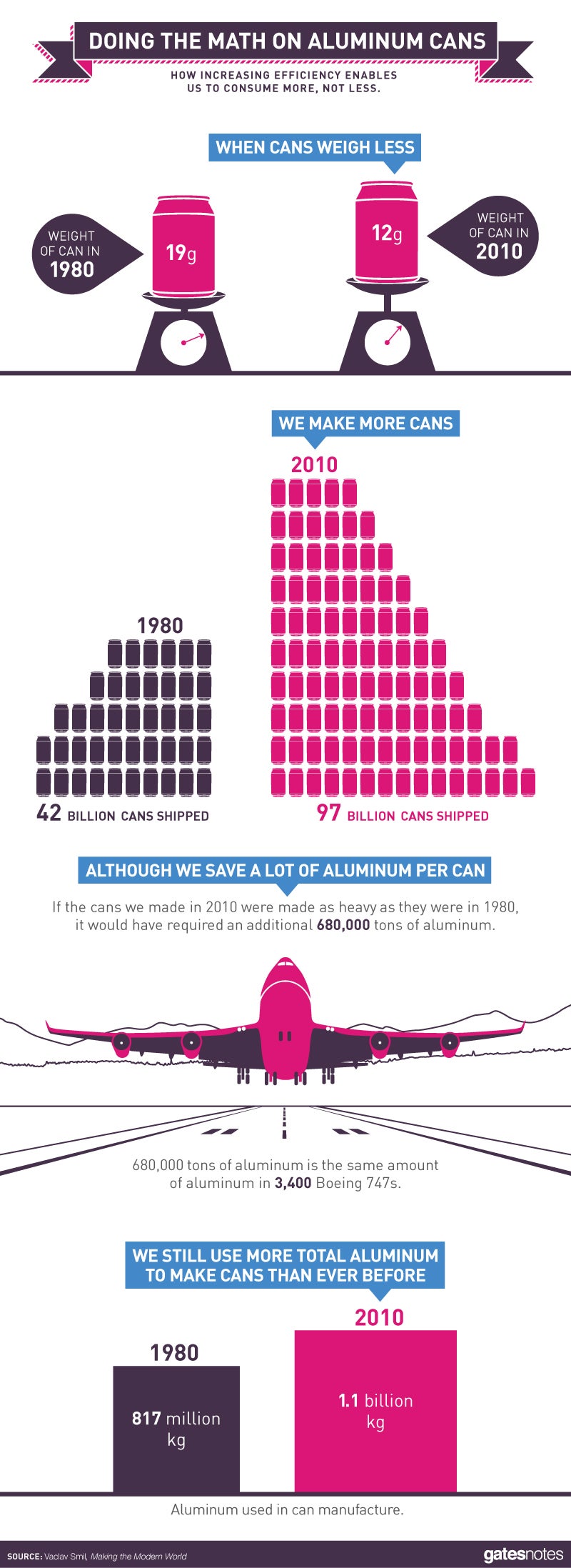
After reviewing the trends, Smil introduces a surprising and counterintuitive idea he calls relative dematerialization. As innovation lets us make a given product more efficiently, with fewer materials or energy, prices go down and consumption goes up. Someone figures out how to make cell phones with less metal, which makes them cheaper, which makes them more widespread. Less metal per phone, but more phones, so more metal overall. “Less,” he writes, “has thus been an enabling agent of more.”
Here’s how the idea applies to soda cans:
What does all this tell us about the future?
First, the good news: Thanks to technical advances, we can make major industrial products like steel and cement more efficiently than ever. On average, making a ton of steel today takes a third as much energy as it did in 1950, and produces 10 percent less carbon.
On the other hand—getting back to relative dematerialization—there’s no end in sight to the rising demand for more materials. Even though the richest countries are leveling off, many other countries are catching up. Smil points out that if the poorest 80 percent of the planet reaches a living standard that’s just a third of what people in rich countries enjoy, the world should expect to continue using more materials for generations to come.
So if consumption won’t level off anytime soon, are we doomed to run out of the stuff that makes modern life possible? As usual, Smil refuses to provide pat predictions. He does say we shouldn’t lose sleep worrying about running out in the next 50 years. Beyond that, there are a lot of variables, but we might need to limit the use of some materials or do a better job with recycling. Smil nods to several innovations that could help avoid future shortages, such as new materials that could cut our need for cement by 65 percent.
I agree with Smil that humans have an amazing capacity for finding ways around scarcity by using materials more efficiently, recycling them, or finding substitutes. The big concern isn’t so much whether we will run out of anything—it’s the impact that extracting and using these materials is having on the planet. For example, the cement industry now accounts for about 5 percent of all carbon-dioxide emissions. That’s one reason I think that developing affordable energy that produces zero carbon is one of the most important things we can do to lift people out of poverty.
I’m also surprised that the oceans get so little attention compared with other environmental problems, and I think they deserve more. They are being overfished and the waters are turning more acidic, killing off coral reefs around the world. Smil cites estimates that at least 6.4 million tons of plastic litter enter the oceans every year. We may have already done irreparable damage to these precious resources.
Above all, I love to read Smil because he resists hype. He’s an original thinker who never gives simple answers to complex questions. He gives me a lot to think about on my drive to work, before my first Diet Coke of the day.
Thanks for Sharing
Read Jared Diamond with me, part 2
Thanks to everyone who shared their thoughts on Jared Diamond’s latest book.
Last week I mentioned I’d be reviewing Jared Diamond’s latest book and invited you to share your thoughts on the book. I wasn’t sure what the response would be. It wasn’t exactly light beach reading, and ten days isn’t much time to find and finish a 460-page book. But I was pleased by how many people responded. Thanks to everyone who weighed in.
A number of commenters hadn’t heard of Diamond before. But I was encouraged by this post from Addison Staples: “I was actually lucky enough as a teenager to be required to read Guns, Germs, and Steel as preparatory reading for AP World History. I was blown away, probably the only book I was ever forced to read in school that absolutely engaged and enlightened me.” That’s great. Every student deserves to be inspired like that.
As for the new book, Andrea wrote that it “is a very good read, in my opinion, but nothing more. It lacks the great enlightenment of the other books” that Diamond has written. I had a similar reaction.
Diamond starts with the premise that human beings were hunter-gatherers for millions of years, and only settled down when we began farming about 10,000 years ago. So most of our genetic selection has been done in a hunter-gatherer environment. He argues that we can learn a lot by studying hunter-gatherer societies in places like New Guinea, where he has spent much of his career. (He uses the term New Guinea to refer to the island that is divided between Indonesia and Papua New Guinea.)
He describes several areas in particular, like raising children, dealing with the elderly, and eating well. He doesn’t romanticize these societies, as I thought he might, or make some grand pronouncement that they all do these things better than we do. He just wants to find the best practices and share them.
Unfortunately, I didn’t find much deep wisdom in the lessons that Diamond documents. But I found the book fascinating anyway.
In part that’s because Diamond has such good anecdotes. There’s one involving a New Guinean nomad who finds a small tree coming out of the ground and becomes convinced it’s a sign of danger. As I read the story, I was sure something bad was about to happen. Diamond eventually concludes that the man was right, but not for the reasons I expected.
At a broader level, The World Until Yesterday made me think about how we have had to overcome some deeply ingrained behaviors in order to develop a modern, interconnected society. As Diamond explains, in a hunter-gatherer society, you trust people in your own group because you know for the most part they share your interests. But when you encounter strangers, you have to assume they’re dangerous. You have a strong incentive to do this: If you don’t, and you turn out to be wrong, they could end up killing you or stealing your food.
Things are different in a modern society. You probably passed by a lot of strangers today without having to figure out whether they might try to kill you or take your lunch. That is a very primal fear we have overcome in order to live in large cities.
Consider how important this has been for global trade and international travel. How many strangers have to do business with each other every day to make the global economy work? Although globalization has been driven by inventions like the jet engine and the standardized shipping container, it wouldn’t be happening unless we were also able to overcome a natural suspicion of strangers. It is another reminder of humans’ amazing ability to adapt.
How did this shift happen? Diamond writes a bit about how on a local level (like for tribes in New Guinea) it’s driven by the need to share scarce resources, such as food. But it’s not really his main point. One book that gets deeper into these questions is The Rational Optimist: How Prosperity Evolves, by Matt Ridley. Ridley focuses on trade more broadly and what it took to overcome these very basic barriers to working with strangers. I’d recommend it to anyone who is interested in this area.
I did appreciate a few of the other observations in Diamond’s book. He is convincing in suggesting that we reconsider how much we isolate the elderly. It is a waste to have people with experience and the free time to share it, and lots of young people who would benefit from it, but no way to connect them. This is an area where I think communications technology could still make a big difference.
In short, if you’re only going to read one Jared Diamond book, make it Guns, Germs, and Steel. But if you have a particular interest in what life is like for hunter-gatherers, The World Until Tomorrow is a good choice.
Finally, a number of commenters suggested similar books to Diamond’s. Nobuo Ikeda mentioned The Better Angels of Our Nature, which is one of my favorite books ever and one I think everyone should read. You can find my review here. Scott and others recommended Why Nations Fail, which I disagreed with pretty strongly and reviewed here.
Thanks again to everyone who participated in this experiment. I’ll be moving on to some of the other titles on my summer reading list and will post more reviews when I can.
Make Love, Not War?
A conversation with Steven Pinker: did the social revolution of the 1960s make people more violent?
Steven Pinker talks about the social revolution of the 1960s in the context of violence.
Steven Pinker’s book, The Better Angels of Our Nature: Why Violence Has Declined stands out as one of the most important books I’ve ever read. I recently had a chance to sit down with Steven and discuss some of the points from the book in greater detail.


That Used to Be Us
America’s future: a conversation with Bill Gates & Thomas Friedman
I recently read and reviewed That Used to Be Us, a new book on how to strengthen America’s economic competitiveness. I sat down with co-author Thomas Friedman for a probing conversation about the vitally important issues raised by the book.
I recently read and reviewed That Used to Be Us, a new book on how to strengthen America’s economic competitiveness. I sat down with co-author Thomas Friedman for a probing conversation about the vitally important issues raised by the book.
An Optimist
How aid is working
Economist Charles Kenny shines a light on the real successes of aid.
Stepping into the public square to announce that foreign aid is important and effective can be lonely work.
As someone who has attempted to make that case over the past decade, I can assure you that the world is often eager to hear just the opposite.
Aid money can and does work. It improves people’s lives and makes the world a better and safer place.
Fortunately, an elegant and deeply researched new book has come along to reframe the debate and tip it, I hope, in a new direction. The title says it all: Getting Better: Why Global Development is Succeeding—and How We Can Improve the World Even More.
The book’s author is Charles Kenny, a senior economist on leave from the World Bank and a fellow at the Center for Global Development and the New America Foundation. He writes a weekly column for ForeignPolicy.com as “The Optimist,” but he is a realist, too, and he brings an economist’s eye to this complicated topic.
In making his case, Mr. Kenny is going up against some notable critics. Recent books by writers like Dambisa Moyo and Matt Ridley have depicted aid as wasteful and even damaging to societies. But even some outspoken aid critics have been impressed by “Getting Better.” One of the best known, economist William Easterly, even provided a blurb, praising the book. “You will never look at global economic development the same way again,” he says. To me, that’s exactly right.
Mr. Kenny acknowledges that the billions of dollars that the West has poured into poor countries has had a limited impact on income, which is what most economists use to measure progress in living standards. As he notes, many countries in Africa today have real per-capita incomes lower than that of Britain at the time of the Roman Empire. Over the past several decades, through good times and bad, the income gap between rich and poor countries has grown. And no one really knows why.
But income is only one measure of success and maybe not the most meaningful one. Mr. Kenny shows that quality of life—even in the world’s poorest countries—has improved dramatically over the past several decades, far more than most people realize. Moreover, with reams of solid data to support his case, he argues that governments and aid agencies have played an important role in this progress.
We care about income mostly as a proxy for what money can buy: food, shelter, health, education, security and other factors that contribute to human well-being. Mr. Kenny’s great insight is to point out the flaw in focusing solely on income. Other trends, related to direct measures of quality of life, are much more encouraging.
Fifty years ago, more than half the world’s population struggled with getting enough daily calories. By the 1990s, this figure was below 10%. Famine affected less than three-tenths of 1% of the population in sub-Saharan Africa from 1990 to 2005. As Mr. Kenny suggests, the record has thoroughly disproved Malthusian prophecies of food shortages caused by spiraling population growth. Family sizes have fallen for many decades now in every region, including Africa.
And there’s more good news. Virtually everywhere, infant mortality is down and life expectancy is up. In Africa, life expectancy has increased by 10 years since 1960, despite the continent’s HIV pandemic. Nearly 90% of the world’s children are now enrolled in primary schools, compared with less than half in 1950. Literacy rates in the sub-Saharan region have more than doubled since 1970. Political and civil rights also have gained ground.
The case made by Mr. Kenny in “Getting Better” is a powerful antidote to overly gloomy assessments of development aid. Wasteful and corrupt aid projects are probably inevitable, and they should never be tolerated. But overall, when you look at the big picture, quite a lot of good things are happening.
What’s more, the book suggests ways to make aid more efficient and effective. Mr. Kenny notes that dramatic improvements in quality of life have been achieved even in poor countries where incomes have fallen. How can this be? He credits the spread of new technologies and ideas. Because of them, as he writes, many of “the best things in life are cheap.”
Eradicating smallpox from the face of the Earth, for example, cost about 32 cents per person in infected countries. In just six years, a drive to vaccinate African children against measles reduced the number who died of the disease by three-quarters, from more than 500,000 a year.
Even larger gains in public health can still be achieved at a stunningly low cost relative to the benefits. Of the 10 million children who die each year in poor countries, one-third could be saved through the wider use of breast feeding, insecticide-treated bed nets and oral rehydration therapy (a simple sugar and salt solution) to combat the effects of diarrhea.
Mr. Kenny recommends focusing development aid on helping to spread such ideas and the cheap technologies that can measurably improve quality of life. He suggests, among other things, that we create a global technology bank to fund research or award prizes for advances that particularly benefit the world’s poor.
After years of doom and gloom on the subject of foreign aid, it is refreshing to find so thoughtful and contrarian an approach to the topic. Charles Kenny shines a light on the real successes of aid, and he shows us the benefits that additional smart investment can bring.


