



Here’s why I decided to give away virtually all of my wealth, and how I pick issues to work on.
In the 1990s, as Microsoft became successful, I decided I would eventually give away virtually all of my wealth.
The goal of my philanthropy is to reduce inequity. Globally, the worst inequity is in health. More than 4 million children under the age of five die every year, nearly all of them in poor countries. Climate change is increasingly a source of inequity because extreme weather is hardest on the world’s poorest people. In the United States, the worst inequity is in education. So these are the primary issues where I fund research, policy work, and other activities.
I do most of my giving on health and education through the Gates Foundation, which celebrated its 25th anniversary last year. I also fund some efforts that aren’t connected to the foundation, including the OER Project. Breakthrough Energy is the vehicle for most of my work on climate and energy.
The foundation and these other organizations focus on developing and deploying innovations that will reduce inequity.
So we look for these market failures and seek to correct them with philanthropic funding for innovations that benefit people in poor countries, with the goal that governments will eventually take the most effective approaches to scale.
I have been lucky to work with strong partners over the last 25 years. My ex-wife, Melinda French Gates, was instrumental in shaping the foundation’s strategies from the beginning. She left the foundation in 2024 to pursue her own philanthropy. My late father, Bill Gates Sr., played a crucial role with his wisdom, legal expertise, and values. Warren Buffett has made incredibly generous donations to the foundation—$39.3 billion since 2006—and served on our board from 2006 to 2021. And the foundation has had four CEOs: Patty Stonesifer, Jeff Raikes, Sue Desmond-Hellmann, and our current CEO, Mark Suzman.
1
Early philanthropy and growth of the foundation
In 1994, I began my philanthropy by establishing the William H. Gates Foundation, which was focused on improving global health and on supporting communities in the Pacific Northwest of the United States. In 1997, Melinda and I created the Gates Library Foundation, which was dedicated to providing internet service in public libraries throughout the United States.
In 2000, we merged these foundations into the Bill & Melinda Gates Foundation with an initial endowment of $20 billion and a focus on health, education, and the libraries program. (It was renamed the Gates Foundation after Melinda left.) Including that original contribution, I have donated a total of $59.5 billion to the foundation.
Warren Buffett’s generosity beginning in 2006 has allowed us to expand our initiatives and reach more people in need. For example, it let us create new programs to help low-income farmers in Asia and Africa grow more food and earn more money.
2
Global health
The foundation works on problems that aren’t getting addressed by markets—diseases and health conditions that disproportionately affect the world’s poorest people.
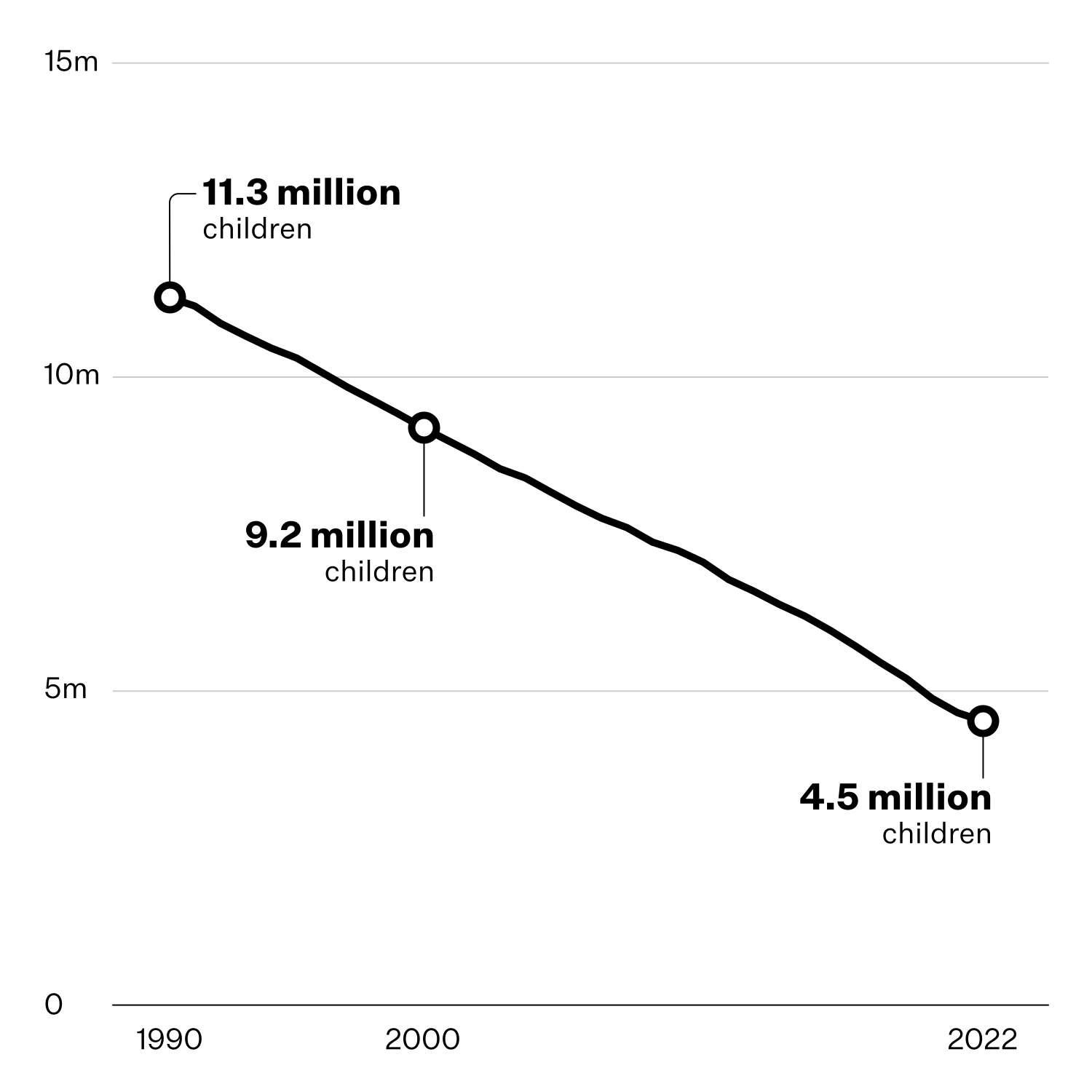
I was inspired to get involved in global health in the 1990s, when I learned that every year, around 10 million children were dying. I was shocked and horrified. Most of them, I found out, were in poor countries and died of preventable causes that I never had to worry about in my own family. Ultimately, reducing childhood mortality in low-income countries became the top goal of my giving. Today, the number has dropped from 10 million children a year to about 4.5 million—still an appalling number, but a mark of real progress and reason to believe that we can eliminate preventable child deaths altogether.
Child deaths have been reduced by more than half
From 1990 to 2019, child mortality worldwide was cut in half. It’s one of the most important things humanity has ever done—and now, we have the opportunity to do it again.
Since its creation in 2000, the Gates Foundation has made a number of contributions to the field of global health.
For example, we’ve improved the world’s understanding of diseases in poorer countries by funding crucial studies, creating tools to track health data, and sharing best practices.
We supported new insights into the causes of diarrheal diseases, which in the early 1990s were killing nearly 1.5 million children every year. At the time, the world tracked only three causes of diarrhea, and most countries didn’t even know how many cases they had each year—the data was only broken down by regions of the globe, not by country.
To get better data, the foundation helped start the Institute for Health Metrics and Evaluation and supported other studies. Today, IHME tracks at least 13 causes of diarrhea and in such detail that many countries can see the number of cases in any area of 25 square kilometers. And more broadly, the world knows much more about causes of death in poor countries today than it did 25 years ago.
For example, we co-founded Gavi, the Vaccine Alliance with a $750 million pledge. Since 2000, Gavi has helped vaccinate more than 1 billion children in the world’s poorest countries, which has prevented more than 17 million deaths. It was instrumental in rolling out a new vaccine for rotavirus; as a result, children’s deaths from diarrheal diseases have dropped to 340,000, a decline of more than 75 percent since the early 1990s. This is a good example of how better data can inform the development and distribution of new tools.
Another organization the foundation helped set up is the Global Fund to Fight AIDS, Tuberculosis, and Malaria. Since its creation in 2002, the Global Fund has saved 65 million lives and cut the combined death rate from AIDS, TB, and malaria by 61 percent. The foundation is also the largest philanthropic funder of research on HIV prevention.
In 2003 we launched the Grand Challenges in Global Health, which funds innovative research to solve critical health problems in the developing world.
In 2005, we pledged $258 million to accelerate efforts to fight malaria through research, development of new treatments, vaccines, and preventative measures, and in 2007, we urged the world to eradicate malaria. This effort—to save as many lives as possible now while setting the stage for eradication—is still our goal today, with funding of more than $300 million a year. Every year I write about the latest efforts on malaria and other mosquito-borne diseases in Mosquito Week on The Gates Notes.
Eradicating polio is a key focus for us. The foundation announced our first major grant for polio eradication in 2007, becoming a core partner of the Global Polio Eradication Initiative with a $100 million challenge grant to Rotary International. Since the GPEI’s formation in 1988, polio eradication efforts have reduced polio cases by 99.9 percent. The foundation has committed more than $4 billion to this work.
Sanitation-related diseases kill more than 500,000 children every year, primarily in low-income countries that don’t have proper sanitation systems. To address this, the foundation launched the Reinvent the Toilet Challenge in 2011 to develop toilets that could operate without water, sewers, or electricity, and that could render waste pathogen-free at a low cost. The response was overwhelming, with over 120 concepts submitted by scientists worldwide. We are now collaborating with partners to deliver the most effective approaches to people around the world.
In 2012, the foundation joined pharmaceutical companies, governments, and nonprofit groups to sign the London Declaration on Neglected Tropical Diseases. Together, they committed to control, eliminate, or eradicate 10 diseases and improve the lives of more than 1 billion people. In 2017, a Guinness World Record was set for the most medication donated in 24 hours, highlighting the global commitment to tackling these diseases.
We’re also part of a united push to dramatically reduce malnutrition, a severe problem that keeps children around the world from fully developing mentally or physically. Our grantees are focused on getting better data about this issue so the world can understand the precise causes of malnutrition in different countries. We also fund innovative new tools, such as fortified foods like flour and edible oils, and cutting-edge research on the gut microbiome. India, Ethiopia, and Nigeria are three of our key partners on malnutrition.
This means developing new technologies as well as making sure they are affordable and available. For example, through our partnership in an advance market commitment, we helped reduce the price of a pneumonia vaccine from $70 to $3.50 per dose, enabling its immediate rollout in poorer countries. This initiative ensured that children in low-income countries received the vaccine at the same time as those in wealthy ones.


