




Keep the Switch On
The energy research imperative
Why we need increased government investment in clean energy innovation.


As someone now working fulltime in global health and development, I see firsthand how the U.S. government’s support for scientific research has improved people’s lives. That support is vital in another area—affordable, clean energy. I believe it is imperative that the government commit to clean energy innovation at a level similar to its research investments in health and defense.
In a time of economic crisis, asking policymakers in Washington, DC, to spend more money might not be the most popular position. But it’s essential to protect America's national interests and ensure that the United States plays a leading role in the fast-growing global clean energy industry. There is really no other choice. Carbon-based fuels are prone to wild price gyrations and are causing the planet to overheat. The United States spends close to $1 billion a day on foreign oil, while countries such as China, Germany, Japan, and Korea are making huge investments in clean energy technologies. The creation of new energy products, services, and jobs is a good thing wherever they occur, but it would be a serious miscalculation if America missed out on this singular opportunity.
The United States is uniquely positioned to lead in energy innovation, with great universities and national laboratories and an abundance of entrepreneurial talent. But the government must lend a hand. Market incentives, alone, will not create enough affordable, clean energy to get the nation to near-zero CO2 emissions, the level of emissions that developed countries must achieve if we are going to keep Earth from getting even hotter. Moreover, developing major new technologies, where the timeframes necessary for true innovation stretch past the normal horizons of patent protection, requires up-front investments that are too large for venture capital and traditional energy companies.
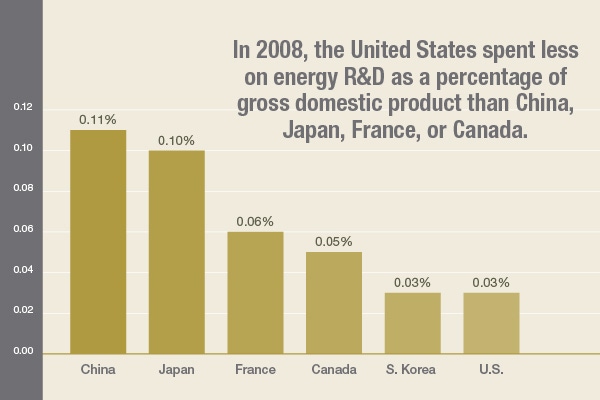
History has repeatedly proven that federal investments in research return huge payoffs, with incredible associated benefits for U.S. industries and the economy. Yet over the past three decades, U.S. government investment in energy innovation has dropped by more than 75%. In 2008, the United States spent less on energy R&D as a percentage of gross domestic product than China, France, Japan, or Canada.
Last year, I joined with other business leaders in a call to increase federal investment in energy R&D from $5 billion to $16 billion a year. (Others, including the President’s Council of Advisors on Science and Technology, have also recommended substantial increases.) Recently, our group, the American Energy Innovation Council (AEIC), issued a second report outlining ways to ensure that government research dollars are targeted wisely to achieve optimal returns. The report also suggests ways to pay for the increased investment: reducing or eliminating current subsidies to well-established energy industries, diverting a portion of royalties from domestic energy production, collecting a small fee on electricity sales, or imposing a price on carbon. Any combination of these could provide the funds needed to increase energy innovation. Even at almost triple the current level of government investment in energy innovation, the research dollars that the AEIC is advocating would represent a small fraction of the money presently spent on renewable energy subsidies and efficiency grants.
Energy transformations take generations. But if the United States begins in earnest today, the nation’s energy challenges can be solved in ways that truly set America on a path of energy independence and that provide affordable energy for everyone, especially the poor. The return on this kind of investment could change—perhaps even save—the world and provide generations to come with a brighter future.
This editorial was originally published in Science magazine.


