




On the Road
Backstage With Fallon, and Other Scenes from My Annual Letter Tour
I want to share a few highlights of my trip to talk about my Annual Letter.


If you’re a regular reader of this blog, you’re aware that Melinda and I recently released our Annual Letter, which discusses myths that hold back progress for the poor. Our hope is to get it in front of as many people interested in health and development as possible. So that meant hitting the road for some interviews. (Melinda spent the week on a long-planned trip to Tanzania, learning about agriculture there.)
My travels took me to New York, London, and then Davos, where I joined the annual meeting of the World Economic Forum.
The letter makes a case that the world is getting better. Probably the most common question about the letter was some variation on, “Look at the war in Syria, climate change, and economic inequality. You don’t really think the world is getting better, do you?”
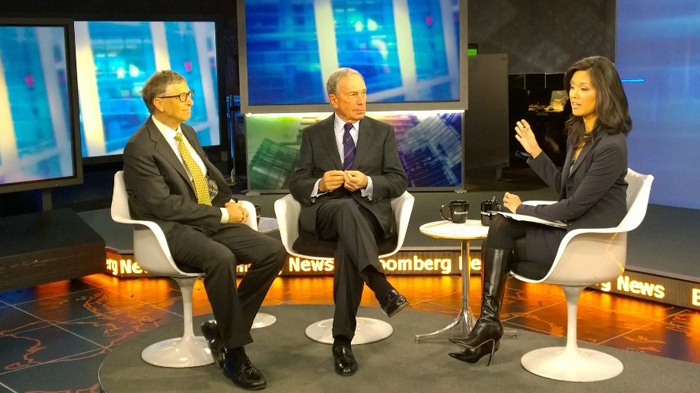
Michael Bloomberg and I talking with Bloomberg Television's "In the Loop" host, Betty Liu, about philanthropy and the progress the world is making against poverty and disease.
Each time, I would argue that while those are certainly tough challenges, the overall arc of history is quite positive. Look at broad measures of human welfare: Child mortality has dropped by half since 1990. The percentage of people in extreme poverty has fallen by more than half since 1990. And so on. These measures are better today than at any time in the past, thanks to innovation, expanding international trade, and a global push to improve the lives of the poorest through aid and philanthropy. It’s true that more than 1 billion people are still living in extreme poverty—but if you understand the progress we’ve made, you feel a lot more optimistic about the opportunity to help them.
A few more thoughts from last week’s trip:
Behind the scenes with Jimmy Fallon
One of the more entertaining stops (at least for me) was an appearance on Late Night with Jimmy Fallon to talk about the letter. I actually went to the studio twice. Early in the day, I shot a video where I put on a bunch of goofy outfits—a chicken costume, a beatnik beard and glasses, etc.—and gave the URL of the Annual Letter. I had to say "GatesLetter.com" about 50 times, and I had to say it in the same rhythm each time so the sound would sync up. If you watch the video, you’ll see what I mean.
Later, I went back to tape the interview. Jimmy came backstage before the taping to say hi. He’s just as nice and energetic as he seems on TV. He had read the letter and was ready with a lot of thoughtful questions. Poverty and disease aren’t obvious topics for a show like Late Night, but he did a great job.
The most surprising question
I suppose I shouldn’t have been surprised by how many people in New York wanted to talk about the Super Bowl and my hometown Seahawks. But that wasn’t the question that threw me.
One talk show picked up on the myth theme from the Annual Letter and asked about the biggest myth about me personally. At first, I wasn't sure what to say—it’s just not something I spend time thinking about.
Eventually I said it’s a myth that I’m the biggest philanthropist in the world. The truth is, getting involved in philanthropy hasn’t required me to give up a single thing that I want. I still get to take vacations with my family, go to the movies, and eat cheeseburgers. Yet I’ve met many people out in the field—health workers, teachers, and more—who have changed their careers and sacrificed enormously to fight disease or improve education. They’re giving up much more than I have. And no one knows their names. So I would say these people are bigger philanthropists than I am.
What’s next
Writing the letter—and reading some of the reactions to it—made me realize I have some more research to do in one area. The public debate over aid has become a bit simplistic and polarized: Depending on whom you ask, aid is either completely magical or a huge waste. I’d like to see a more nuanced discussion over what forms of aid are most effective, so we can focus more money and effort on them.
Unfortunately, there’s no consistent way to classify and evaluate different types of aid. For example there’s disaster relief, aid for education, aid for health systems, aid that funds research on global public goods like vaccines or new seeds, aid in war zones like Afghanistan, and so on. Much aid goes to poor countries that really need it, while some still goes to the richer middle-income countries. But the ways experts categorize aid today don’t really help us understand which approaches have the biggest impact for the poor. So I’ll be learning more about this in the coming months and will write more about it in a future post.
How you can help
Finally, I heard from some people who had read the letter and wanted to know how they could help. If you want to give money, organizations like Save the Children and Heifer International are a great place to start. Bono’s organization, ONE, is a great way to lend your voice. Or you can set out to learn more about health and poverty, so you can help fight some of the cynicism about the possibility of progress. We really can help people save and improve lives, and make the world a more fair and equitable place.


